What Is an NLP Chatbot and How It Differs From LLM Chatbots

Contents
Contents
As the rush for AI implementation intensifies, many companies are piling up AI solutions, often without understanding what they truly need. As a result, they invest time and money into software that doesn’t meet their business goals and get disappointed with AI.
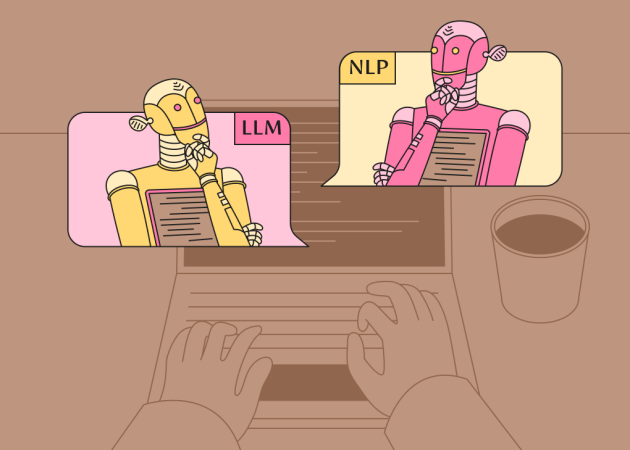
Natural language processing vs. large language models are two technologies that are often misunderstood in terms of their use cases. NLP and LLM chatbots can both effectively automate text processing, but their capabilities differ. While NLP chatbots handle rule-based and intent-classification requests, LLM chatbots support deep contextual understanding and learning.
This blog post clarifies the difference between NLP and LLM chatbots to help companies choose the most suitable technology combination. Read on to learn more about each option and when to use them.
What Is an NLP Chatbot?
An NLP chatbot (natural language processing chatbot) is an AI-powered application that uses NLP to understand human language and trigger responses based on pre-programmed rules or small ML models. It uses a combination of machine learning, computational linguistics, rule-based approaches to language processing, and deep learning to recognize and generate text. The model retrieves key information to understand a user’s intent and entities (e.g., product names, dates, locations), and interacts with them in a human-like manner. NLP chatbots are suitable for information requests, task-based inquiries, and standard conversations.
How NLP Chatbots Work
The first step is understanding user intent. Then, the model retrieves important details from the message, decides how to respond, and generates a relevant message. After the intent and entity recognition, the bot triggers a predefined action or scripted conversation. These responses are standardized or semi-dynamic with some level of personalization.
What Is an LLM Chatbot?
An LLM chatbot (large language model chatbot) is an advanced AI system that relies on GenAI models to handle unique user inquiries and generate personalized, highly contextual responses. LLM is a type of deep learning architecture trained on large volumes of text datasets using self-supervised learning. These chatbots can understand the broader context and take into account conversation history to cover a wide range of topics and handle unexpected questions. The most popular examples of LLM chatbots are ChatGPT, Gemini, and Claude.
How LLM Chatbots Work
The process begins with the chatbot breaking down the text into smaller units called tokens. Then, the model encodes the relationship between multiple tokens and predicts the next tokens based on context understanding. This way, it can generate natural, coherent responses and hold a human-like conversation.
Key Differences: A Head-to-Head NLP vs. LLM Comparison
The main difference in NLP vs. LLM performance is that large language models can handle more advanced tasks. While LLM chatbots excel in open-ended tasks, like content generation, summarization, and translation, where contextual nuance and versatility are needed, NLP is more lightweight, efficient, and cost-effective for narrow, well-defined tasks. The NLP vs. LLM architecture, context understanding, flexibility, and many other aspects also differ. Here is a detailed comparison table to help you understand what to expect from each type of chatbot.
| NLP Chatbot | LLM Chatbot | |
| Training Data | Trained on smaller, task-specific datasets. The data usually focuses on one domain | Trained on massive datasets with more generalized topics. Relies on self-supervised training |
| Architecture | Simpler models such as bag-of-words model, N-grams, and recurrent neural networks (RNNs) for structured language processing | Transformer-based neural architectures, such as Generative Pre-trained Transformers (GPT) or BERT, for handling complex language patterns |
| Context Understanding | Sentence or phrase-level processing; some can track short-term context, but broadly lack multi-turn reasoning | Takes into account context and keeps the history of conversation; Supports retrieval-augmented generation (RAG) to obtain information from external knowledge bases |
| Response Generation | More predictable; Template- or rule-based responses | Less predictable; Variable responses with human-like speech |
| Scalability | Sufficient scalability for rule-based tasks; For automating multiple types of flows, rule maintenance may become complicated | High scalability for different types of tasks |
| Specificity | Well-defined use cases with a limited knowledge base | Universal and cross-domain |
| Accuracy | Higher accuracy for well-defined tasks | Good for general inquiries; Prone to hallucinations and making up non-existent facts for more specific requests |
| Human Intervention | Close supervision during model training for rule definition or supervised learning; Performance monitoring after deployment | Less human intervention during training, but closer supervision after deployment. |
| Regulatory Compliance | Easier to manage and more reliable in strictly regulated environments | More regulatory risks involved due to black-box decision-making process |
| Cost | More affordable due to simpler training and maintenance | More expensive due to inherence costs and more complex integration |
It’s worth noting that neither model is perfect in every scenario. NLP solution development works well for companies that seek basic automation for common user inquiries, such as customer support or FAQs. Large language models can handle more unpredictable requests and offer dynamic responses. These characteristics don’t make LLM vs. NLP mutually exclusive. They mean that each chatbot category is better suited for different tasks.

How to Build Your Conversational AI Strategy: 5 Steps
Although AI adoption has reached 72% and continues to grow, not every company needs AI automation for all its operations. In many cases, optimizing the most repetitive processes can be sufficient to achieve business goals.
To make sure conversational AI implementation pays off and meets your expectations, create a comprehensive strategy beforehand. You must know why you are implementing chatbots and select an optimal technological solution. These are the steps to get ready for successful conversational AI adoption.
1. Map your Business Needs
Don’t implement chatbots just because everyone does. You must identify the operations that require optimization (e.g., automated customer support, sentiment analysis, knowledge management, reporting, etc.). It will enable you to set clear KPIs and measure the impact of innovations.
Over 50% of companies using AI apply it to two or more business functions. Only 8% for five or more. It shows that most organizations try to balance AI-powered automation with operations that require human intervention.
That’s why you should focus on high-impact use cases. Automate the operations where you can see the best results. These are usually the most time-consuming routine tasks.
2. Evaluate Readiness
Make sure your infrastructure, data sources, and security systems are ready for AI implementation. It will minimize the risks of operational inefficiencies, legal issues, and reputational harm. Preparing data and workflows for chatbot implementation also enhances the quality of output, making users more satisfied with your services.
LLM systems typically require more careful preparation, as they are more complex to implement. The LLM adoption process requires narrow expertise to establish data governance, prompt engineering, RAG pipelines, safety guardrails, and continuous quality monitoring. On the other hand, NLP solutions are standardized and involve fewer risks. Experienced LLM developers can run an AI readiness audit to estimate your readiness for conversational AI and help prepare.
3. Understand User Persona
To create a truly helpful chatbot, you must know what bothers its potential users. Analyze your target audience and their typical queries to determine what kind of chatbot can meet their needs. NLP chatbots are generally suitable for simple questions within a specific domain. LLM chatbots support more general queries and engaging, multi-step conversations.
4. Design Conversational Workflows
Map the user journey with the main stages and potential dialogues. The key message categories include greeting, asking, informing, checking, apologizing, suggesting, and conclusion. These are the conversations you must prepare your chatbot for, especially if you create an NLP solution. Designing conversational workflows for LLM chatbots is less crucial, but still useful. It can help you achieve more consistent and predictable responses.
Also, plan how the chatbot will act when it cannot respond. It must be able to apologize and then clarify the request or escalate to a human agent.
5. Create a PoC
Choose an optimal tech solution, NLP, LLM, or hybrid, based on the previously defined goals and use cases. Develop a pilot version to validate the feasibility and gather user feedback. It allows you to test the basic chatbot to identify weaknesses and refine the concept.
After getting the first reviews from real users, fix the flaws and continue with full-scale chatbot development and implementation. Be sure to keep a human in the loop for use cases that require supervision and additional assessment. AI models are likely to shift over time, so you may need to retain them or fine-tune the rules.
When to Choose an NLP Chatbot
The text-based NLP market is projected to grow at a 45.10% CAGR, reaching $60.07 billion by 2031. The steep growth shows that, despite more advanced technologies emerging, NLP solutions remain in high demand. Businesses adopt natural language processing to automate repetitive tasks that require accuracy and stable responses. Here are the main cases when choosing NLP chatbots is more feasible:
- Basic customer support automation. NLP chatbots are effective for handling repetitive questions, such as FAQs. They parse customer queries, retrieve relevant information, and offer pre-set responses or solutions. It significantly speeds up customer support, reducing operational costs and improving satisfaction.
- Predictable intents and entity types. When you know what requests to expect, you can use NLP technologies to pre-program responses, retrieve data from the knowledge base, or deliver semi-dynamic replies. It ensures consistent output and stable quality of services.
- Strictly regulated fields. NLP chatbots are easier to control, which becomes an advantage in regulated fields where compliance requirements are much stricter, such as finance or insurance.
- Information extraction. NLP chatbots are highly convenient for summarizing documents and quickly finding the necessary information.
- Quick and affordable deployment. Cost-efficiency is another valid reason to choose NLP chatbots over more sophisticated solutions. They take less time to implement compared to LLMs and require less computing power to maintain.
You can see real-world examples of NLP chatbots on almost any website that provides online support. Financial apps and healthcare booking systems also often rely on NLP. In particular, H&M is one of the retail stores that utilizes NLP to automate customer support. Its bot helps users find info on the website or check their order updates.
When to Choose an LLM Chatbot
LLM chatbots are considered a better option for open-ended questions. They can handle more complex user requests and operate outside of pre-set rules or scripts. It makes them an efficient solution for cases that require human-like conversation, with multiple questions and an unpredictable flow. The McKinsey report shows that many organizations are experimenting with LLM-powered agentic AI systems, with 23% of enterprises expanding their use within at least one business function.
Here are the main cases when you should consider using an LLM chatbot over traditional NLP models:
- Less predictable user input. Trained on large volumes of diverse data, LLM chatbots can cover a broader range of requests compared to NLP models. It makes them particularly good for answering general questions, not limited to specific domains.
- Complex problems. When a task is too complex for rule-based output and requires creativity, large language models can handle it thanks to their ability to understand context. They can also maintain multi-step communication, clarifying different details about the problem and gathering additional information.
- More natural user experience. LLM chatbots generate human-like responses, which feel smoother than standard replies by NLP models. It feels like a real support agent takes time to solve a user’s problem.
- Personalized interactions. LLM bots adapt their tone and responses based on the conversation history and context provided during the session. It improves the quality of request processing and speeds up resolution.
- Multiple input types. Advanced large language models process multiple types of content, including text, images, audio messages, and documents.
The renowned examples of LLM chatbots are ChatGPT, Claude, Microsoft Copilot, and Gemini. You can use them as independent solutions or integrate them into third-party applications to expand the functionality with generative AI.
The Best of Both Worlds: The Hybrid Approach for LLM vs. NLP
Although both NLP and LLM chatbots can be used as standalone technologies, a hybrid approach is gaining popularity. The combination of more predictable responses based on NLP technologies and LLM models handling open-ended conversations brings the following benefits:
- Operational efficiency. Traditional NLP can handle high-volume, structured tasks quickly, while LLMs cover more complex and resource-intensive operations, cutting manual work and redundant flows.
- Improved accuracy. NLP and LLM complement each other, improving the relevance and reliability of output.
- Interpretability and more control. NLP methods, especially rule-based systems, provide more transparency into how decisions are made, which is crucial in regulated sectors like finance or healthcare, while LLMs offer advanced reasoning capabilities.
- Inference cost optimization. The use of NLP for preprocessing and repetitive queries reduces the number of LLM calls, which are priced per AI token.
- Increased scalability. Since tasks are distributed between two systems, hybrid solutions are more flexible and easier to scale.
Many companies use a hybrid approach to upgrade their existing NLP systems with LLM functionality. Instead of abandoning legacy systems, they build on top of them, layering two technologies. You can choose this option if you already have an NLP chatbot, or build a hybrid custom AI chatbot from scratch by designing an architecture that supports both models.
The way you combine NLP and LLM models at different stages of information processing depends on what you expect from the output. If you need reliability and control, use NLP first for intent classification and rule-based decisions. Forward requests to the LLM only when additional assessment is needed. Alternatively, you can apply LLM at the initial stages to handle more open-ended conversations, and NLP later on to make the output more structured and validate it.
For example, a company can apply a hybrid model for customer support automation. While an NLP model extracts data entities from requests, an LLM enables the system to provide human-like replies and hold the conversation. Personalized marketing is another use case of the hybrid approach. NLP technology detects user intent, and then LLM generates personalized responses (e.g., emails).
Final Word on NLP vs. LLM Comparison
Natural language processing vs. large language model chatbots can both effectively optimize routine conversations and document processing. NLP chatbots are great if you need precision and predetermined output based on rules. LLM chatbots understand context from various types of input and generate rich responses. Despite the misconception that NLP systems are outdated, they are still valuable for more specialized or resource-constrained tasks that LLM models often struggle with.
Whichever solution you implement depends on the use case. While NLP chatbots are better suited for predictable intents, information extraction, and intent recognition, LLM solutions can handle more complex requests, generating personalized output. There is also a hybrid approach combining both types of models within a single system. It’s gaining popularity lately and may enable you to get the benefits of NLP and LLM at the same time, merging accuracy with context awareness. If you’re not sure which solution would work better in your case, contact us to get advice.
FAQs
Is an LLM chatbot always better than an NLP chatbot?
No, LLM chatbots are not always more effective than NLPs. They have different functionality and uses, which affects the choice of technology. While LLM solutions handle more complex conversations that require flexibility and creativity, traditional NLP chatbots are more reliable for specific tasks and generate predictable output based on rules and scripts or semi-dynamic responses.
Are LLM chatbots more expensive to build and maintain?
Yes, in most cases, LLM chatbots are more expensive than NLPs. Even though they rely on third-party models (e.g., GPT-4, 5), fine-tuning and integrating one requires substantial investment. You should also consider high inference cost and operational expenses, which additionally increase the cost of LLM chatbot maintenance. Besides, the cost of LLM model development typically exceeds that of NLP development, as it requires more specialized expertise and careful prompt engineering, testing, and integration.
Can an NLP chatbot be upgraded to an LLM chatbot?
Yes, you can integrate LLM capabilities into an existing NLP chatbot to upgrade it with contextual understanding. NLP chatbots are rarely replaced altogether. A more common approach is combining both types of models to perform rule-based and context-aware tasks. It allows companies to ensure high response generation accuracy while making the output more personalized and flexible.
How do you prevent LLM chatbots from “hallucinating” or giving incorrect answers?
One of the options is to implement retrieval augmented generation (RAG) to power generative models with external databases. They will retrieve information from verified sources and only then generate answers based on it. RAG is a preferred option for most enterprise use cases since it’s safe and affordable. Although these steps cannot eliminate hallucinations 100%, they significantly reduce the risks and enhance the quality of LLM output.
What is NLU (Natural Language Understanding) and how does it relate to NLP?
NLU relies on semantic and syntactic analysis to interpret the meaning behind human language. This technology focuses on comprehension and understanding the intent, meaning, and context of a query, rather than the meaning of separate words. Natural language processing is a broader field that also includes text preprocessing, tokenization, and natural language generation (NLG), along with natural language understanding. Therefore, NLU is a part of a larger NLP pipeline.
Subscribe to blog updates
Get the best new articles in your inbox. Get the lastest content first.
Recent articles from our magazine





Contact Us
Find out how we can help extend your tech team for sustainable growth.