Top Use Cases of Agentic AI in SaaS: From Onboarding to Intelligent Analytics

Contents
Contents
The market is becoming more challenging and demanding for SaaS solutions, with thinner margins, higher customer churn rates, and greater competition. What can you do about it as a SaaS company? Consider implementing agentic AI services to automate repetitive operations and offer better customer service in addition to other enhancements.
Many are already investing in agentic AI. McKinsey has asked organizations about how they use agentic AI, and here are some insights: 39% are experimenting with AI agents. The most common use cases include IT operations, knowledge management, marketing and sales, and service operations.
AI agents for B2B SaaS offer ample opportunities. You can adopt agentic AI to automate user onboarding, implement a proactive customer success strategy, run advanced lead qualification, and enhance other product features. Let’s explore more practical examples of AI agents for B2B SaaS platforms and where they deliver the most impact.
Key Benefits of AI Agents in SaaS
The recent PWC report, based on senior executives’ opinions, lists the main reasons behind companies adopting generative AI solutions and smart agents. These are increased productivity (66%), cost savings (57%), faster decision-making (55%), and improved customer experience (54%). The benefits of using AI agents for B2B SaaS platforms largely overlap with the listed ones, and include:
- Faster services due to end-to-end customer support automation. AI in SaaS delivers much more comprehensive automation than traditional automation tools. Human support agents are engaged only for complex, ethical, or high-risk issues. All other requests are handled automatically. Since agentic AI considers context, including previous logs, usage data, and account status, it can autonomously handle the majority of requests. Such automation considerably speeds up customer support, reducing resolution time from hours and days to minutes.
- More effective work and optimization of routine tasks. SaaS AI agents handle repetitive tasks, such as system monitoring, triggering workflows when related events occur, and auto-assigning and prioritizing tasks for ticket resolution. They also detect which actions lead to the most successful outcome and learn from the result. As a result, the work of human agents becomes more efficient, and they don’t waste time on basic maintenance and support tasks. They can focus on difficult cases and help users who need personalized, face-to-face assistance.
- Lower support costs and improved accuracy. AI automation adoption by B2B SaaS companies reduces the risk of human error, as agents follow the same rules and are more reliable for routine tasks. Fewer escalations, less rework after mistakes, automatically solved issues, and reduced need to maintain a large support team significantly reduce operational expenses.
- Smoother customer experience and higher satisfaction. With AI agents in SaaS software, users get personalized service based on the full customer history and usage. AI agents also retrieve information from previous sessions to provide replies and predict potential issues using predictive analytics. When human help is needed, the AI agent transfers conversations with full context to avoid repetition.
- Scalability without significant team size changes. AI workflow automation in SaaS products makes it easy to expand your customer base and add new features. No need to hire dozens of support agents, onboarding specialists, sales, and engineers to maintain the system growth. Advanced automation allows you to scale the system without massive investments. It also helps manage load peak and changing demand without disruptions or downtime.
Besides the listed benefits of AI SaaS use cases, agentic AI can do much more. It allows you to increase user retention and customer lifetime value (LTV) through unique features, optimize redundant operations by coordinating teams, and automate continuous product improvements.
Use Case 1: The 24/7 Onboarding Specialist
The initial hours of user experience with the product determine whether they will continue using it. Churn rates are highest during the first two weeks, since people know little about your product’s benefits and have not fully incorporated it into their workflows. Another risk factor is a free trial, which usually lasts up to 14 days. If you don’t treat new users well enough, they will leave.
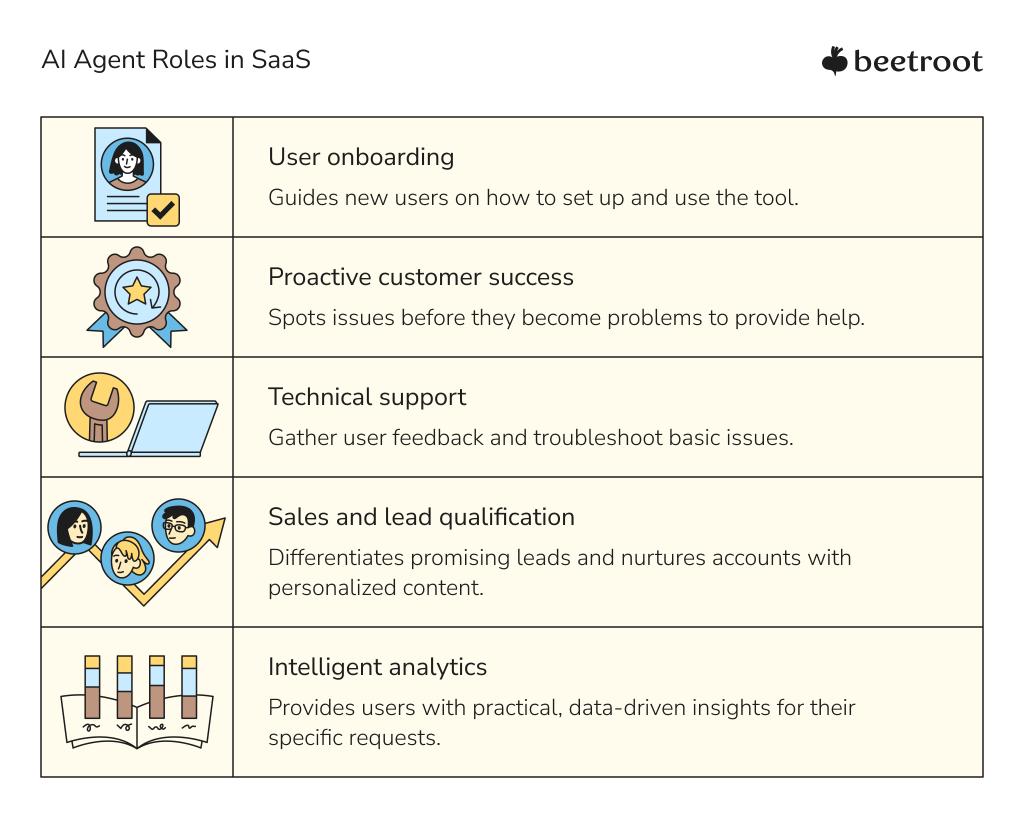
User onboarding automation is one of the top use cases for AI in SaaS to address early user churn. Agentic AI is well-suited to automate processes like product onboarding and cover the hours when human agents don’t work. Instead of hiring a round-the-clock support team, you can have a few human specialists and give other tasks to AI agents, especially during the night shifts. They will provide instant responses and evaluate users’ requests to offer personalized guidance, identify bottlenecks, and help complete the most critical actions required to start using the app. More complex requests will be forwarded to human support specialists and solved during working hours. Agentic AI capabilities are enough to cover plan selection, initial setup, and integrations.
The use of AI in SaaS products for onboarding also brings faster time to value (TTV), which shows the time necessary to understand the benefits of the solution. The earlier your users see the practical value in your product, the more likely they are to convert to paid plans.
Use Case 2: Proactive Customer Success and Churn Prevention
By implementing agentic artificial intelligence in SaaS, software providers can help customers reach their personal goals faster. AI detects issues before they become problems and prompts users to contact the support team immediately. Such an approach considerably improves satisfaction, retention, and product-led growth (PLG). Additionally, companies that invest in customer success and proactive engagement can achieve a 107% higher ROI within three years, according to Forester.
How does it look in practice? AI in SaaS products continuously monitors user behavior in real time, along with support ticket details and CRM data, to detect unusual patterns or anomalies. Then the agent evaluates risk based on multiple factors and autonomously triggers the appropriate action (e.g., sending an in-app alert with guidance or emailing a personalized guide based on usage issues). Afterward, it evaluates the effectiveness of completed actions and learns from the outcome to self-improve.
Implementing proactive customer success practices enables SaaS vendors to cover the entire user base rather than focusing solely on high-value accounts. Timely interventions reduce churn and may even support cross-selling. The agent runs complex data analysis to determine which premium feature best meets the user’s needs and offers them a free trial. Once they feel the practical value of the expanded capabilities, they are more likely to upgrade the plan.

Use Case 3: Autonomous Technical Support
Agentic AI gives a unique opportunity to fix technical issues automatically, not just discuss them with a chatbot. It can handle the majority of tickets without human intervention by running root-cause diagnostics, making fixes, and sending post-incident reports. You can use it to automatically troubleshoot expired API keys or tokens, dependency failures, missing webhooks or callbacks, incompatible versions, disk full errors, and other common problems.
The agent learns from mistakes and, each time, offers more relevant support. According to data from various AI platforms, it can resolve up to 80% of issues autonomously, escalating to human support in particularly complicated cases. Even after escalation, the agent assists the support team with root cause analysis and recommended steps to speed up resolution. It also means reduced load on the support team due to fewer tickets and accurate routing.
Use Case 4: Sales & Lead Qualification
AI SaaS can simplify the work of sales reps by categorizing leads and nurturing them to increase the likelihood of conversion. Given that 42% of sales reps complain that the low quality of leads makes selling more difficult than a year ago, getting some agentic AI help can make a huge difference.
The agent can automatically capture firmographic, behavioral, and confidence signals and run feature engineering for intent detection. Then, the system completes lead scoring and ICP matching to identify the most promising leads and update the information in the system. If the accounts are not ready to convert, the AI agent keeps sending personalized follow-up emails, initiates a chat, makes a special offer, or triggers another relevant action. Prospects who are potentially ready for advanced feature adoption, a premium plan, or extra tools are forwarded to the sales team. It minimizes the speed-to-lead time and considerably improves sales.
Use Case 5: Intelligent Analytics for Users
SaaS solutions that include analytics functionality can benefit significantly from the implementation of agentic AI. These agents automatically process large volumes of structured and unstructured data from multiple sources, interpret patterns, and offer reasoning. AI highlights statistically meaningful changes and provides users with recommendations for possible actions (e.g., personalized customer messages, UX changes, pricing updates, etc). Users can directly ask the agent questions like “Why are more users churning in February?” and receive a data-driven reply with recommendations. It speeds up analytics and replaces confusing charts with practical insights.
Implementation Tips for Launching Agentic AI in SaaS
Boosting SaaS products with autonomous AI systems is worth the effort, but it’s not easy. You must prepare quality data and ensure explainable, compliant, and ethical AI use. It’s also necessary to keep human agents in the loop for operations that require critical judgment and unusual decisions. Here are more practical tips on how to power your SaaS product with agentic AI:
- Start with a single use case. Don’t implement AI agents for multiple operations at once to avoid overloading your system, team, and users. Start with a specific use case, for example, automating the generation of admin tasks or reporting, and test it out. Focus on the routine operations that take the most time and resources to achieve a measurable impact.
- Build AI agents in parallel. Set up a sandbox environment to avoid touching your live systems and prevent accidental data deletion, misconfiguration, or safety threats. Using the sandbox makes iteration and learning more controlled. It will allow you to test AI models and see how they operate without harming the real users.
- Prepare high-quality data. Collect data from multiple sources, standardize metrics, apply cleaning, enrichment, and anonymization to prevent bias. The quality of data directly affects the efficiency of AI systems and output reliability.
- Make sure AI decisions are transparent. Keep decision logs and audit trails to understand the reasoning behind every AI decision. It increases user trust and helps prevent inaccuracies or at least quickly identify why they happen to troubleshoot.
- Set KPIs for monitoring. Track usage metrics to see whether people are using your AI feature and gather feedback. Measuring KPIs allows you to assess the ROI and efficiency of different agentic AI use cases and determine whether your investment pays off to make more informed product decisions.
Future Trends in SaaS AI Agents
Gartner estimates that by 2029, agentic AI tools will autonomously resolve 80% of customer service issues. It means that more SaaS platforms will be powered with agentic AI for customer support and other repetitive operations. Agentic AI features will become the basics that most users expect from a SaaS platform. Those who fail to upgrade their software may start losing to competitors. Another powerful trend is that AI solutions are becoming more niche-focused, turning into vertical AI — specialized AI systems built for specific industries and use cases like finance or healthcare.
Ethical, explainable, and trusted AI will also change the rules for implementing agentic AI. As more users demand transparency and express distrust of AI solutions, companies implementing agentic AI will have to prove its accuracy and reliability. Explainable decision-making, bias detection, audit trails, and keeping human support engaged are essential both for user trust and regulatory compliance.
If you are considering implementing intelligent assistants in your SaaS product, we are here to help. Our team has implemented AI functionality across multiple projects and knows how to make it meet specific business goals. Contact us to discuss the use cases of agentic AI in your project.
FAQs
Can AI agents handle complex technical support tickets?
AI agents for SaaS can assist with complex support requests by guiding multi-step troubleshooting. An agent can gather additional information, follow diagnostic trees, and suggest known solutions. They also rely on connected knowledge systems to retrieve relevant information and learn from previous instances. In many cases, this helps resolve issues faster or prepare high-quality handover for engineers. However, agentic AI still requires human involvement for novel failures or technical support tickets that involve high risk or require a broader context.
Is it hard to integrate AI agents into an existing SaaS product?
It can be challenging depending on your system architecture, data quality, and security and compliance requirements. In many cases, you will need to prepare legacy systems for integration, ensure data security, implement robust APIs, and manage complex workflows between multiple system components. That’s why agentic AI integration often requires assistance from a SaaS AI agents development company or an experienced engineering vendor.
What is the difference between a chatbot and an AI agent in SaaS?
An AI agent is a more advanced system than a traditional chatbot and is designed to handle more complex, multi-step tasks. While regular chatbots rely on basic automation using rules, scripts, and RPA, agentic AI systems are more adaptive and context-aware. This makes AI agents suitable for processing unstructured data and handling workflows that require a multi-step, dynamic approach. Traditional chatbots, on the other hand, are better suited for predictable, repetitive workflows that rely on structured input.
How much does it cost to implement AI agents in SaaS?
The cost of agentic AI implementation depends on the type, complexity, and functionality of the agent. No-code or plug-and-play agents usually have more basic capabilities, but they are more affordable than custom-built solutions tailored to the SaaS product. Infrastructure costs, data preparation and cleaning, additional integrations, and maintenance also affect the budget.
Do AI agents require constant supervision?
Overall, no. Agentic AI can handle repeatable tasks and low-risk requests, especially with careful training and validation against historical data. At the same time, they are not fully autonomous systems. For ethical and responsible AI use, humans should remain in the loop and step in when a decision is too complex, ambiguous, or high-impact for an agent to make. Therefore, most AI agents require occasional supervision and must be able to escalate to a human operator when needed.
Subscribe to blog updates
Get the best new articles in your inbox. Get the lastest content first.

Recent articles from our magazine






Contact Us
Find out how we can help extend your tech team for sustainable growth.