

Contents
Contents
AI chatbots have become a practical part of how many companies handle early-stage customer conversations. A well-designed AI chatbot solution can help engage visitors in real time, capture intent, and support lead qualification without adding pressure on sales teams. Instead of relying only on static forms or delayed follow-ups, chatbots create a faster, more interactive way to guide prospects toward the right next step.
In this guide, we’ll break down how AI chatbots support lead generation, what features matter most, and how to measure success based on lead quality and funnel impact.
What Makes AI Chatbots Effective for Lead Generation?
The main advantage is timing. When someone lands on a page with a specific question, website chatbots for lead generation can respond immediately — before the visitor loses interest or leaves. That responsiveness supports user engagement in a way that static forms simply can’t match, because the conversation starts while intent is still high.
Personalization adds to this. Using natural language processing (NLP) and intent recognition, AI-powered chatbots for lead generation can identify what a visitor is actually looking for and respond with relevant information, a targeted offer, or a lead magnet suited to where they are in the funnel. This tends to support conversion rate optimization (CRO) compared to static pages that treat every visitor the same, though the degree of improvement depends on how well the chatbot is built and whether its flows reflect real visitor behavior.
AI chatbots for sales add another layer by supporting lead qualification. They can ask targeted questions, apply lead scoring, and route high-intent prospects to a sales rep at an appropriate point. Many platforms also include automated scheduling, which removes the back-and-forth of booking a demo or a call.
Where things get more nuanced is with proactive messaging and omnichannel lead gen. Reaching prospects across multiple channels can increase touchpoints, but it can also feel intrusive if the timing or targeting isn’t right.
AI chatbots for lead generation tend to perform best in these scenarios once the core experience (clear conversation flows, qualification logic, reliable CRM integration, etc.) is already working well.
How to Generate Leads with AI: 4 Practical Steps to Build a Lead-Generating Chatbot
Building a chatbot that drives results takes more than adding a chat widget to your site. To generate leads with AI, you need a clear plan for how the bot will engage visitors, qualify prospects, and guide them toward a concrete next step. The following steps cover what that looks like in practice when building chatbots designed specifically for lead generation.
Step 1: Define User Intent and Conversation Flows
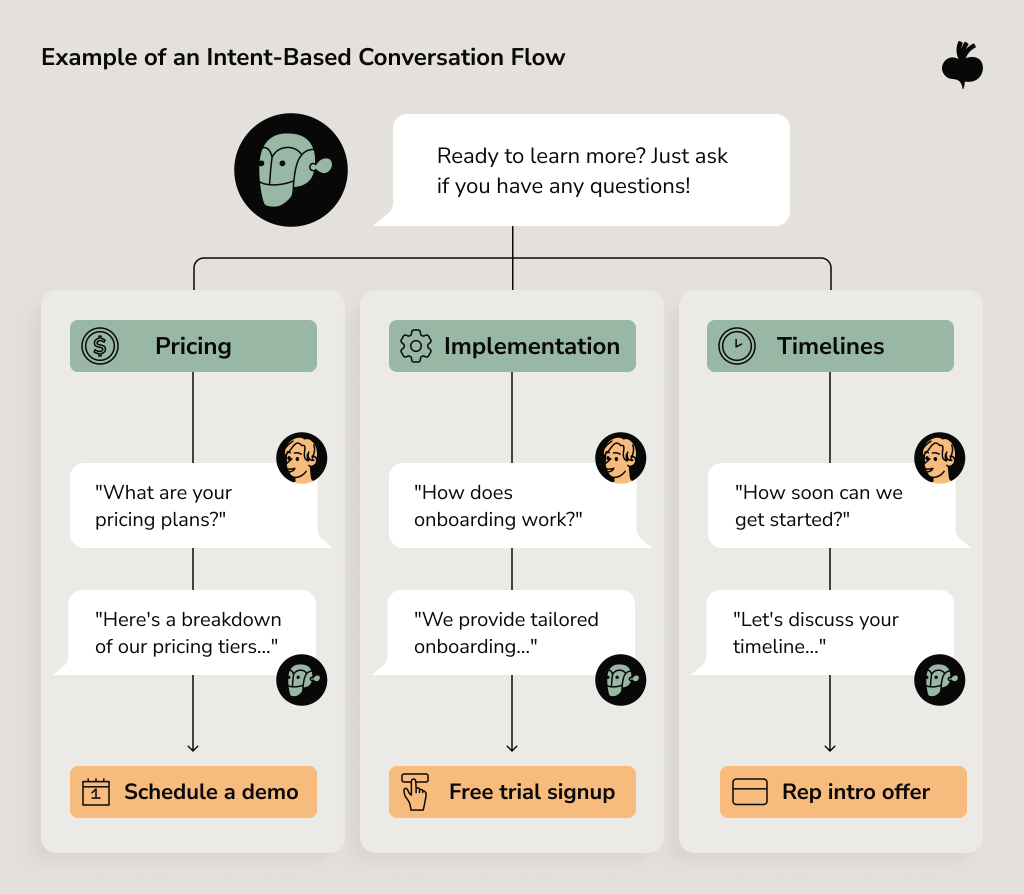
The first step in building effective chatbots for lead generation is understanding why visitors start a conversation in the first place. Some may want pricing, others need product details, and some are ready to book a demo. Clear intent recognition helps the chatbot respond with a relevant message instead of generic replies.
When visitor goals are clear, conversation design becomes more straightforward. You can shape flows that guide people toward a logical next action, whether that’s sharing contact details, booking a call, or requesting more information. Well-structured flows can also apply basic lead scoring to distinguish high-intent prospects from early-stage browsers. The key is that the flow reflects how visitors actually behave, not how you’d ideally like them to behave. This approach helps turn everyday conversations into more focused interactions that generate steadier lead capture.
Step 2: Implement Intelligent Lead Qualification Questions
Static forms collect information, but they don’t adapt to the person filling them out. A chatbot can. With the right setup, chatbots can qualify leads through conversational questions that feel more like a natural exchange than a survey.
Instead of asking everything up front, the bot adapts to what the visitor says, as someone asking about pricing will likely need different follow-up questions than those interested in concrete use cases or timelines. This way, the bot helps capture the details sales teams actually need, without overwhelming the user. Yet it requires careful flow design to avoid asking too much too soon, which is one of the more common reasons prospects drop off mid-conversation.
Step 3: Connect the Chatbot to Your Sales Funnel
A chatbot becomes much more useful when it’s connected to the tools your team already uses. If it can pass structured lead data into your CRM, marketing automation, and analytics setup, the conversation doesn’t dead-end at the chat window.
When someone shares their email, company size, or buying timeline, that information should flow directly into your Pipedrive, Salesforce, or whichever system your sales team works from. Reps can then follow up the lead with the right context instead of starting cold.
Automation can extend this further — by triggering a follow-up email, enrolling the lead in a nurture sequence, or sending a demo reminder based on what was discussed. Analytics completes the picture by showing where prospects drop off and which conversation paths actually lead to conversions.
Step 4: Personalize the Conversation Based on Traffic Source
Not every visitor arrives with the same intent, and the chatbot shouldn’t treat them as if they do. Someone coming from organic search might still be in early research mode. Someone clicking through from a paid campaign or a product-focused email is often further along and looking for specifics.
A traffic source provides the chatbot with useful context before a word is exchanged. A visitor landing on a pricing page is a reasonable candidate for a direct prompt about plans or demo options. Someone arriving from a blog post may respond better to a lighter entry point — a helpful resource or a simple question to narrow down their needs. These adjustments can improve lead quality, but they require your AI chatbot solution to support source-aware routing and that the right triggers are configured for each entry point. This approach is especially useful in retail, where an AI chatbot for e-commerce often supports product discovery and purchase-focused questions.
AI-Powered Chatbots for Lead Generation: Important Features
Not every chatbot helps with lead generation. The ones that work well share a few practical capabilities: they can guide conversations with purpose, qualify prospects, and pass structured data t into the sales funnel.
Below are the features that typically define the best AI chatbots for lead generation.
Intent Recognition and Conversation Routing
A chatbot needs to identify what the visitor is actually looking for before it can return a useful response. Some people want pricing. Others are trying to understand the product. Some are already close to booking a call. Intent recognition helps the chatbot route each visitor toward a relevant next step rather than defaulting to a generic answer.
Intent recognition typically works well for common, predictable inputs like pricing questions, demo requests, or product comparisons, but visitor language is rarely that predictable. Industry-specific terminology, vague phrasing, and non-trivial conversation paths all require deliberate design work to handle them properly. Poor intent handling is one of the common reasons chatbot conversations stall before reaching a qualification step.
Intelligent Lead Qualification Logic
Lead qualification works better when it unfolds as a gradual exchange. Instead of front-loading a long questionnaire, a well-built chatbot asks targeted questions one at a time and adapts based on user responses. This is where conversational AI design does the real work, structuring the flow to capture what the sales team needs without sounding scripted or overwhelming the visitors.
The difficulty is in the design. Writing qualification flows that don’t make prospects feel processed without sacrificing data quality is genuinely hard to get right on the first attempt. Most teams find this requires iteration — reviewing drop-off points and refining questions based on how real visitors actually respond.
CRM and Funnel Integration
A chatbot that doesn’t connect to your existing stack has limited practical value. Lead data needs to flow into your CRM and follow-up tools so sales teams can act on it promptly and with full context.
Building that integration properly means thinking through data mapping and handoff logic from the start, not as an afterthought. A chatbot that passes a name and email into your Pipedrive is connected in a technical sense. But to be useful, the data needs to be structured and complete enough that reps can follow up without having to re-qualify the conversation from scratch.
Context-Aware Personalization
A visitor arriving from a paid campaign targeting enterprise buyers has a different starting point than someone who found a blog post through search results. Chatbots that factor in traffic source, page context, or campaign parameters can open with a more relevant prompt and ask more targeted questions from the onset.
This feature is straightforward in concept but requires deliberate setup. It means configuring different triggers for different entry pages or sources, which adds development time but tends to produce better-quality lead data than a single generic flow applied across your entire funnel.

Advanced AI Chatbots for Lead Gen: Voice Bots and Multi-Language Support
Some teams reach a point where a standard chatbot interface isn’t enough for their audience or use case. Voice bots and multilingual support can extend a chatbot’s functionality, but whether these features are worth the investment depends on the specific friction they’re solving. Gartner predicts that by 2028, at least 70% of customers will use a conversational AI interface to start their customer service journey — a signal that conversational touchpoints are becoming the norm rather than an exception. Still, these advanced features work best when they actually serve the user and your sales pipeline rather than adding complexity for its own sake.
Voice Bots: Useful for Speed
Voice bots make sense when people want fast answers or quick routing — callbacks, appointment/consultation bookings, or simple service questions. They also reduce friction on mobile, where typing can feel like extra effort, especially during high-intent moments.
That said, voice does not automatically improve lead quality. In many B2B funnels, buyers prefer text because they can scan it quickly, return to it later, or share it internally. Voice works best in scenarios where speed matters more than depth, and where the flow is designed to loop in a human at the right point rather than trying to handle complex qualifications autonomously.
Multi-Language Support: A Strong Fit for Global Audiences
Multi-language support matters most when language is a natural barrier — for international audiences, regional markets, or scenarios when visitors are less likely to engage fully in a second language. Removing that barrier can improve both the quality of the conversation and the completeness of the collected information.
The integration side is where it gets complex. Multi-language support needs to feed into the same CRM and qualification process as everything else, so sales teams aren’t working with fragmented data across regions. Building this properly means accounting for language handling at every stage of the flow — not just the chat interface itself.
When Advanced Features Make Sense
These capabilities can be expensive to build and maintain if the fundamentals aren’t in place. If the core chatbot still struggles with basic qualification, unclear conversation flows, or poor CRM integration, adding voice or multilingual support won’t fix those problems — it will make them harder to diagnose.
The right time to build advanced features is when the core experience is already working well and a specific, identifiable friction point justifies the additional investment.
Key Metrics for AI Chatbots for Lead Generation
Chat volume is one of the least useful numbers to track on its own. A high number of conversations can look impressive, but it doesn’t always translate into qualified leads or sales follow-up. The metrics that actually matter focus on intent, lead quality, and how well the chatbot integrates with the rest of the funnel.
Lead Qualification Rate
One of the clearest indicators is how many conversations result in a qualified lead. This shows whether the chatbot is asking the right questions and applying lead scoring effectively. Tracked over time, this metric also helps you identify which questions actually separate high-intent prospects from casual visitors.
Chat-to-Lead Conversion Rate
For AI chatbots for sales automation, conversion rate is more telling than engagement. The key question is whether the conversation leads somewhere concrete — a demo request, an email signup, or a booked meeting. If chats consistently end at the question-answering stage without a next step, the chatbot may be useful as a support tool but isn’t functioning as a lead generation asset.
Intent Recognition Accuracy
Good chatbot performance depends on understanding what visitors actually mean, not just what they type. Tracking whether the chatbot correctly identifies high-intent signals (e.g., pricing questions, implementation timelines, specific use cases) indicates whether conversations are being routed appropriately. Weak intent recognition tends to surface a pattern of generic replies and missed buying signals rather than a single obvious failure point.
Drop-Off Points in the Flow
Where users leave the conversation is often more instructive than where they engage. If prospects consistently exit after a particular question, the flow may feel too long or poorly timed, or the question itself may be poorly framed. Drop-off analysis is one of the most reliable ways to improve qualification quality, as it shows where the design is working against the conversation rather than with it.
Handoff and Follow-Up Success
Track how often qualified chats are routed correctly to a rep, pushed into the CRM, and followed up within a reasonable time window. This is where lead gen chatbots either succeed or fall short. A well-worded conversation that doesn’t result in a timely, informed follow-up produces the same outcome as no interaction at all.
Scheduling and Action Completion
If the chatbot includes automated scheduling, track how often visitors actually book a call or demo. Completed actions are a stronger signal of intent than long conversations: a short exchange that ends with a booked meeting is more valuable than a lengthy one that ends without a clear next step.
CRM Data Completeness
A lead is only actionable if the sales team has enough context to work with. Track how consistently chatbot-captured leads include the fields your pipeline depends on, such as role, company size, timeline, or use case. Gaps here usually point to qualification logic that needs tightening rather than a data or integration problem.
Sales Acceptance Rate
Another practical metric is how often sales teams actually accept and pursue chatbot-generated leads. If reps consistently ignore or downgrade them, it’s a signal that the qualification logic isn’t producing leads that meet their threshold, regardless of what the chatbot’s own metrics show. Sales acceptance rate connects chatbot performance directly to pipeline impact, which is a more honest measure than chat volume or engagement data alone.
Lead Quality Over Time
Finally, look beyond the first interaction. Do chatbot-sourced leads progress through the pipeline? Tracking how they convert at each stage — from qualified lead to opportunity to closed deal — shows whether AI lead generation is producing leads sales teams can actually move forward with, or just filling the top of the funnel with dead-end contacts.

Common Mistakes When Using AI Chatbots for Lead Generation
AI chatbots can help with lead generation, but only when they’re built with a clear purpose and integrated into the funnel properly. Many teams add a chatbot and expect it to start producing leads on its own. In practice, the outcome depends on how well the conversations are designed around real customer intent.
Treating Chat Volume as the Main Success Metric
A chatbot that generates a lot of conversations may still produce low-quality leads. The focus should be on intent and qualification, not activity. More chats don’t help if they don’t move prospects toward a meaningful next step. In some cases, high volume is actually a sign that the bot is answering basic support questions instead of guiding sales-relevant conversations.
Asking Too Many Questions Too Early
Lead qualification matters as much as timing. If the chatbot opens with a long list of questions, visitors often drop off before the conversation goes anywhere useful. It is advised to collect information gradually, based on what the user is actually trying to do. A short, well-placed question at the right moment consistently outperforms an upfront qualification block.
Using Generic Scripts Instead of Intent-Based Flows
One of the most costly design mistakes is treating every visitor the same way, regardless of what they’re asking. When the chatbot cycles through the same script to handle pricing questions, support requests, and demo-ready prospects, it fails to guide any of them effectively. Visitors notice quickly when the responses don’t match their intent. Clear intent-based flows make conversations feel more relevant and reduce unnecessary steps.
Poor Handoff to Sales or CRM
If qualified conversations are not routed to the right sales workflow, the value of the chatbot drops to near zero. The handoff needs to be designed as carefully as the conversation itself, passing structured data into your CRM with enough context for the sales team to follow up with the lead without having to start from scratch.
Over-Automating Conversations
AI chatbots can take pressure off marketing and sales teams, but they shouldn’t try to handle every scenario. Visitors still want the option to speak with a person when questions get specific, or the decision feels high-stakes. It is important to design a clear escalation path, where the handoff to a real human feels like a natural next step rather than a system flaw.
Ignoring Ongoing Optimization
Chatbots aren’t a one-time setup. Over time, drop-off patterns and visitor intent can shift, and qualification logic that worked at launch may become less effective. The best approach is to treat optimization as an ongoing process: review the chats regularly, adjust the flow, and keep improving based on real visitor behavior. This is what separates a chatbot that keeps performing from one that gradually stops producing quality leads.
Is an AI Chatbot the Right Next Step for Your Funnel?
AI chatbots can support lead generation when they’re built with a clear role in the funnel. The goal isn’t to replace sales teams or chase more conversations for their own sake. It’s to help capture high-intent prospects, collect useful context, and make follow-up easier for the people who handle the next step.
If you’re exploring AI chatbots for lead generation and want to understand what approach makes sense for your business, reach out. Our team will discuss your specific goals, traffic sources, and sales process, and help you map out a chatbot strategy that fits your project needs.
FAQs
What is the difference between rule-based bots and AI-powered chatbots for lead generation?
The difference between rule-based bots and AI-powered chatbots for lead generation is that rule-based bots follow fixed scripts and decision trees, while AI-powered chatbots use intent recognition and natural language processing to respond more flexibly to visitor questions.
Are AI chatbots for lead generation suitable for small businesses?
AI chatbots for lead generation are suitable for small businesses because they can help capture and qualify leads without requiring a large sales or support team, especially when traffic volume is limited but response speed matters.
Do AI chatbots work for mobile website visitors?
AI chatbots for lead generation work well for mobile website visitors because chat-based interactions are often faster than filling out forms on a phone and can reduce friction during high-intent browsing.
Can AI chatbots integrate with existing sales tools?
AI chatbots for lead generation can integrate with existing sales tools by connecting to CRMs, marketing automation platforms, and scheduling systems, which helps move qualified leads into the normal follow-up workflow.
Do AI chatbots really improve conversion rates?
AI chatbots for lead generation can improve conversion rates when they reduce response time, guide visitors to the right next step, and collect qualifying information more naturally than static forms.
How long does it take to see results from AI lead-generation chatbots?
Results from AI lead-generation chatbots vary depending on conversation design, qualification logic, CRM integration, and follow-up processes. Some teams see early signals within the first few weeks but meaningful, consistent lead quality improvement typically takes longer to establish.
Subscribe to blog updates
Get the best new articles in your inbox. Get the lastest content first.

Recent articles from our magazine




Contact Us
Find out how we can help extend your tech team for sustainable growth.