
Contents
Contents
Most large companies’ supply chains use data that is hours or even days old. Information about demand moves slowly through planning systems designed for a simpler time. By the time a problem is noticed, there is less time to react. Operations teams using custom AI tools for supply chain tasks often face the same main problem: data is abundant, but few systems can process it fast enough to support real-time operational decisions. Business software built in the 1990s was never designed to handle sensor data, shipping updates, supplier risk alerts, and demand information simultaneously.
The numbers confirm that gap.
- A Gartner survey of 509 supply chain leaders from October 2025 found that changes in ways of working driven by advancements in AI and agentic AI will be the most influential driver of future supply chain performance over the next two years.
- Yet as of mid-2025, only 23% of supply chain organizations had a formal AI strategy in place, according to a separate Gartner study.
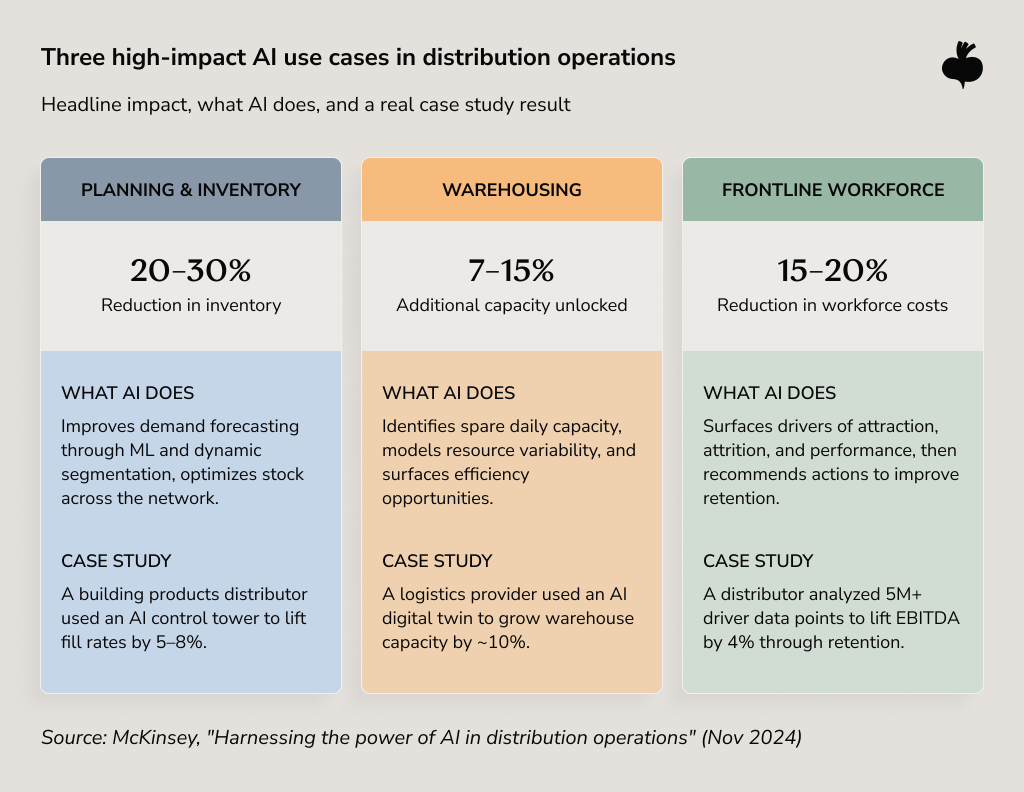
AI for supply chain management is changing this in specific, measurable ways. According to McKinsey’s analysis of AI in distribution operations, embedding AI can reduce inventory levels by 20 to 30%, logistics costs by 5 to 20%, and procurement spend by 5 to 15%.This article covers practical applications: where each one works, what it requires, and what operations leaders should realistically expect.
The Impact of Practical AI on Modern Logistics
AI tools for supply chain management shift planning from a weekly batch cycle to a near-real-time decision layer. The core change is not automation of tasks but continuous processing of inputs that legacy systems handle sequentially, if at all.
The acceleration in adoption reflects three converging factors:
- Lower infrastructure costs for machine learning workloads.
- More warehouses and delivery trucks are now using IoT integration that can connect and share information.
- Better systems now let different business and warehouse software applications share up-to-the-minute information with external systems.
Generative AI for supply chain management helps consolidate and process multiple types of operational information. Large language models can convert procurement data, supplier communications, and demand signals into structured planning recommendations, reducing the time analysts spend on S&OP preparation.
McKinsey’s 2025 State of AI report found that inventory management, along with supply management, is among the functions where organizations most commonly report meaningful revenue increases from AI adoption, with high-performing organizations nearly three times as likely as others to have fundamentally redesigned their workflows.
How Does an Autonomous Supply Chain Work?
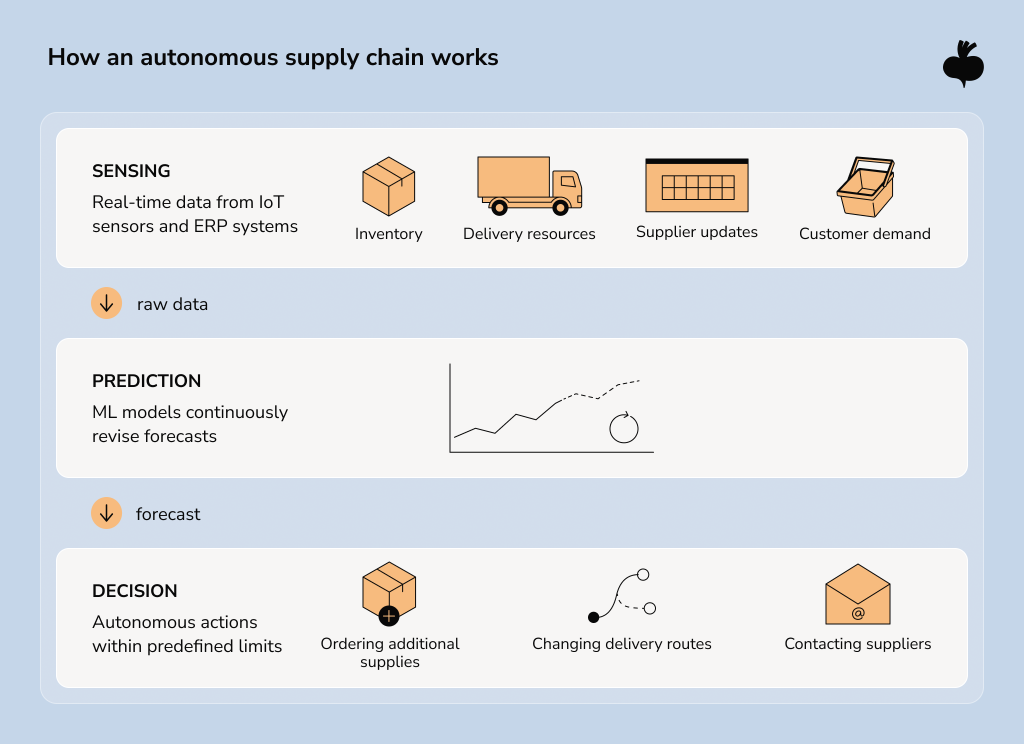
Operations leaders increasingly ask how an autonomous supply chain works in practice. The answer lies in three coordinated layers that move from raw data collection to operational action. An autonomous supply chain works through three coordinated layers that operate in sequence:
- Sensing layer. Connected devices and systems gather up-to-the-minute information about inventory, delivery resources, supplier updates, and customer demand.
- Prediction layer. Models continuously update forecasts as new operational data enters the system.
- Decision layer. Autonomous supply chain planning systems take action within predefined limits, such as ordering additional supplies, changing delivery routes, or contacting suppliers when needed.
Human supervision is still very important, especially for important decisions. As teams see that the models work well in real situations and trust their results, they allow the models to make more decisions on their own.
A Core Practical AI Application: Demand Forecasting
Demand forecasting is where most organizations first see clear results from using AI in supply chain management. How accurate the forecast is affects almost every later planning decision. Mistakes add up: if the forecast is off in the first week, it can later lead to an inventory problem, a pattern supply chain teams call the bullwhip effect.
Statistical methods perform well in stable conditions, but they are less reliable when product launches, demand spikes, or weather disruptions shift patterns quickly. Machine learning models handle these shifts better because they process a broader input set simultaneously: point-of-sale data, search trends, weather forecasts, promotional calendars, and historical patterns, updating continuously rather than on a weekly cycle.
The best AI strategies for supply chain management in demand forecasting balance model accuracy with operational integration. A forecast that lives in a standalone analytics tool and requires manual export to an ERP loses much of its value during the handoff. The integration into existing planning workflows is where the practical benefit is realized, not in the model itself.
AI Applications for Intelligent Inventory and Warehouse Management
AI inventory optimization addresses a problem that resists traditional solutions: balancing service levels with carrying costs across a network of locations with interdependent demand patterns.
Calculating optimal safety stock across 10,000 SKUs and 50 locations, while accounting for supplier constraints and product substitutability, exceeds the practical limits of spreadsheet-based planning. AI-powered inventory systems automatically update when to reorder based on:
- How quickly each product sells at each location
- How much supplier delivery times change
- How much stock is available at all locations
- Historical stockout and overstock patterns
The result is fewer emergency orders, lower carrying costs, and better service levels, typically achieved simultaneously rather than in trade-off.
Warehouse automation takes this even further. Computer vision systems perform quality inspection faster and more consistently than manual checks. Robot picking systems that use AI to plan their actions need fewer workers and make fewer mistakes. Real-time tracking at the bin level means stock movements update the replenishment model as they happen.
Gartner predicts that by 2030, 50% of cross-functional supply chain management solutions will use intelligent agents to autonomously execute decisions across the ecosystem, a signal of where warehouse automation investment is heading over the next planning cycle.
Optimizing Logistics and Route Planning with Practical AI Solutions
AI-powered route planning considers many more factors at once than older planning tools: vehicle capacity, delivery time limits, traffic, stop proximity, fuel use, and real-time disruptions. If something goes wrong, the system quickly updates the routes and adjusts upcoming deliveries.
Last-mile delivery is where costs matter most, accounting for about 40-50% of total logistics spending. Even small improvements in stop clustering, route efficiency, and failed-delivery rates can yield significant savings across large delivery networks.
The following uses of AI in shipping and delivery operations already show clear benefits:
- Dynamic route optimization. Real-time recalculation as conditions change.
- Carrier performance monitoring. Flagging underperforming lanes before they affect SLAs.
- Predictive maintenance. AI uses vehicle data to spot problems before they cause breakdowns, helping avoid unexpected stops.
- Load consolidation. AI matches shipments to fill trucks more efficiently, reducing empty trips and lowering emissions.
What about autonomous vehicles?
The question of how autonomous trucks will change the supply chain comes up often, for good reason: self-driving technology has been discussed for years as a potential transformation for logistics. But fully autonomous operation remains out of reach for most real-world conditions.
In the near term, autonomous trucking is most viable on controlled highway corridors and port-to-warehouse routes, structured environments where AI-driven routing and fleet optimization are already proving their value. Dense urban last-mile delivery is a different challenge entirely, because it involves variable road conditions, edge cases, and regulatory constraints that current systems cannot yet reliably handle.
Using Practical AI for Supply Chain Resilience
Using AI for supply chain risk management shifts the operational posture from reactive response to early detection. Risk monitoring systems gather information from supplier financial reports, news, shipping records, weather reports, and commodity prices. If a supplier starts to have financial problems, or if shipping data shows a significant backlog building at a port, the system warns before it becomes a major supply problem.
A team responsible for buying from 500 suppliers cannot keep track of the supply chain visibility and every supplier’s risks in the network. AI-driven monitoring runs continuously across the full base, surfacing emerging risks between review cycles rather than depending on periodic check-ins.
AI in supply chain management for sustainability operates through the same mechanisms. Route optimization directly reduces fuel consumption and related emissions. More accurate demand forecasting limits overproduction and excess inventory, both significant sources of waste. Predictive maintenance extends asset lifecycles and reduces fleet downtime.
As explored in Human-in-the-Loop in AI Workflows, AI-generated risk signals require human review for consequential decisions, such as switching a primary supplier, rerouting significant freight spend, or invoking a business continuity plan. The AI narrows the decision window. Human judgment determines the response.
Gartner’s March 2026 prediction that 60% of supply chain disruptions will be resolved without human intervention by 2031 illustrates the direction this is heading. But today, people still need to make critical calls.

Overcoming Implementation Barriers for Supply Chain AI Applications
The gap between a compelling AI pilot and a production system that operations teams rely on is where most supply chain AI projects stall. Understanding the challenges of autonomous supply chain implementation requires looking beyond the technology into the operational context.
Autonomous Supply Chain Implementation Challenges
Based on common failure points in production environments, the table below maps the most common implementation barriers to their operational impact and the most practical first response:
| Implementation barrier | Where it shows up | What to do first |
| Data quality issues | Inconsistent master data across ERP, WMS, and supplier systems | Audit and unify master data before model development begins |
| Legacy ERP integration | Real-time data pipelines don’t exist natively in SAP or Oracle | Invest in integration layer as a prerequisite, not an afterthought |
| Change management | Planners distrust AI recommendations that conflict with experience | Prioritize model interpretability; involve planners in validation |
| Pilot-to-production gap | Pilots succeed in controlled conditions, fail at operational scale | Run pilots on live data from day one, not cleansed test datasets |
| Unclear ownership | No team owns the AI model lifecycle post-deployment | Assign ownership before go-live, including retraining cadence |
Gartner’s survey of supply chain leaders found that most CSCOs focus on project-by-project short-term wins rather than a defined AI investment strategy, creating what Gartner describes as “franken-systems,” complex, layered architectures that hinder long-term transformative potential.
How to Build an Autonomous Supply Chain?
Knowing how to build an autonomous supply chain starts with accepting that it is a staged process, not a single deployment. Each phase validates the data infrastructure and expands the scope of what AI can reliably handle next.
The organizations seeing consistent returns from autonomous supply chain implementation follow a staged approach:
- Scope a focused use case where data quality is relatively high and operational impact is measurable.
- Instrument before modeling. Establish baseline metrics and clean data pipelines before selecting model architecture.
- Integrate into existing interfaces. Embedding recommendations directly in the ERP planners already in use drives adoption. Parallel systems rarely do.
- Measure, then expand. Define what success looks like at the pilot scale before deciding
what to extend.
Once the implementation path is clear, the next question is whether the operational and organizational payoff justifies the investment.
- The operational case is measurable: lower forecast error, fewer stockouts, reduced logistics costs, and earlier disruption detection.
- The organizational case matters just as much: planning teams spend less time reacting to disruptions and more time on supplier development, network design, and strategic procurement.
For teams evaluating where to begin, AI Agents vs. Traditional Automation Tools provides a useful framework for defining the right starting scope.

Final Thoughts
AI in supply chain management is not just one technology. It covers a range of tools designed to solve a specific operational challenge, including demand sensing, AI-driven inventory optimization, logistics routing, and risk monitoring. The companies that see steady results are not always the first to adopt. Instead, they choose the right starting point, rely on high-quality data, and ensure AI fits into their teams’ existing workflows.
Autonomous supply chain capabilities represent a direction, not a switch. Moving from old planning systems to flexible, AI-powered operations happens step by step. Each implementation validates the data infrastructure, builds organizational confidence, and expands the scope of what AI can reliably support.
If you are working through a specific supply chain challenge, demand volatility, inventory inefficiency, logistics cost pressure, or supplier risk visibility, our teams help organizations scope, build, and integrate custom AI agents into their existing systems: no packaged tools, no generic frameworks: engineering work shaped to your operational context.
FAQs
What are the most impactful AI applications in supply chain management?
The most impactful AI applications in supply chain management include demand forecasting, inventory tracking, delivery route optimization, and risk monitoring. Demand forecasting delivers the highest upstream value because forecast accuracy directly affects inventory planning, procurement timing, and order fulfillment efficiency.
How does AI improve demand forecasting accuracy in logistics?
AI improves logistics demand forecasting accuracy by processing a wider set of inputs than statistical methods can handle —point-of-sale data, external signals, promotional calendars, and real-time inventory positions — and updating continuously as new data arrives.
Can AI reduce supply chain operational costs?
AI reduces supply chain operational costs by improving forecast accuracy, optimizing inventory levels, and streamlining logistics execution. According to McKinsey, embedding AI in distribution operations can lower inventory levels by 20 to 30%, logistics costs by 5 to 20%, and procurement spend by 5 to 15%. These reductions result from fewer emergency orders, lower carrying costs, and more efficient route planning.
How do you integrate AI with existing ERP systems in supply chain management?
Bringing AI into existing ERP systems in supply chain management means establishing reliable mechanisms for data to flow between the ERP and AI tools, resolving data issues to ensure information is accurate, and integrating AI suggestions into the planning tools teams already use. The hardest part is usually connecting everything, not building the AI itself.
What data is required to implement AI for inventory optimization?
Implementing AI for inventory optimization requires historical demand data at the SKU and location levels, supplier lead-time records, current inventory positions, and stockout and overstock event history. Data quality matters more than data volume. Clean, consistent records across two to three years typically provide sufficient signal for initial model training.
Subscribe to blog updates
Get the best new articles in your inbox. Get the lastest content first.
Recent articles from our magazine






Contact Us
Find out how we can help extend your tech team for sustainable growth.