

Contents
Contents
Many companies still rely on batch processing in cases when real-time streaming data pipelines would be more efficient. Some common use cases include AI chatbots for marketing operations, dynamic pricing functionality, fraud detection systems, live in-app recommendations, and cybersecurity monitoring, which require low data latency.
Data remains a highly underutilized asset — McKinsey research finds that 28% of business leaders say they possess data assets that can be monetized. However, it’s also important to understand when real-time data brings tangible benefits and when standard analytics approaches are enough.
A key sign that a business should upgrade its systems is when faster, more accurate decision-making, a better customer experience, or improved operational efficiency would meaningfully change outcomes. Below, we break down the best options for real-time data analysis and how to adopt such systems without overbuilding.
From Batch Processing to Real-Time Data Pipelines
Even though batch processing is often viewed as an outdated data analytics approach, but serves as a different tool for different tasks — one that can coexist with real-time data pipelines in the same system. Batch processing involves collecting large volumes of information over prolonged periods and analyzing it at scheduled intervals. It relies on complex aggregations and algorithms that process historical data. Unlike real-time analytics, batch processing works well for tasks that don’t require instant decisions.
The most typical use cases for batch processing include:
- Historical trend analysis
- Repetitive business processes
- Model training and feature engineering
- Data cleaning and transformation
Modern real-time data analytics became more accessible with the rise of distributed streaming platforms like Apache Kafka and stream-processing frameworks (Apache Flink, Spark Structured Streaming). Real-time analytics now plays an increasingly important role in data-driven AI workflows, where models need fresh context to produce useful outputs — for example, GenAI agents operating on live operational data or recommendation engines adapting to user behavior in real time.
Real-time insights are usually a more suitable approach for:
- Anomaly detection systems
- Predictive analytics
- Fraud detection
- Demand forecasting
- Intelligent automation
- User-facing experiences
- Time-sensitive data pipelines
Choosing between batch and real-time processing mainly depends on whether faster data would actually change the resulting decision. The volume and nature of analyzed data also affect the choice, since static or slowly changing data are better suited for batch processing, while rapidly changing event streams require instant processing. If the benefits of real-time data — immediate insights and proactive decision-making — fit your business, implementation will require data analysts and an engineering team, whether in-house or through an external partner. Real-time analytics is typically more challenging to adopt and requires specialized tech expertise.
Industry Applications: Where Real-Time Insights Are Mission-Critical
Some industries depend on real-time data insights more than others, as they must respond quickly to changing operational conditions and direct customer interactions. Real-time marketing insights let sales and marketing teams approach a prospect with the right message at the moment they’re most likely to convert. AI-powered fraud detection flags risky transactions before they settle. These and similar use cases can win a lot from managed real-time data pipelines — and demonstrate the clearest real-time data benefits at scale
FinTech and Financial Services
Financial systems require maximum agility as even a few seconds of delay or outdated reports can lead to fraud losses, missed compliance signals, or poor credit decisions. A recent McKinsey report on ‘Intelligence at scale and data monetization’ describes a collections optimization case in which one bank built a Gen AI tool that analyzes customer data in real time to identify who to contact, when, and through which channel — then triggers the corresponding outreach. Real-time insights help teams act on the highest-probability accounts first, increasing the likelihood of receiving the payment.
Real-time data also powers customer-facing AI in finance — for example, financial AI chatbots that resolve routine queries instantly and route special-attention cases to human specialists.
Beyond these, financial organizations rely on real-time analytics for fraud detection, transaction monitoring, and risk scoring. Streaming pipelines evaluate each transaction against behavioral patterns, geolocation, and historical activity to detect anomalies and flag suspicious card usage. The same infrastructure can also monitor transactions for Anti-Money Laundering and other compliance requirements, and update risk scores based on the latest data.
Marketing and Sales
Real-time data platforms for marketing teams provide specialists with the latest analytics and create a foundation for advanced automation. Marketing and sales operations are highly time-sensitive as they target rapidly changing customer behaviors and intent. When a lead is ready to buy, a well-timed message brings direct revenue. Knowing when to send that message — and what to say — depends on real-time marketing insights.
Customer analytics software monitors user behavior across multiple platforms, identifies patterns, and either provides insights or automatically triggers appropriate actions. These capabilities can be used for:
- Real-time personalization through dynamic website content, intent-based recommendations, personalized email, and push notifications;
- Chatbots that support upselling and cross-selling in user chats to drive revenue and reduce customer churn;
- Ad platforms like Google Ads that adjust bids and audiences based on live click-through and conversion data;
- Sales tools that detect buying intent from behavior to deliver relevant messages and offers.
All these require tools and a database for real-time data — typically a streaming store or in-memory data platform built to serve queries with sub-second latency.
The same McKinsey report describes a case in which a leading automotive manufacturer improved its after-sales performance with AI-powered data analytics. The solution integrates data from ERP, CRM, and external systems to generate personalized product and service recommendations based on the customer’s journey stage. The system drives a 15-25% increase in qualified leads and 25-30% more sales of parts and services.
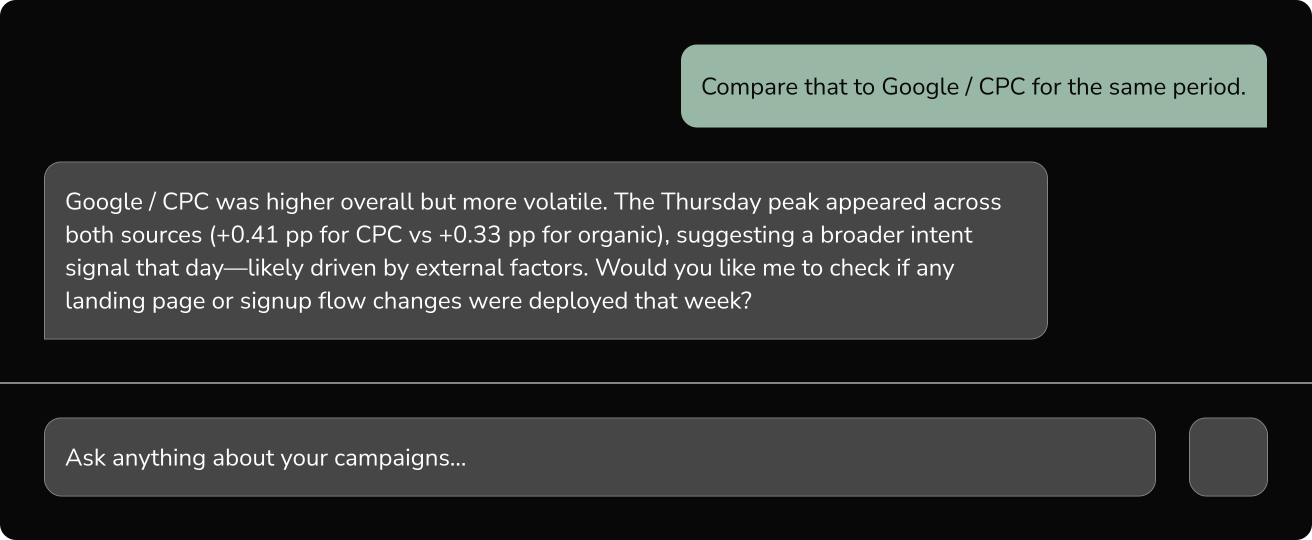
Closer to home, Beetroot built an AI Marketing Copilot using near-real-time analytics — a conversational AI agent that provides marketers with instant insights, cutting reporting turnaround from days to near real-time. It also reduced ad-hoc requests to data teams by 60%, improving the efficiency across departments.
Logistics & Supply Chain
Logistics and supply chain depend heavily on timely data and, therefore, can benefit from real-time insights. Real-time tracking systems provide continuous visibility into shipments and vehicles. They collect data from GPS and IoT sensors to proactively manage delays and minimize transportation disruptions.
Real-time systems also adjust routing based on live conditions like weather or traffic. Rerouting occurs automatically as new data arrives, reducing fuel consumption and delivery times.
Dynamic planning is another practical application of real-time analytics in logistics and supply chain. Data-powered systems track demand fluctuations to adjust delivery schedules and balance load between multiple warehouses. They detect supply disruptions and either trigger an automated response — rerouting, reordering, reallocating stock — or escalate to a human operator in critical cases.
Together, these real-time and near-real-time capabilities improve the cost efficiency and on-time performance of transportation.
Technical Foundations for Real-Time Insights
Real-time analytics moves through a sequence of interconnected processes that include data collection, ingestion, integration, analysis, action, and automated response. The system first gathers data from multiple operational sources, processes high volumes of events with low latency, combines live data with historical context when needed, and serves the result to a downstream system or user.
These operations largely rely on a combination of the following technical capabilities:
- Event-driven architecture. Real-time analytics systems commonly use event-driven architectures built around distributed streaming platforms such as Apache Kafka. This architecture approach enables systems to process large volumes of continuously generated events with low latency and enables multiple apps and teams to consume the same event streams independently.
- Streaming data pipelines. Real-time data pipelines usually consist of ingestion, stream processing, storage, and serving layers that move and process data continuously. Platforms such as Apache Kafka are commonly used for ingestion and buffering, while frameworks like Apache Flink or Spark Structured Streaming enable real-time computations and event processing.
- System requirements. Real-time systems must meet strict operational requirements, including low-latency processing, in-memory computation, high throughput with horizontal scaling, and high fault tolerance.
Building and implementing real-time analytics solutions needs technical expertise in distributed systems, streaming infrastructure, data engineering, machine learning, and observability. Organizations that do not have a dedicated data platform team can quickly access specialized skills by hiring data scientists, data engineers, platform architects, and subject matter experts from external providers.
The Human Element: Cultivating a Real-Time Decision Culture
Real-time insights cannot be truly effective when isolated. Organizations that want to gain real value from instant analytics must adjust their workflows and train teams accordingly. Otherwise, they will keep working in the old way just because they are used to it. Besides, many people still have limited trust towards advanced analytics systems, particularly when they are powered by AI, and the decision mechanism is not clear.
The successful implementation of a real-time decision culture requires a shift in decision ownership. Instead of separating data-related processes between multiple teams, where analysts generate reports for managers, organizations should accelerate decision-making. Teams need clear authority to act on signals without waiting for reporting cycles or approval chains..
The importance of quick actions also increases the requirements for data quality and system reliability. Since teams stop working with data directly, responsibility shifts. Now, data quality is ensured by data engineering teams that implement guardrails to ensure data is ingested, cleaned, and processed correctly. Only when teams see that real-time data is worth relying on will they act upon it.
Finally, although real-time analytics implies automation, human oversight is still essential. Marketing, finance, logistics, customer services, and other teams must be trained to take specific actions based on the received insights or triggers. It may require upskilling the team and training them on how to use real-time systems properly.
A healthy real-time culture means clear decision boundaries between automation and human input. Tools should automate routine decisions and escalate complex cases and exceptions to humans. It reduces the load on human resources, making them more agile, and ensures humans remain in the loop and supervise system operations.
Finding the Right Approach to Building Real-Time Data Systems
Building real-time data analytics systems requires business and feasibility analysis to choose between custom builds or SaaS products and design a suitable architecture. You also need to decide whether to develop and implement software in-house or partner with an external provider with relevant experience. These are the tips to guide you to an optimal approach:
- Understand what problems you aim to solve with real-time data analytics. The choice between real-time, near-real-time, or batch data processing depends on the type of data-driven tasks. While fraud detection requires minimum latency, for marketing personalization, several seconds of latency may be totally acceptable.
- Estimate your available engineering resources. If you have a data engineering team that can design and maintain the infrastructure long-term, an in-house custom build may be an option. If your engineering resources are stretched — or if the specialized expertise sits outside your team’s core skill set — an external partner who designs and builds custom systems can deliver faster and absorb the ongoing maintenance effort.. Off-the-shelf SaaS is the third option, but you need to consider scalability ceilings and customization constraints that show up once volume or business logic grows.
- Choose a suitable architecture based on existing and potential data needs. Once you decide to develop a custom build, choose an event backbone, stream processing model, and data activation layer. Note that slightly higher latency simplifies the architecture.
Adopting advanced analytics tools within an organization is a big move that requires more than choosing between custom development or SaaS. It will have a long-term effect on your business efficiency and growth. You will need to reshape your business workflows and ensure continuous maintenance and improvement of data-based systems.

Real-Time Data Pipelines: When They Matter, When They Don’t
Real-time streaming data pipelines are a powerful capability, but that doesn’t automatically make them a recommended choice for every system. They reduce data latency to the point where insight and action can happen almost in the same moment, allowing teams and systems to react to operational changes while the information is still relevant..
The greatest value of real-time processing comes from workflows where immediate insights directly affect operational efficiency, customer experience, risk management, or revenue generation — in use cases like fraud detection, marketing personalization, logistics coordination, dynamic pricing, or customer communications.
Real-time systems don’t replace traditional analytics altogether. They complement existing data architectures where faster response times create measurable business value.
If you are exploring how to turn operational data into faster decision-making, Beetroot can help design and implement a real-time data architecture aligned with your business goals, infrastructure, and available engineering resources.
FAQs
What is the difference between real-time and near-real-time data processing?
The difference between real-time and near-real-time processing is data latency. While real-time processing handles data within milliseconds to seconds, near-real-time data operations take seconds to minutes, introducing a slight delay. Latency makes real-time systems more suitable when an immediate response is required. Near-real-time processing is a typical choice for solutions that allow for a small delay with lower complexity as a trade-off.
Is real-time data always better than batch processing?
No, real-time data is not always better than batch processing, as they just serve different purposes. Real-time data processing is more suitable for workflows that require immediate responses, while batch processing relies on historical data and may be used for trend analysis, repetitive business processes, or model training.
What are the biggest challenges in implementing real-time data pipelines?
The biggest challenges in implementing real-time data pipelines relate to extremely low latency and handling large volumes of data. These include achieving very low latency while maintaining data consistency, addressing data quality issues such as incomplete or duplicate records, ensuring high fault tolerance, integrating with multiple data sources, and managing infrastructure complexity and operational costs.
Is real-time analytics relevant for small and mid-sized businesses?
Yes, real-time analytics can benefit small and mid-sized businesses when used for fast-moving operations or customer interactions. SaaS tools with real-time analytics functionality make immediate insights available for teams with different budgets. At the same time, SMEs should use real-time analytics carefully when higher costs and complexity don’t match the actual business value.
How can companies ensure data quality in real-time systems?
Companies ensure data quality in real-time systems through a set of established best practices: validating data at ingestion through strict schemas, applying automated validation and cleansing workflows, monitoring pipelines through real-time observability tools, enforcing data governance, and keeping humans in the loop for critical cases.
Subscribe to blog updates
Get the best new articles in your inbox. Get the lastest content first.
Recent articles from our magazine





Contact Us
Find out how we can help extend your tech team for sustainable growth.