


Contents
Contents
Most finance leaders who evaluate an AI assistant are not just asking which model to use. They’re asking which kind of system they need, for whom, and how to deploy it without creating a new category of risk. An assistant that helps a compliance analyst find a policy clause and an assistant that answers a customer’s question about their account balance aren’t two flavors of the same product. They are two different deployment contexts, with different data access, failure consequences, and controls.
Much of the real work in financial AI chatbot development happens before any model is chosen. Teams need to decide what the assistant should and shouldn’t do, which systems it can touch, and how it escalates when it reaches its limits. The goal is conversational AI development that fits a real workflow, not a generic LLM interface dropped in front of sensitive systems.
In this article, we break down the practical use cases for both internal and customer-facing AI assistants, explain the different risks each one carries, and walk through the architecture decisions that support secure, governance-aware deployment in a regulated financial environment.
Internal vs Customer-Facing AI Assistants in Finance: Key Differences
The cleanest way to separate the two is by who talks to the assistant and what happens when it gets something wrong.
An internal finance virtual assistant serves employees: analysts, compliance specialists, operations staff. Its users are trained, accountable, and able to sanity-check an answer. Employees can review and correct a wrong response before it affects a business process or customer outcome. A customer-facing banking bot serves customers, prospects, and applicants, who may have limited ability to verify information independently, may act on it immediately, and often experience an error as a breach of trust.
Internal and customer-facing assistants often require different approval processes, testing standards, governance controls, and escalation policies. Internal assistants typically access approved internal documents and structured data through existing employee permissions. Customer-facing financial services chatbots may touch account data, personal information, and transaction systems, which raises the stakes on privacy and authentication.
Success for an internal tool is measured in time saved and retrieval accuracy. For a customer tool, it’s measured in resolution rate, trust, and clean escalation to a human. Escalation needs differ sharply: an internal assistant can route an employee to a colleague, while a customer-facing one needs a reliable, auditable handoff path for anything it shouldn’t handle alone.
The practical implication follows from these differences: internal use cases are often the safer place to start, while customer-facing assistants should never be treated as safe by default.
Conversational AI Banking: What Are Internal AI Assistants in Finance?
Internal AI assistants are the lower-risk entry point for conversational AI banking: employee-facing tools that support finance teams in their daily work. They sit on top of approved knowledge sources and internal systems, and their job is to reduce friction in repetitive, document-heavy, or knowledge-retrieval tasks.
Adoption has moved quickly. In EY’s 2025 survey of banking institutions, 77% of banks had actively launched or soft-launched generative AI applications, up from 61% in 2023. As organizations move from experimentation to production deployments, many start with internal assistants because they can introduce governance, monitoring, and human oversight before exposing AI systems directly to customers.
What keeps the stakes contained is the nature of the work: the audience is internal and accountable, the data stays within the organization’s controlled environment, and a mistake is more likely to be a productivity issue than a customer-harm or regulatory event. That doesn’t make internal assistants risk-free, but it does make them easier to govern while a team builds operational maturity.
Many organizations begin their custom AI chatbot development initiatives with internal knowledge assistants, employee helpdesk tools, or workflow support systems before expanding into customer-facing use cases.
Compliance and Regulatory Monitoring
Compliance teams spend enormous time searching policies, tracking updates to applicable regulations, and checking whether a process aligns with current requirements. An internal assistant can accelerate that work through retrieval-augmented generation over approved policy documents and regulatory texts, surfacing the relevant clause and pointing to its source.
The important constraint: this supports compliance monitoring, it doesn’t replace it. The assistant retrieves and summarizes; a qualified compliance officer still interprets and decides. Framing matters here, and the honest framing is “compliance-aware support tool,” not “automated compliance.”
An assistant that drafts a first-pass answer with citations a specialist can verify is genuinely useful. One that is treated as the final decision-maker creates avoidable risk. In practice, finance organizations often pair these assistants with audit logs and review workflows so recommendations stay traceable.
Analyst Copilots and Report Generation
Financial analysts work with dense source material: filings, market data, and internal reports. An assistant can retrieve figures from quarterly filings, summarize long reports, draft recurring market or risk updates, and answer questions across a large body of internal and external financial documents without the analyst having to search through each source manually.
This is where NLP in finance becomes practically useful, with intent recognition, entity extraction, and document understanding turning unstructured text into something queryable. As with compliance workflows, analysts need visibility into the sources behind any generated output. Where the workflow extends into forecasting, fraud triage, or anomaly detection, the assistant might need to connect with predictive analytics tools for finance or structured models. The same principle still holds: the copilot speeds up the analyst’s work, not replaces their judgment on what the numbers mean.
Internal IT, HR, and Finance Helpdesks
A large share of internal support tickets are repetitive: how to request access, where a policy lives, how onboarding works, or where employees find reimbursement, procurement, and expense-management guidance. An internal assistant can resolve many of these directly, freeing helpdesk staff for the cases that actually need a person.
The volume is the point. These workflows give teams a practical way to test retrieval quality, escalation workflows, and audit logs in day-to-day operations, on questions where errors are easier to detect and correct. Proving those patterns out here makes them dependable before assistants move into more sensitive environments.
Financial Chatbots and Virtual Assistant Banking: Customer-Facing Use Cases
Customer-facing AI assistants interact directly with banking and fintech customers. This is virtual assistant banking in the sense most people mean it. That’s where the controls have to tighten considerably, because every interaction touches customer trust, privacy, and often regulated activity.
The shift isn’t only technical. Customers often cannot independently verify whether an answer is grounded in their actual account data, so accuracy and honest uncertainty become non-negotiable. The assistant may need to authenticate the user and access account data, all within clearly defined permissions and response boundaries. None of this is safe by default; it’s safe only when designed, tested, and escalated deliberately. The range here runs from simple FAQ bots through richer generative AI banking assistants to more advanced agentic workflows, and conflating them is a common scoping mistake.
Conversational Banking and Account Management
The practical, high-value use cases are concrete: helping a customer find a transaction, review account activity, check a payment status, navigate a service, get card support, or move through onboarding. These are well-defined tasks where a properly designed assistant can genuinely improve the customer experience.
They also require secure integrations with core systems and proper identity checks, since the assistant is now reading real customer data and, in some cases, acting on it. A read-only assistant that helps customers find information carries a different risk profile from one that can initiate payments, change account settings, or trigger service actions. The design question is less “can it answer” and more “what is it allowed to do, for whom, after which verification step,” with every sensitive action logged.
Personal Finance Guidance and AI Personal Finance Assistants
An AI personal finance assistant can help customers understand their spending, categorize transactions, set budget goals, identify recurring expenses, and learn basic financial concepts. There’s real value in helping people see their own money more clearly.
The boundary here is regulated financial advice. An assistant can offer spending insights and education. However, it shouldn’t present itself as giving personalized investment or financial advice unless the organization is explicitly authorized and has built the controls, disclosures, and supervision that regulated advice requires. By default, the assistant should be transparent about what it does and doesn’t do, with a clear path to a qualified human for anything that crosses into advice.
AI-Powered Customer Support
The most reliable use cases for AI chatbot customer service banking are answering FAQs, ticket triage, multilingual support, case summarization for human agents, and clean handoff. The assistant resolves high-volume, routine queries and routes the rest to the right team.
Human-in-the-loop design is the backbone here. Complaints, suspected fraud, vulnerable-customer situations, disputed transactions, and advice-seeking conversations should not be left to the assistant alone and need especially clear escalation rules. When a case is beyond the assistant, it should pass to a human agent with full context, so the customer doesn’t have to start over.
Generative AI Banking Risks and Mitigation
A finance AI assistant’s real risk lies in the data, systems, and actions it can reach through its integrations. Because these assistants are generative AI banking systems connected to data and workflows, their risk profile differs from a standalone model or a simple FAQ bot. Building generative AI solutions for finance means designing for that exposure from the start.
A useful reference point here is the OWASP Top 10 for LLM Applications, which outlines common security risks in LLM-powered systems. In finance deployments, a handful of risks deserve particular attention:
- Prompt injection. Attackers manipulate the assistant through the content it processes, affecting how it retrieves information, follows instructions, or acts on connected systems.
- Sensitive data exposure. The model surfaces personal, proprietary, or confidential information it shouldn’t reveal.
- Hallucinations. The assistant produces confident answers that are wrong, incomplete, or unsupported by existing sources, which a customer has no easy way to catch.
- Unauthorized access. Permissions are scoped too broadly, so the assistant can reach data or systems beyond the user’s role or use case.
- Weak auditability. Logging gaps that make an incident hard to reconstruct after the fact.
- Poor escalation. The assistant has no reliable handoff path, leaving employees or customers stuck when a case is out of its depth.
The mitigations are mostly about limiting what the assistant can do and verifying what it says. Least-privilege access keeps it from reaching data or systems beyond its task, and segregating untrusted external content reduces the risk that retrieved content can influence the instructions, tool behavior, or generated results. Answers should be grounded in approved sources, and higher-risk outputs must be validated before they reach users or workflow. Sensitive actions should be logged for monitoring and review, while escalation belongs in the design from the start rather than being bolted on once the assistant is already live.
These risks can be reduced and governed when the architecture anticipates them. They are security problems as much as model problems, which is why access control, data exposure, and operational resilience sit at the center of cybersecurity consulting for finance teams building AI assistants.
Architecture Considerations for Secure Conversational AI Banking
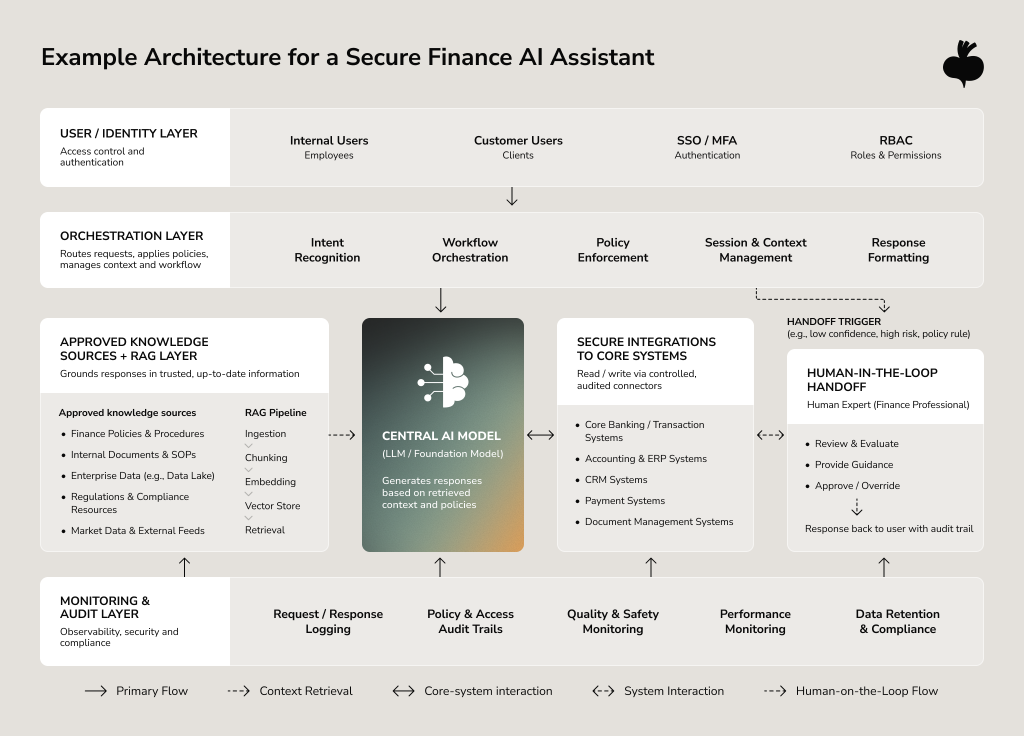
Most of what makes a finance assistant safe, controlled, and accountable lives outside the model. The architecture around it is what keeps the assistant useful, bounded, and accountable: access control, grounding, monitoring, and escalation.
The core elements are consistent across deployments. Role-based access control and identity management keep the assistant within what each user is permitted to see and do, while approved knowledge sources and RAG help ground its answers in vetted content. Integrations to core systems run through controlled, monitored interfaces, and audit logs make the assistant’s behavior observable and reviewable after the fact. Underpinning all of it, a reliable human-in-the-loop handoff gives the assistant a safe exit for anything beyond its remit.
The same architectural pattern can support both internal and customer-facing assistants, but customer-facing deployments usually require stricter identity checks, narrower action permissions, and more explicit escalation controls.
Teams also need to test retrieval quality, permission boundaries, fallback behavior, and escalation paths across realistic user scenarios before release. These checks help confirm that the assistant will function as intended beyond ideal conversations.
Architecture decisions also carry governance implications. Financial institutions operate under growing expectations around operational resilience, third-party risk, auditability, and change management. Frameworks such as DORA place greater emphasis on understanding technology dependencies and maintaining visibility into outsourced services.
For AI assistants that rely on external models and infrastructure, that makes audit-ready design, monitoring, and clear vendor accountability matter early. Building secure data pipelines, controlled integrations, and governance-aware workflows that support those requirements is a core part of what an AI development team delivers for finance.
Choosing the Right Deployment Model
The right starting point depends on four things: workflow complexity, risk level, integration depth, and governance requirements.
For most organizations, an internal assistant is the sensible first move. It delivers value on contained, lower-risk workflows while the team builds the controls, monitoring, and escalation patterns that a customer-facing system will demand.
A customer-facing assistant makes sense when there’s a clear, well-bounded customer need and the organization is ready to invest in stricter authentication, testing, and human handoff. These deployments are easier to govern when the assistant’s role is narrow at first, such as answering product questions, helping users navigate services, or supporting read-only account queries.
A hybrid model, internal-first with a narrow customer-facing pilot, is often the most realistic path. Starting with an internal copilot lets the team learn where the model struggles or hallucinates in a controlled environment, then graduate to a limited customer-facing pilot once internal metrics and security thresholds are met. That second stage tests conversational experience, latency, and real-world edge cases while humans stay in the loop to approve actions and catch mistakes before a full public rollout.
A fully custom-built solution becomes the right answer when workflows are highly specific, integrations span multiple systems, or governance requirements make off-the-shelf tools difficult to adapt. The decision should follow the workflow and its risk, not the other way around.
How Beetroot Helps Build AI Assistants for Finance
At Beetroot, we help finance teams design and build AI assistants around their actual workflows, systems, and governance requirements. Rather than fitting your processes to a ready-made product, we build around your organization’s systems, governance requirements, and operational processes.
Depending on the use case, our work can bring together generative AI development for assistant capabilities, NLP development services for document understanding and information retrieval, secure integrations with internal systems, predictive analytics for data-heavy workflows, and cybersecurity controls that support access management and operational resilience. The goal is to build an AI assistant shaped to your environment, permissions, processes, risk profile, and long-term product direction.
The Right Finance AI Assistant Depends on the Workflow, Risk, and Architecture
Internal and customer-facing assistants should not be designed the same way, because they serve different users, carry different risks, and require different controls. An internal assistant can start with a contained workflow and help teams build operational maturity. A customer-facing assistant needs stronger authentication, tighter governance, and dependable human escalation. Both depend on architecture that keeps the assistant grounded, observable, and accountable.
The most successful finance AI assistants are designed around the workflow they support, the systems they connect to, and the level of risk they introduce. When those decisions are made deliberately, the assistant fits the work instead of complicating it. If you’re evaluating where to start, our team can help you scope the right assistant type, shape its architecture, and ground it in the realities of how your organization operates.
FAQs
What is the difference between internal and customer-facing AI assistants in finance?
Internal AI assistants in finance are employee-facing tools that support analysts, compliance specialists, and other staff with tasks such as policy search, document retrieval, and report drafting. Customer-facing AI assistants interact directly with banking or fintech customers and require stricter controls because they may access account data and affect customer trust, privacy, and experience.
How do banks use AI chatbots for internal operations?
Banks use internal AI chatbots to support employees with repetitive, knowledge-heavy work, including searching policies, monitoring regulatory updates, summarizing documents, drafting recurring reports, and handling routine IT, HR, and finance helpdesk questions. These internal assistants speed up retrieval and reduce manual effort while leaving final judgment to qualified staff.
How is conversational AI used in retail banking?
In retail banking, conversational AI is used in customer-facing assistants that help with account-related tasks such as transaction search, payment status, card support, and service navigation. Conversational AI in retail banking can also support FAQ handling, ticket triage, multilingual help, and case summaries for human agents, provided the assistants have secure integrations, identity verification, and reliable human handoff.
What are the main risks of deploying AI assistants in financial services?
The main risks of deploying AI assistants in financial services include prompt injection, sensitive data exposure, hallucinations or inaccurate answers, unauthorized access through overly broad permissions, weak auditability, and poor escalation. These risks are higher in customer-facing deployments and are mitigated through least-privilege access, grounded knowledge sources, output validation, audit logging, and human escalation.
What does a secure AI assistant architecture for finance look like?
A secure AI assistant architecture for finance combines role-based access control and identity management, approved knowledge sources with retrieval-augmented generation, secure integrations to core systems, monitoring and audit logs, and reliable human-in-the-loop handoff. This architecture keeps the assistant grounded, bounded, and accountable rather than relying on a model alone.
Subscribe to blog updates
Get the best new articles in your inbox. Get the lastest content first.
Recent articles from our magazine





Contact Us
Find out how we can help extend your tech team for sustainable growth.