


Contents
Contents
AI solutions for finance have experienced a great surge, with 87% of CFOs predicting it will be extremely important or very important to their departments in 2026.
However, many C-level executives are still caught between the proven impact of AI implementation and the fear of falling behind. While the pressure to innovate is immense, only one-in-eight CEOs has noticed both cost and revenue benefits from AI adoption.
The issue is not whether AI works – it does. The key is to understand where this technology delivers measurable value and where it should be used first. Today’s article covers the most feasible use cases of AI in financial operations with typical challenges and an implementation roadmap.
Why Financial Operations Are an Ideal Starting Point for AI Adoption
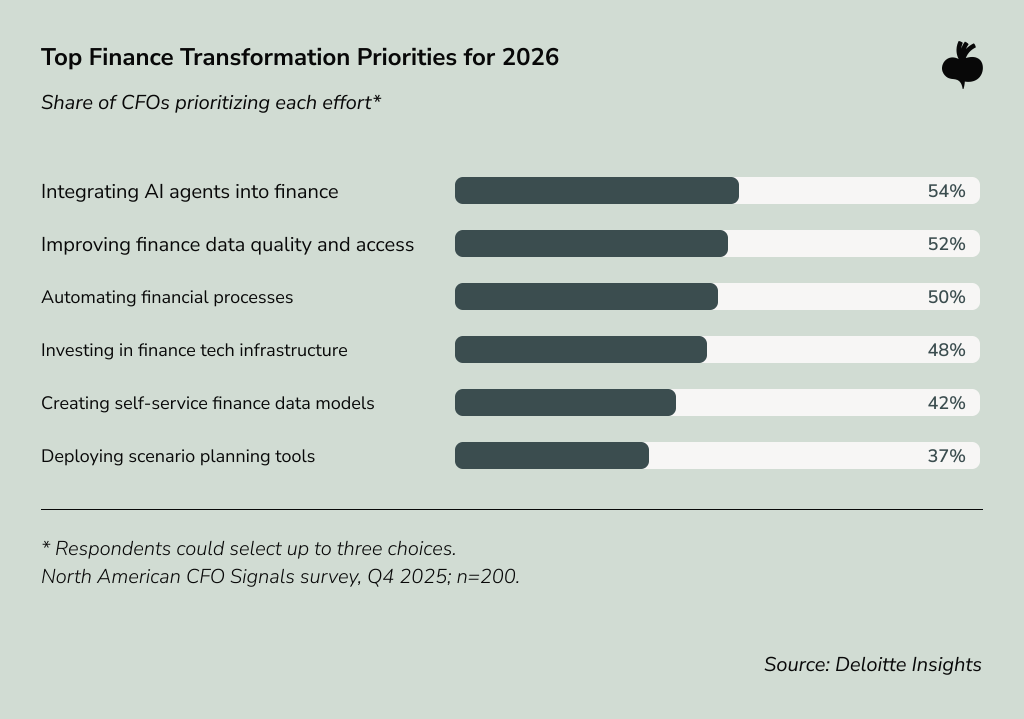
The same Deloitte survey reveals that 50% of CFOs view digital transformation of finance as one of the top priorities. Why does AI-driven transformation in financial operations seem so promising?
Many financial operations are repetitive, which makes them highly suitable for AI-powered automation. Invoice processing, expense review, accounts payable management, transaction reconciliation, and financial data entry are governed by clear business rules and policies. The use of standardized documents and workflows means AI systems can learn patterns and perform core financial operations with a sufficient level of accuracy and autonomy. And since financial departments handle thousands or millions of similar transactions, even limited use of AI in financial operations brings tangible operational efficiency gains.
In many organizations, financial departments have enterprise resource planning (ERP) systems and standardized invoices and payment records with structured data. As a result, adopting AI for corporate finance is easier due to properly organized documentation, although data quality issues may still require cleansing and validation.
Another reason to use AI tools for corporate finance is greater visibility into performance. Financial departments usually rely on well-defined metrics such as processing time, cost per transaction, error rate, and ROI. You can easily set the baseline and measure the impact of AI after workflow orchestration. It allows organizations to quickly see the impact of AI in financial services operations and dynamically fine-tune the system to achieve the expected results.
High-Value Use Cases for AI in Financial Services Operations
When it comes to finance, most organizations focus on intelligent automation, fraud detection, and predictive analytics as core areas. In these domains, AI delivers maximum benefits, enabling companies to speed up operations, reduce costs, and detect suspicious activities early on. The Deloitte survey conducted across banks and insurers reveals that 58% of banks and 30% of insurers use AI for fraud detection, including anti-money laundering (AML) and know-your-customer (KYC); and 53% of banks and 37% of insurers use it for customer experience.
Besides the listed AI use cases, companies that want to automate customer-facing communications or internal knowledge search can implement AI chatbots for finance. These bots retrieve information from connected authoritative data sources to answer common questions and provide internal and external support with high accuracy. Let’s take a closer look at high-value uses of AI for automated financial processes across organizations below.
Accounts Payable Automation
A traditional invoice-to-pay cycle involves manual invoice review, data extraction, PO validation, and routing documents for approval. With AI-powered financial data tools, organizations can automate most of these operations, leaving humans in the loop mostly for supervision and exceptions.
AI-enhanced OCR technology automatically reads invoices in different formats. It can extract data and instantly match it against POs and receipts. If documents are missing information or have any critical discrepancies, the system flags them and forwards them for human review. This way, financial teams can focus on exceptions and problematic cases while repetitive work is done automatically. It means fewer manual operations and errors, and reduced administrative overhead.
Matching Payments and Financial Data at Scale
As the organization grows, the volume of transactions starts to increase and requires more manual checks and matching. That’s where AI can help reduce workload by automating reconciliation workflows based on learned patterns and historical data.
AI tools not only automate matching but can also run anomaly detection, flagging duplicate payments, missing transactions, and unusual account activity. They also route documents for human review if necessary. As a result, financial data matching becomes more accurate, and human reviewers handle edge cases only.
Automated Audit Trails and Compliance Support
The use of AI agents in financial services operations allows organizations to move from traditional auditing processes to mostly automated audit trails. Instead of manually gathering records, verifying transactions, and maintaining documentation, they can automatically capture and link data across systems. Organizations receive detailed records of every action happening within financial workflows to support compliance with standards and regulations, such as SOX and IFRS. AI solutions also automatically flag inconsistencies, guiding teams on which records require fixing. This way, companies gain real-time visibility into potential regulatory risks for improved governance and compliance.
The Beetroot team has built an AI-powered financial reporting system for an international company to standardize financial data and make operations more transparent. The company used to store financial data across different systems in diverse formats and needed a unified system for BI tools and chat-based data access. The implemented AI agent accelerated responses to business questions, improved sensitive data protection, and created a scalable reporting environment. Read about this and other case studies in our practical guide on AI in finance.
Forecasting Operational Risks and Cash Flow Patterns
Predictive AI in financial operations monitors transaction patterns in real time to detect anomalies that may signify disruptions in operations. The technology can identify delayed receivables, unusual spending activity, and supply chain bottlenecks, and perform cash flow forecasting, informing finance leaders about the risks. It enables financial teams to take proactive measures and implement mitigation strategies based on the current market dynamics, cash flow trends, and price movements.

Measuring the Operational Efficiency of Financial AI
According to the latest PWC survey, only 30% of CEOs feel confident about revenue growth in 2026, as turning AI investment into tangible returns gets challenging. Considering these numbers, organizations need to plan for measuring the impact of AI before its implementation — to minimize the risk of launching inefficient AI initiatives and continuing to support them regardless of the low ROI.
The metrics your team can use to measure AI in financial operations depend on the type of automated processes. Below are some universal indicators to consider:
- Reduced processing time. Compare the average completion time required for operational tasks after AI implementation with the manual or rule-based baseline to ensure that innovations accelerate repetitive operations.
- Fewer manual errors. Track the frequency of data-entry mistakes, incorrect calculations, document misclassification, and reconciliation errors before and after AI.
- Decision accuracy. Make sure the adopted AI system is not only fast but also reliable and delivers output that doesn’t require profound revisions. The ways to measure prediction accuracy depend on the use case and typically include precision/recall and false-positive rates.
- Human productivity. Check whether your employees can accomplish more tasks in the same amount of time or have switched to more complex operations. When implemented efficiently, AI brings noticeable productivity improvements, allowing companies to scale their operations without considerably expanding their staff.
- ROI timelines. Measure how quickly you start recovering your investment, taking into account initial implementation costs, annual cost savings, revenue improvements, risk reduction benefits, and productivity gains.
Apart from the listed objective measures that allow organizations to evaluate the operational efficiency of AI, it may also be useful to gather direct employee feedback. Ask people what they like and dislike about the innovation and how they use AI. Often, efficiency losses happen due to the lack of governance within the organization. If it turns out that AI tools for corporate finance fail to deliver as expected, your company may benefit from business intelligence consulting to implement reliable tracking and increase system productivity.
Common Challenges When Implementing AI in Financial Operations
We have already discussed profitability as one of the challenges related to measuring the efficiency of automated financial processes. However, successful AI implementation also comes with other difficulties you should take into account before implementation to avoid long-term negative consequences.
Governance and Explainability
When an organization is not mature enough to implement AI, automation creates many gray areas and undermines compliance. Without structure, it is unclear who is responsible for monitoring AI output and where human oversight is still required.
Companies should establish clear governance frameworks and ethical guardrails to ensure AI is safe and compliant before adopting it. They must define accountability, risk management procedures, and model validation requirements to meet regulatory requirements. It’s also important to ensure AI explainability, making its output more understandable to humans and, therefore, actionable.
Integration Complexity
Successful adoption of AI solutions depends on access to multiple data sources, transaction systems, customer databases, and reporting platforms. Most financial departments already have legacy systems that have been there for years and may complicate new integrations.
These limitations lead to implementation delays and considerably increase the project’s costs and complexity. That’s why we recommend auditing your existing infrastructure before deciding on which AI automation solution to integrate. It may be necessary to start with partial or full system modernization and building data integration frameworks first.
Data Quality
Even though financial records are usually structured, some organizations still have poor-quality data that cannot be used for AI-based automation. Incomplete customer records, duplicate entries, outdated information, or limited access to historical datasets prevent AI tools from properly operating and undermine the reliability of their output and actions.
Before adopting AI for finance operations, organizations need to prepare data for further processing through cleansing, standardization, and validation. It’s also necessary to establish governance and data monitoring to ensure stable data quality and prevent inaccurate predictions or flawed decision-making.
Human Oversight
While financial operations are a good option for automation, they still require human oversight as many legal, ethical, and economic consequences are involved. Organizations must follow the human-in-the-loop approach and escalate all atypical or critical cases to human agents for review. It’s important to clearly redistribute tasks and make sure people still review AI-generated recommendations, supervise model performance, and can override incorrect decisions in time.

Implementation Roadmap for AI in Financial Services Operations
The implementation of AI in financial services operations is a gradual process. A staged approach allows organizations to mitigate risks and more accurately evaluate the impact of AI on each workflow. The typical steps to follow are:
- Identify opportunities and prioritize use cases. Analyze your existing financial operations and determine those that are the most likely to benefit from AI-powered automation. These are repetitive operations and don’t require critical judgment and end-to-end human supervision.
- Prepare data and infrastructure. Consolidate data from siloed systems, clean and standardize financial records, and ensure governance and compliance controls to achieve the data quality required for smooth AI operation.
“If you ask an AI to generate a report from a big lake of unstructured data, you will get one — and it might even look fine. But ask the same question next month, and you’ll get a different report. In finance, that’s not acceptable.”
— Joris Hoogerdijk, Chief Financial Officer at Beetroot.
- Develop and test a PoC. Build a pilot version of custom AI solutions with basic functionality to see how it works, gather user feedback, and plan further functionality and enhancements based on real data, not assumptions.
- Integrate the solution into existing workflows. Include AI outputs into decision-making processes, integrating core financial systems, and create human-in-the-loop approval workflows for operations that require human oversight.
Note that stable and efficient AI operation depends on continuous monitoring and regular fine-tuning. You will need an in-house AI engineering team or a reliable third-party vendor to provide maintenance and support.
Summarizing Primary Uses of AI for Corporate Finance
Businesses with large financial departments or considerable volumes of financial operations, including invoice processing, expense review, accounts payable, and transaction reconciliation, can considerably benefit from AI solutions. These operations involve multiple types of repetitive tasks that can be effectively automated, reducing costs and improving productivity.
Successful financial AI adoption starts with determining operational bottlenecks and optimal use cases. Organizations must clarify where automation brings maximum efficiency and prefer measurable business outcomes over experimental AI initiatives. Meet our AI experts to discuss optimal AI uses within your organization and get an implementation roadmap.
FAQs
What is the typical ROI timeframe for AI automation in financial operations?
The typical return on investment (ROI) timeframe for AI automation in financial operations is 6 to 18 months. For simple process automation like invoice processing or expense auditing, the tangible results can show up after 3 months, while a profound AI-driven finance transformation takes 12+ months to reach full ROI. The timeline depends on implementation complexity, process volume, and existing operational efficiency.
How does generative AI improve invoice processing workflows?
Generative AI improves invoice processing by automating manual, template-based workflows across the accounts payable cycle. AI solutions can read semi-structured and unstructured invoices to automate data extraction, identify discrepancies, summarize issues, and route documents to the necessary human agent.
Can AI reduce errors in financial reconciliation and bookkeeping?
Yes. AI can significantly reduce errors in financial reconciliation and bookkeeping by automating data entry, accounts receivable and payable matching, and anomaly detection. It also eliminates manual data-entry mistakes, flags discrepancies, and ensures consistent application of accounting rules, allowing finance teams to improve accuracy and accelerate operations.
How secure is financial operational data when using LLM-based systems?
The security of financial operational data in an LLM-based system depends on its deployment, configuration, and governance. LLM-based systems can be safe enough for most financial operations as long as they have role-based access controls, auditability, and continuous rigorous security reviews.
Does AI in financial operations replace finance professionals?
No, AI doesn’t fully replace finance professionals. It augments their work by automating repetitive operations such as invoice data entry, transaction matching, reconciliations, and report generation. Finance teams still provide critical judgment and supervise the accuracy of AI systems, solving cases that require human oversight.
Subscribe to blog updates
Get the best new articles in your inbox. Get the lastest content first.
Recent articles from our magazine





Contact Us
Find out how we can help extend your tech team for sustainable growth.