How CX Teams Use Predictive Analytics to Compete on Customer Retention
- May 29, 2026
- 10 min read
- AI/ML


Contents
Contents
Customer acquisition has always been expensive. But while ten years ago the arbitrage of low-cost ads on social platforms could still offset customer loss, today privacy regulations, the decline of third-party cookies, and sheer market saturation have sent CAC skyrocketing, making churn impossible to outspend.
Even investing thousands in hyper-targeted top-of-funnel strategies, customers still leave if the follow-up experience lags behind baseline personalization. And that’s the most frustrating part, as having tons of CRM and support data doesn’t automatically translate to actionable foresight. It needs predictive analytics solutions to connect the fragments into a unified view of the customer journey and operationalize it.
As rising CAC makes traditional growth models obsolete, let’s take a look at how predictive analytics in customer experience helps organizations better anticipate and respond to subtle behavioral shifts that precede churn. You’ll also learn where it applies across the customer lifecycle, what infrastructure it requires, and how to measure its impact.
How Predictive Analytics Reduces Customer Churn
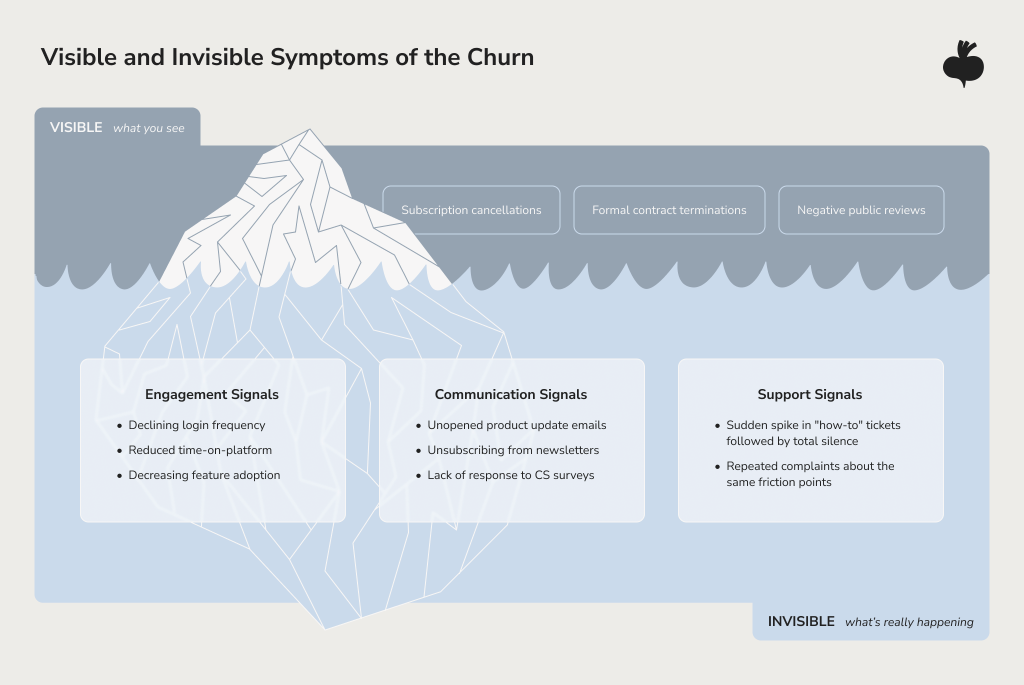
The signals of dissatisfaction usually flow unnoticed because connecting a 10% drop in core feature usage and an uncharacteristic spike in support ticket frequency is practically impossible through manual monitoring alone. These real-time insights and early indicators already exist in your product logs and CRM, but they remain just dormant data points if you can’t bring them into the workflows where retention decisions are made.
Predictive analytics for customer retention is a decision-support function that helps connect the dots between historical churn patterns and current account health to intervene just in time and secure the customer’s lifetime value. Machine learning models learn behavioral patterns across the customer lifecycle, including product engagement, support interactions and usage trends. They determine risk scores before the customer has already left, and flag it. In other words, predictive analytics in marketing gives companies leverage to route the necessary attention to the right accounts at the right moment.
The Value of Predictive Customer Analytics in Journey Mapping
The job of most CX systems ends at the signal collection phase. They calculate a churn score, flag a low health rating, or log a drop in engagement, and then leave the response to whoever happens to check the dashboard that morning. There is no link between data and delivery, and the real danger to your retention is the time it takes to act on that discovery.
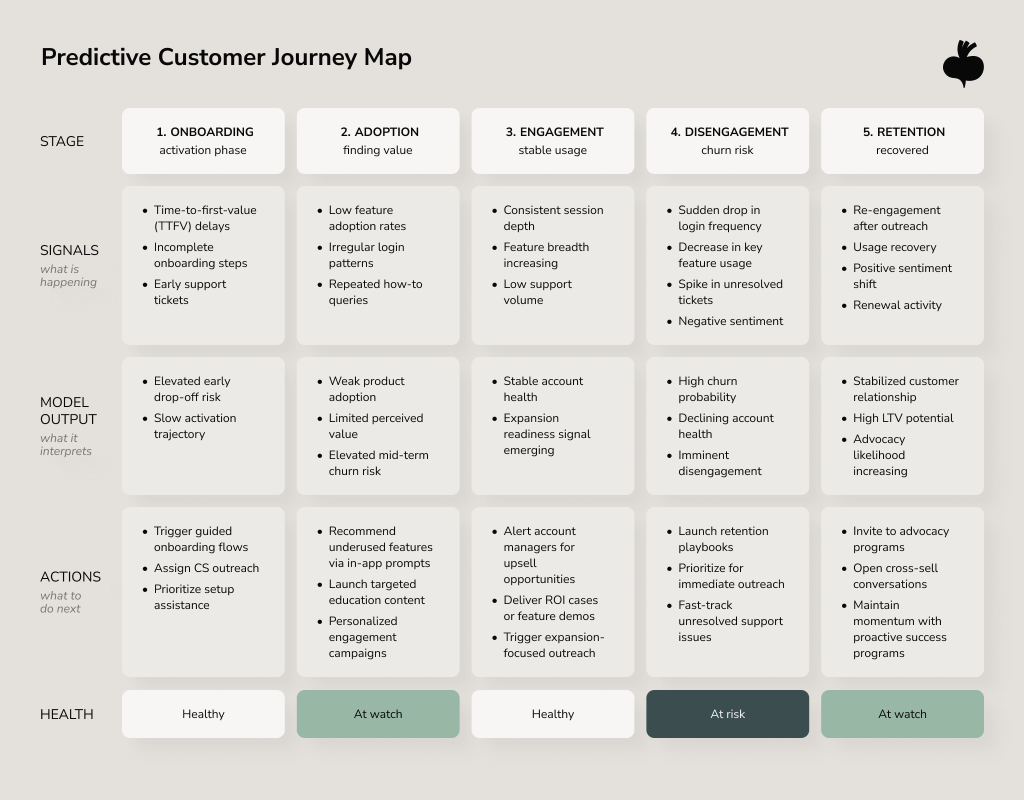
Predictive analytics in customer experience brings structure to the chaos of raw behavioral signals and aligns customer journey mapping with real-time insights and usage trends. It can help at different stages of the lifecycle:
- Onboarding. ML models analyze the first few user sessions. If the system detects a deviation from the success pattern, it automatically triggers a personalized nudge or a guided walkthrough.
- Engagement & expansion. Continuous monitoring of usage trends allows organizations to identify upsell readiness and approach customers with expansion opportunities when they are most likely to convert.
- Predictive service. Predictive analytics in customer service enables customer journey forecasting, anticipating each stage of the buying cycle and triggering automated interactions in real time based on the predicted next step.
- Retention. When a customer is flagged as high-churn risk, the system pulls them from standard promotional campaigns and reroutes them to a retention sequence to address their specific issues.
According to recent data from Forrester, experience-led businesses that leverage analytics to personalize the customer journey are 1.6x more likely to increase customer lifetime value (CLV) and 1.7x more likely to secure higher retention rates.
However, to achieve this level of predictive precision, simply integrating custom churn predictive analytics into your workflows isn’t sufficient. Streamlined data ingestion and cross-system coordination are obligatory prerequisites for true journey orchestration.

What Predictive Customer Analytics Needs to Work Properly
As we briefly touched on above, to unlock predictive analytics customer experience benefits, it’s important to prepare the surrounding environment, where data quality and integration are key enablers. For a system to have an end-to-end view of the user journey, it needs reliable, unified pipelines that combine data from CRM activity, product usage, and support logs into a consolidated stream ready for predictive modeling.
Gartner predicts that organizations failing to integrate their data silos will abandon 60% of AI projects due to fragmented data. In light of this, turning to data engineering services helps avoid falling victim to that statistic and solidifies three things: unified data, clean pipelines, and real-time processing.
The infrastructure and its processing capabilities play a key role in enabling real-time CX interventions. The better it’s architected to manage continuous data flow, the easier it could support timely and relevant responses. Given the increasing complexity of data privacy, integrating regulatory compliance (GDPR/CCPA) and AI ethics into your data governance framework will save you from costly legal fallout and systemic biases. What’s important here is to approach data architectures as a repeatable, secure system that matures alongside your product.
Essential Data Sources for Predictive Customer Analytics
If you want a model to anticipate a customer’s mood as accurately as an experienced account manager, it needs to receive a blend of historical records and real-time intent signals relevant to each customer case. The effectiveness of predictive models depends more on the quality and consistency of these inputs than on raw volume alone. So, let’s understand what inputs customer experience predictive analytics demands to make those signals actionable.
CRM Data
CRM records establish account identity and lifetime value. Predictive analytics for customer behavior models learn the typical timing of renewals and purchases to map the ideal usage cycle and highlight when someone’s intervention is needed. CRM provides a commercial lens on the customer and historical context, vital for data-driven decisions, yet it’s retrospective and needs to be paired with more dynamic sources.
Product Usage Metrics
Usage data is a more accurate barometer of intent than surveys. Predictive customer analytics can process massive data streams, such as login frequency, session depth, feature adoption, clickstream data, and browsing history, to shorten market response times and enable real-time segmentation. But first, it needs all those data sources unified into a single stream.
Support Logs
Usage metrics tell you what is happening, and support data explains why. For example, a user might stay highly active in the product only because they are struggling to complete a basic task, not because they are finding value. Feeding support logs into predictive systems helps recognize repeated issues early, which is an indicator of high-churn risk regardless of activity levels. To have these insights flowing uninterruptedly, organizations opt for MLOps services to automate model retraining and keep them running flawlessly.
Behavioral Data
Every digital interaction — from how someone navigates your app to the way they interact with your emails — leaves a trail. These patterns show you exactly when a customer is breezing through and where they’re getting stuck or circling back. That’s the most powerful tool for personalization, but also the hardest to unify cleanly across touchpoints.
Operationalizing Change for Data-First Support Teams
Implementing predictive analytics is as much a cultural shift as it is a technical one. According to a recent Gartner survey, nearly 47% of employees report feeling overwhelmed by new workplace technologies, struggling to find the information to do their jobs.
To overcome skepticism and drive adoption, it’s critically important to address the following possible roadblocks.
Disruption of Established Workflows
Commonly, support teams operate on a reactive, ticket-by-ticket basis. Switching to predictive analytics for customer retention calls for abandoning this linear structure and static annual planning with weekly batch reviews for more dynamic sensing and seizing mechanisms. This change abolishes existing KPIs and the habitual way of work, demanding the development of new operational protocols that teams may be hesitant to adopt without a clear roadmap.
The Ownership Trap
One of the killers of a data-first culture is the diffusion of responsibility. When a high-risk flag appears, ambiguity over who should take over, the success team, the account executive, or support, leads to total inertia. To make predictive analytics customer churn models work, it would help to create a pre-defined playbook that specifies who owns the customer recovery process for every particular alert.
Missing Analytics Literacy
Many CX teams, especially those dealing with AI-driven insights for the first time, face a disconnect between receiving data alerts and knowing how to respond to them and which action to take. Without training the team to read these outputs, you end up with a high-tech system that does nothing but confirm why you’re losing customers and has little ability to prevent it.
Privacy Boundaries in Predictive Analytics in Customer Experience
The adoption of predictive marketing has created a tension between the pursuit of hyper-personalization and rising consumer privacy demands. It’s true that data-driven models let us be incredibly specific about who we’re targeting, but they simultaneously heighten public skepticism regarding the responsible use of data.
GDPR sets the global standard for privacy, requiring a clear lawful basis for data collection and processing. Explicit consent, data minimization, and the right to be forgotten are the main safeguards that reduce legal and reputational risk. Similar protections exist in the US — the CCPA grants consumers the right to know what data is collected and to opt out of its sale.
But regulation is only part of the risk picture. As predictive analytics customer retention systems use more sensitive behavioral data, three ethical thresholds become easy to cross:
- Surveillance vs. service. Trying to make predictive analytics more accurate, adding more data points may seem justified, yet without guardrails, small optimizations can become intrusive.
- Nudging vs. manipulation. Models that guide behavior and do it too forcefully weaken customer autonomy. When users don’t know their choices are being shaped, the relationship loses its authenticity.
- Algorithmic bias. If training data involves only support tickets from high-value enterprise accounts and email interactions, the model will overlook other segments, and you won’t even notice the blind spots until churn patterns emerge.
When planning your model deployment, consider privacy as the default operating principle that will address all these risks. Some of the essential policies to implement:
- Being transparent about what data is collected and why, and how it informs predictions
- Establishing consent mechanisms that users can change
- Applying privacy-preserving techniques like federated learning, which trains models locally.

Connecting Predictive Analytics in Customer Experience to Revenue
Like any investment, predictive CX needs a concrete return framework to prove its long-term value. The good news is that the ROI of predictive customer analytics delivers bottom-line growth in several ways.
Retention Economics
The better the retention rate, the more stable recurring revenue you have, which reduces the pressure on sales teams to constantly fill the funnel.
What to track: churn rate of flagged vs. unflagged accounts; retention campaign conversion rate.
Customer Lifetime Value Optimization
Given that AI-driven predictive models improve customer segmentation accuracy to 92%, it becomes possible to reallocate your resources towards customers who offer the greatest long-term profitability. You gain the ability to better protect your most valuable accounts and spot hidden gems — small accounts that traditional segmenting ignores but have the revenue potential of your future top spenders.
What to track: CLV of AI-prioritized segments vs. baseline average.
Support Efficiency
Proactive support keeps your operating costs down by clearing out bottlenecks behind the scenes. It’s much cheaper to solve technical hiccup early than it is to manage a wave of support tickets once the damage is done. That’s a measurable reduction in handle time, escalation rate, and first-contact resolution cost.
What to track: support ticket volume and escalation rate pre/post predictive deployment.
Tips on Finding the Right Tech Partner for Predictive CX Initiatives
Building a system for predictive CX analytics is an engineering task. You won’t find a ready-to-use one that comes pre-integrated with your CRM or pre-trained on your customer behavior. From this perspective, it’s vital to find a partner that has profound expertise in data engineering and ML integration, as well as a sharp business sense to ensure the technology serves the strategy.
What to look for in a technology partner:
Data Engineering Maturity
A solution architect you choose to cooperate with must be able to build robust data pipelines that unify siloed information from all your touchpoints into a single source of truth, and make it production-ready for real-time scoring.
ML Integration
Look for expertise in connecting model outputs to the actual CX workflows and avoid those that deliver a dashboard and call it done. The goal is to enable seamless execution where the system automatically orchestrates the next best action.
Systemic Support & Scalability
You want an implementation partner committed to long-term maintenance. Otherwise, you’ll be left to manage a system you don’t fully understand, against data volumes that outpace your current cloud infrastructure.
Business-Technology Alignment
A partner should be your strategic ally and have the business acumen to translate technical requirements into operational efficiencies that directly protect your bottom line.
This is the approach Beetroot follows. We aren’t a vendor who delivers isolated tools; we are a strategic collaborator who builds custom predictive customer analytics with data architecture and ongoing support included. First, we learn about your existing situation and commercial objectives to identify a realistic first use case and only then propose a tailored roadmap. If you’re evaluating where to start, consulting with the right technical partner can accelerate and help make the right choice.
Master Your Churn with Predictive Analytics Customer Retention Systems
Predictive analytics in customer experience works best when it’s built on the right data infrastructure, connected to the workflows your CX teams use, and kept up to date with customer behaviors. Opting for a custom system allows you to own your logic and refine it as your market changes, having full control over its development.
If you’re exploring where predictive CX fits in your organization, our team is happy to help you think through it. Contact us and tell us what you’re dealing with, and we’ll help you figure out the next step.
FAQs
How does predictive analytics improve customer retention?
Predictive analytics enhances customer retention by identifying at-risk customers at the moment their engagement levels begin to drop. The main benefit of ML models is the ability to catch the first whispers of customer dissatisfaction and tell which relationships need a human touch to get back on track.
Can predictive analytics work with limited customer data?
Predictive analytics can deliver useful results with limited customer data, provided the available data is clean, well-structured, and tied to meaningful customer actions. Establishing minimum viable infrastructure delivers immediate value while the system progressively collects more diverse customer data to improve long-term predictive accuracy.
How do companies integrate predictive insights into existing CRM systems?
Integration of predictive insights into CRM systems involves mapping data science outputs to specific operational workflows, such as lead scoring or automated email triggers. In practice, integration requires clean data pipelines that feed CRM records with real-time behavioral data from product usage and support logs.
How can organizations ensure high data quality for predictive customer models?
High data quality for predictive customer models is achieved by standardizing how customer records are structured and cleaning pipelines that remove duplicates and correct inconsistencies at the point of entry. Regular data auditing is vital for maintaining the relevance and accuracy of churn predictions.
How long does it take to implement predictive analytics for customer experience?
Implementing predictive analytics for CX typically takes between three and nine months, depending on data readiness and system complexity. The discovery phase helps define the right use cases and align them with measurable outcomes, followed by full-scale integration into existing CRM workflows and automated CX systems.
Subscribe to blog updates
Get the best new articles in your inbox. Get the lastest content first.
Recent articles from our magazine





Contact Us
Find out how we can help extend your tech team for sustainable growth.