
Coding Bootcamps for Teams in 2026: What Companies Should Actually Compare
- July 20, 2026
- 9 min read
- EdTech

Contents
Contents
Most rankings of the best programming bootcamps are written for one person making a career change. They compare tuition, acceptance rates, and graduate salaries — useful signals if you’re the one enrolling. Training a team is a different decision: closing a specific skills gap, helping engineers adopt new tools responsibly, and easing some of the hiring pressure, all without pulling people away from delivery for months.
Team training pays off when the program fits a few practical realities: whether the coding bootcamp matches your stack and roadmap, whether it can support a team with mixed experience levels, whether it works across time zones, and whether you can tell afterward if the new skills show up in real work. Those factors separate a program your team applies in practice from one that fades after a sprint or two. That same thinking shapes how Beetroot builds corporate training solutions around a team’s real goals and knowledge gaps.
How Companies Can Evaluate Coding Bootcamps in 2026
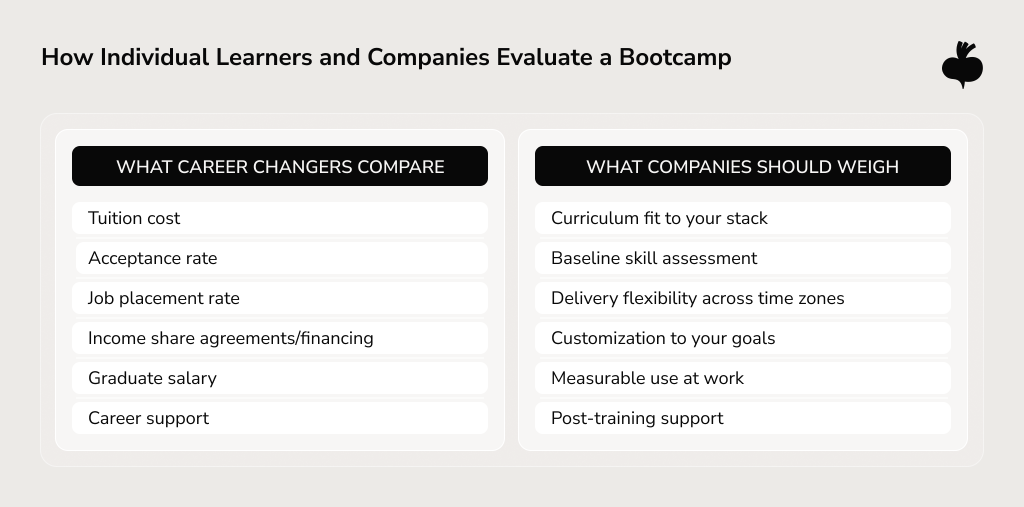
Open any list of the top coding bootcamps, and you’ll see the same comparison columns: cost, duration, format, coding bootcamp acceptance rate, job placement rate, and career support. Those criteria exist for an individual learner deciding whether a program is a smart personal choice.
For a company, some of those columns matter less, and others need to be interpreted differently. Your engineers already have jobs. A placement rate tells you nothing useful; what you need to know is whether a Python or full-stack engineer track will transfer to the codebase your team actually maintains. The criteria worth comparing instead:
- Curriculum fit — does the learning content map to your real technical stack and project context?
- Team readiness — can the program assess and group engineers by skill level so the pace fits everyone?
- Delivery flexibility — does it work for distributed, hybrid teams across time zones?
- Customization — can topics, pace, and examples be adapted to your business?
- Measurable outcomes — is there a way to see whether skills are being applied at work?
Corporate Training and Team Upskilling: When Bootcamp-Style Learning Makes Sense
Hiring is often slow and expensive when the capability you need is spread across a team. If your whole frontend group needs to adopt a new framework, or several teams need to use AI-assisted coding tools, recruiting specialists one by one takes months and leaves your existing engineers no better equipped. Bootcamp-style training fills that role differently: it lifts the people you already have toward a shared standard.
The data backs the shift in priorities. In LinkedIn’s 2025 Workplace Learning Report, 91% of L&D professionals said continuous learning is more important than ever for career success, and the report points to a widening gap in capabilities that are hard to replace through hiring alone. A real tension sits underneath that consensus: 49% of respondents say their executives are concerned that employees lack the right skills to execute business strategy.
Structured, well-scoped upskilling can reduce some hiring pressure, strengthen internal mobility, and help teams adopt new technologies more confidently when it reflects how the team really works. It offers a clear way to build internal capability, which is why upskilling modern tech teams has moved from a nice-to-have to a core part of how engineering leaders plan for change.
Bootcamp-style learning makes the most sense when:
- A capability gap is shared across several people rather than isolated to one role.
- You want consistency, with everyone working from the same patterns and standards.
- The skill is new enough that informal, self-paced learning would leave gaps or bad habits.
- You need a defined timeline and measurable progress.

Key Factors When Choosing the Best Coding Bootcamp for Your Team
When you compare coding bootcamps, enterprise training providers, and custom workshops, a few factors tend to matter more for teams than a program’s public ranking. The ones below are worth weighing against your own context.
Curriculum Relevance to Business Goals
A curriculum built for individual career changers covers what’s broadly employable: popular languages, common frameworks, and a portfolio project. For a team, the content should reflect your roadmap instead. If your engineers maintain a React frontend and you’re moving toward AI-assisted workflows, a generic “intro to web development” track wastes their time and your budget. Ask whether the provider will adapt examples and projects to your stack and challenges, and look for one that starts with a gap analysis. The question to anchor the decision: what will the team do differently at work after this?
Coding Bootcamp Acceptance Rate, Prerequisites, and Baseline Assessment
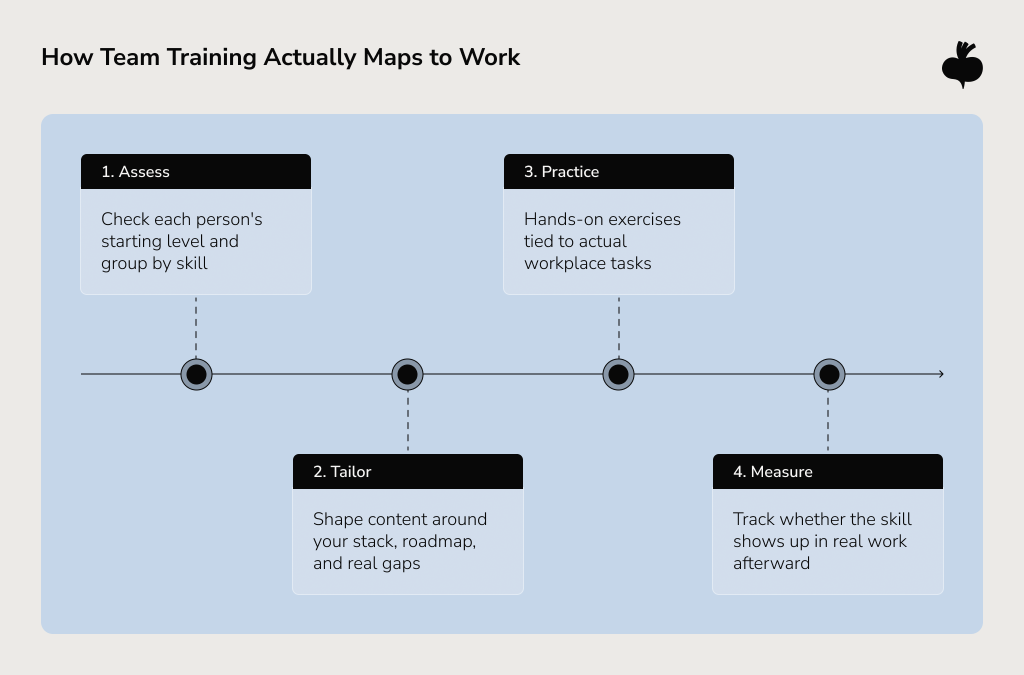
The coding bootcamp acceptance rate is among the most-searched bootcamp questions by prospective students, and it’s a real filter for individual applicants. However, for companies enrolling their own people, this metric is largely irrelevant — baseline assessment matters more. A mixed team of seniors and recent hires will likely struggle in a single, undifferentiated cohort. Therefore, the right program should evaluate each participant’s starting level and group them into tracks that match their individual learning pace.
Platform Flexibility for Global and Hybrid Teams
Hybrid and remote work are now the norm for engineering teams, which changes what good delivery means. A program that only runs live, in one time zone, excludes half of a distributed team. Look for a mix: live sessions for discussion and feedback, async materials people can work through around delivery commitments, and platform access that doesn’t depend on everyone being online at once. Scheduling is often what determines whether corporate training works: even strong content can fail when sessions are planned poorly or require people to participate outside reasonable working hours.
Hands-On Learning and Instructor Expertise
Skill comes from practice, not from watching lectures. The programs that transfer to real work are built around hands-on exercises tied to workplace tasks, with feedback from instructors who’ve done the job. An expert practitioner can connect a concept to a real decision your team will face — a tradeoff in a code review, a security consideration, a testing gap — with a specificity a recording can’t match. When you evaluate instructors, look past credentials to relevance: have they worked in contexts like yours, and can they give applied feedback on your team’s work?
Post-Bootcamp Support and Measurement
Training that ends with the last session rarely sticks. Ask every provider what happens after: follow-up materials, check-ins on whether skills are being applied, and a way for managers to give feedback on real work. This is also where you can track business impact by watching whether the new skill appears in the codebase, the review process, or implementation quality. L&D leaders are increasingly moving from activity metrics toward outcomes tied to revenue, retention, and productivity. If a provider can’t tell you how you’ll know it worked, that’s a meaningful gap.
How Much Do Coding Bootcamps Cost in 2026?
For individual learners, public bootcamp pricing gives a useful starting point. Course Report’s 2026 guide puts the average coding bootcamp tuition at roughly $14,142, with tuition ranging from $3,500 to $30,000. Bootcamps vary in length from 6 to 28 weeks, while the average program lasts around 14 weeks. Some programs also offer deferred tuition or income-share agreements (ISAs), where learners pay after landing a job.
For companies, those figures rather point to the market context than to a direct pricing benchmark. Custom team workshops and corporate bootcamps are scoped differently because the program must reflect the team, training goals, and the level of support needed before and after the sessions. Pricing usually depends on:
- Cohort size and how many teams are involved
- Training scope and depth, from a short workshop to a multi-week capability track
- Level of customization to your stack and goals
- Pre-training assessment and learner grouping
- Instructor seniority and time commitment
- Post-training support and measurement
That’s why a single “price per person” rarely captures what corporate training actually involves. When considering team upskilling, it’s better not only to ask how much the program costs, but also what specific capability the company wants to develop, how much customization the training requires, and how the team will apply the skills they gain in their future work. This perspective reflects the reality of commissioning training that targets specific skill gaps, rather than purchasing a standardized product.
Are Coding Bootcamps Worth It for Companies in 2026?
For a company, worth is measured in capability rather than salary uplift. On that measure, structured upskilling earns its place when it does a few things well: it reduces a specific skills gap, helps your team adopt new technology faster and more confidently, and produces work you can point to afterward. The labor-market backdrop supports the investment, with the U.S. Bureau of Labor Statistics projecting 15% job growth for software developers, quality assurance analysts, and testers through 2034, well above average, which keeps the skills you build internally valuable.
Bootcamp-style training won’t, on its own, guarantee productivity gains, retention, or hiring savings, and any provider promising those outcomes is overselling. Well-designed training can give teams a faster, more consistent path to a shared capability than informal learning usually provides, and a measurable one when you set it up to be measured.
Best Code Bootcamps vs Custom Corporate Training: Which Fits Your Team?
Companies usually get more value from comparing types of providers and matching them to their situation than from ranking the best code bootcamps against each other:
- B2C coding bootcamps are built for individual career changers. They can work for one person learning a new skill from scratch, but they are rarely designed around a team’s shared context or business goals.
- Enterprise training providers are useful when companies need structured programs at scale, especially across many teams or locations. The trade-off is that the curriculum may still be standardized.
- Custom corporate workshops are scoped to your stack, skill gaps, and roadmap, usually with built-in assessment, applied exercises, and adaptation. These fit teams that need training to map directly to real work.
- Internal academies suit large organizations that can sustain ongoing, in-house capability building. They can be durable, but the commitment is bigger: they require ownership, curriculum upkeep, facilitation, and management.
- LMS-enabled programs support scalable delivery and tracking, which are especially useful for distributed teams that need consistent access to learning materials and visibility into individual progress.
Most companies don’t need the highest-ranked B2C program. They need the provider type that matches how their team works and what they’re trying to change. A small, focused gap might be solved with a custom workshop. A workforce-wide transformation might call for a blended approach with a strong delivery infrastructure behind it.
How Beetroot Supports Practical Team Upskilling
At Beetroot, we approach team upskilling as practical capability-building. We deliver expert-led training through Beetroot Academy, covering areas such as GenAI for developers, green coding, accessibility, and cybersecurity. Where an off-the-shelf course doesn’t fit, our practitioners scope custom workshops around your team’s needs — by focusing on hands-on sessions and practical cases, and identifying gaps before training starts.
This training work is supported by the broader engineering and EdTech experience we bring to the table. We have worked on learning platform projects, including the Beetroot Academy LMS, which gave us practical insight into how technical learning is delivered, supported, and measured. Together with our wider EdTech solutions experience, this helps us design training with both software engineering reality and learning design in mind.
Responsible AI adoption is a clear example where this approach matters. As teams take on more AI-assisted work and begin maintaining AI-powered products, from a custom AI chatbot to larger systems, they need enough practical understanding to review outputs, manage security risks, and test what they ship. We treat AI as a skill that takes judgment, so we build code review, security, and testing into our training.

The Best Coding Bootcamp Is the One Your Team Can Apply at Work
A bootcamp is a useful way to build capability, but it isn’t the right move for every gap. Its value depends on the situation: how widely the skill is needed, how your team is set up, and whether people will use what they learn once the sessions end.
The clearest returns come from training that maps to real work: closing a shared skills gap, helping a team adopt new tools responsibly, and showing up afterward in the codebase or team confidence. This kind of training doesn’t replace hiring, and won’t fix everything on its own. Done well, it works best alongside your existing team, building shared capability where focused learning creates real value.
Tell us what skill gap your team is working through, and we’ll help you shape a training plan around your goals, your starting point, and the way your engineers actually work.
FAQs
What are the best coding bootcamps in 2026 for remote team upskilling?
The best coding bootcamps in 2026 for remote team upskilling are programs that combine flexible delivery with practical, role-relevant content. For distributed teams, the best fit is usually a custom corporate program or workshop that offers live sessions, asynchronous materials, and platform access across time zones, with curriculum tailored to the team’s actual technology stack. For companies, delivery flexibility and curriculum relevance matter more than a program’s public ranking or individual job-placement rate.
How much do coding bootcamps cost in 2026?
In 2026, the average cost of an individual coding bootcamp is roughly $14,000 for about 14 weeks, with tuition ranging from $3,500 to $30,000 depending on the specialization and format. Corporate and custom team training is priced differently. It is not comparable to individual tuition because the cost depends on cohort size, training scope, level of customization, instructor seniority, pre-training assessment, and post-training support.
How do enterprise programming bootcamps differ from standard B2C courses?
Enterprise programming bootcamps differ from standard B2C courses primarily in audience and design. B2C courses are built for individual career changers and focus on employability, tuition, and job placement. Enterprise programming bootcamps are built for existing teams and focus on closing specific skills gaps, aligning training with business goals, assessing participants by skill level, and measuring how new skills are applied at work.
How do corporate bootcamps train teams with mixed seniority levels?
Corporate bootcamps train teams with mixed seniority levels by assessing each participant’s baseline skills before training begins and grouping or streaming learners so the pace matches their level. This keeps senior engineers engaged and supports junior engineers, and it allows instructors to give relevant, applied feedback to each group rather than teaching a single undifferentiated cohort.
How are modern coding bootcamps training teams to use AI-assisted coding tools responsibly?
Modern coding bootcamps train teams to use AI-assisted coding tools responsibly by treating AI as a skill that requires judgment. Responsible AI-assisted coding training emphasizes code review, security awareness, testing, documentation, and clear team guidelines, enabling engineers to verify AI-generated output before deployment.
Subscribe to blog updates
Get the best new articles in your inbox. Get the lastest content first.
Recent articles from our magazine






Contact Us
Find out how we can help extend your tech team for sustainable growth.