
How AI Helps Reduce Your Carbon Footprint Without Increasing Costs
- June 5, 2026
- 10 min read
- AI/ML
- Sustainability

Contents
Contents
If you lead a mid-sized or large company in the EU, the pressure is already tangible. Regulatory frameworks like CSRD demand detailed emissions reporting, and a coalition of 640 investors managing $127 trillion in assets now expects environmental disclosure through CDP. The question is no longer whether your organization needs carbon footprint management software — it’s whether you can afford to keep doing it the expensive way.
Most companies still treat sustainability as a cost center: spreadsheets, consultants, manual data collection. But a growing body of evidence shows that AI-powered carbon footprint management software doesn’t add cost — it removes the inefficiency that made carbon management expensive in the first place. For organizations investing in data engineering infrastructure that feeds these sustainable AI solutions, this article lays out the business case stage by stage, with the data to support it.
You’ll find where the real costs hide in traditional carbon management, which AI applications generate net savings, and how to structure a rollout where the first phase pays for the next. If you’re already navigating sustainability as both an obligation and an opportunity, what follows is the practical playbook for making it cost-neutral.
Key Takeaways
- AI-powered carbon management typically pays for itself within 4–12 months by automating measurement and reporting tasks that consume $0.5–2M annually in manual effort.
- Negative-cost abatement measures — like AI-optimized HVAC and logistics routing — generate net savings before touching capital-intensive projects.
- A phased approach (Measure, Reduce, Report, Neutralize) lets organizations start small and scale based on proven ROI at each stage.
- Even with CSRD’s narrowed scope, investor pressure from $127 trillion in assets means most companies will need carbon reporting capability regardless.
- The AI used for carbon management doesn’t need to be expensive — task-specific models outperform general-purpose LLMs at a fraction of the cost and energy.
Why Carbon Management Still Feels Like a Cost Center
For most organizations, carbon accounting looks like this: hire consultants, pull data from dozens of disconnected systems, reconcile it in spreadsheets, and repeat every reporting cycle. According to Net0, this process typically costs $0.5–2M per year in consultant and labor costs alone.
That figure doesn’t account for the data quality problem. IEA’s 2024 analysis found that 62% of organizations reporting Scope 3 emissions — the supply chain emissions that often represent 70–90% of a company’s total footprint — cite data quality as their primary barrier. When the numbers can’t be trusted, teams spend more time verifying and less time acting.
The result is a familiar cycle: the cost of doing it right keeps climbing, the value stays abstract, and the business case gets harder to defend in budget reviews.
The reframe worth considering: the expensive part isn’t sustainability itself. It’s the manual, fragmented approach most companies take. AI doesn’t add a new cost — it targets the specific inefficiencies that drive carbon management spend. The measurement bottleneck, the data reconciliation, the multi-framework reporting — these are exactly the repetitive, data-intensive tasks where AI for environmental sustainability delivers measurable savings.
The sections that follow cover four concrete applications where AI reduces both emissions and costs simultaneously.
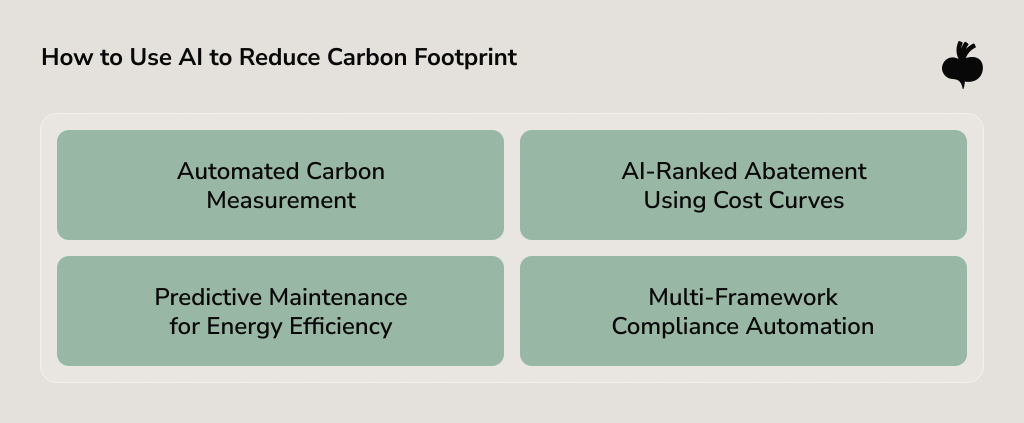
Four Ways to Use AI to Reduce Carbon Footprint While Cutting Costs
Each of the following AI applications has documented financial returns — measured across real deployments, not projected. Understanding the relationship between AI and carbon footprint at each stage is key to building a credible business case.
Automated Carbon Measurement
Manual carbon accounting is the single largest cost driver in most sustainability programs. AI eliminates the bulk of it.
Modern AI pipelines connect directly to existing systems — ERP platforms, IoT sensors, utility APIs, procurement databases — and pull emissions data automatically. No new hardware required. The AI normalizes data across sources, applies the correct emissions factors, and maintains a continuously updated carbon inventory.
The numbers from CO2 AI (a BCG spin-off focused on carbon management) illustrate the impact: companies using their platform reduce carbon footprint calculation time by 75% while capturing four times more emissions detail than manual methods. That’s not just faster — it’s more accurate, because the AI catches emissions sources that manual audits miss.
In dollar terms, Net0’s analysis shows AI removes 60–80% of traditional carbon accounting costs. For a company spending $1M annually on carbon measurement, that’s $600K–800K back in the budget — often more than enough to fund the carbon footprint management software and the next phase of the sustainability program.
For organizations evaluating platforms, the market now includes mature options built for enterprise-scale deployments: Watershed takes an API-first approach that integrates with existing systems, Sweep is designed specifically for EU companies navigating CSRD alignment, and CO2 AI brings BCG’s consulting pedigree to the AI-powered energy savings platform category.
AI-Ranked Abatement Using Cost Curves
Once emissions are measured accurately, the next question is: where to cut first? This is where most organizations rely on intuition — and where AI provides a structured alternative.
The approach uses Marginal Abatement Cost (MAC) curves: a ranking of every possible emissions reduction measure by cost-effectiveness. Some measures require capital investment (installing on-site renewables, for example). But many operational improvements — LED lighting retrofits, HVAC scheduling optimization, logistics route changes — have negative abatement costs. They save more money than they cost to implement.
AI automates this ranking by analyzing operational data, energy consumption patterns, and equipment performance to identify which reduction measures deliver the highest financial return per tonne of CO2 eliminated. Instead of funding capital-intensive projects first, you act on the savings opportunities that pay for themselves.
The evidence is concrete. Google DeepMind applied reinforcement learning to data center HVAC systems and achieved a 40% reduction in cooling energy consumption — a significant cut in both the energy bill and the associated carbon emissions, with no new infrastructure required.
For your organization, this means the AI surfaces the reductions that generate net savings first, building budget headroom for the capital projects that come later. If you’re evaluating how to reduce AI carbon footprint alongside operational emissions, MAC curve analysis covers both.
Predictive Maintenance for Energy Efficiency
This is one of the lowest-risk AI investments available, and it directly reduces both costs and carbon emissions.
Equipment running suboptimally — a compressor with worn bearings, a boiler with scale buildup, an HVAC unit with a failing valve — consumes measurably more energy than properly maintained equipment. U.S. Department of Energy estimates put this waste in the range of 5–20%, and it compounds across every piece of equipment in a facility portfolio.
AI-driven predictive maintenance uses sensor data to detect performance degradation before it causes failure. Instead of running equipment until it breaks or servicing it on a fixed schedule regardless of condition, predictive models flag exactly when and where intervention will have the greatest impact.
The ROI data is among the strongest for any AI application. OxMaint’s 2024–2025 industry analysis found that 95% of adopters report positive ROI, with payback periods of 6–14 months. Energy savings from maintenance optimization alone average roughly 12%.
If your organization already uses predictive analytics for demand or financial forecasting, applying the same approach to equipment health and energy consumption is a natural extension — one that cuts energy costs and Scope 1 and 2 emissions simultaneously. It’s a clear example of how organizations can reduce carbon footprint through AI that’s already part of standard operational workflows.
Multi-Framework Compliance Automation
Regulatory reporting is where sustainability costs quietly compound. CSRD requires one set of disclosures. CDP requests another. TCFD and GHG Protocol each have their own data structures and reporting formats. Maintaining separate workflows for each framework — each with its own consultants, timelines, and review cycles — is expensive and error-prone.
AI collapses this into a single data model. A well-designed compliance platform ingests emissions data once, then auto-maps it to the required format for each framework. One data pipeline, multiple outputs. When regulations change — as they regularly do — the AI updates the mappings rather than requiring the team to rework reports manually.
EcoRatings’ 2025 analysis quantifies the savings: AI agents cut ESG reporting costs by 60–85%, saving more than 500 analyst hours per year. The ROI payback comes in 4–12 months, compared to the 18–24 month average for manual reporting implementations.
This matters especially in the current regulatory environment. The EU’s Omnibus I package (February 2026) narrowed CSRD’s scope from roughly 50,000 companies to about 5,000 — raising the threshold to 1,000+ employees and €450M+ turnover. But narrowed scope doesn’t mean reduced urgency. CDP’s coalition of 640 investors with $127 trillion in assets continues to expand its disclosure requirements, and supply chain pressure flows downstream regardless of whether your company falls under CSRD directly.
For companies that need reporting capability — whether by regulation or by investor expectation — AI makes the process affordable. For EU-based organizations evaluating AI partners, look for GDPR-compliant processes and ISO 27001 certification as baseline trust signals.
How to Start With Carbon Footprint Management Software
The biggest misconception about AI-powered carbon management is that it requires a large upfront investment. It doesn’t — if the rollout is structured correctly.
The phased approach: Measure, Reduce, Report, Neutralize
Each stage generates enough value to fund the next:
- Measure first. Automate carbon data collection. This stage alone eliminates significant annual consulting and labor costs — Net0 estimates $0.3–1.6M depending on current spend. Start with Scope 1 and 2 data from your own operations — the data is readily accessible, and the accuracy gains are immediate.
- Reduce second. Use AI-ranked abatement analysis to identify negative-cost reduction measures — the changes that save money while cutting emissions. Act on those first. The savings build the business case for larger investments.
- Report third. Once the data pipeline is automated and reduction efforts are tracked, compliance reporting becomes a downstream output rather than a standalone project. Multi-framework automation cuts reporting costs by 60–85%.
- Neutralize last. Carbon credit procurement and offset strategy come after operational reductions are exhausted. AI helps verify credit quality and optimize procurement — but this stage only makes sense once the earlier stages have proven their ROI.
Start with a proof of concept
A proof of concept focused on the highest-ROI opportunity — usually measurement automation or predictive maintenance — is the fastest path to executive buy-in. Run it within a single business unit or facility, measure the cost savings against a defined baseline, and use the results to secure funding for a broader rollout. Once the PoC demonstrates measurable savings, scale to a cross-functional deployment covering all operational sites.
The enterprise carbon management market now includes platforms designed for phased deployment: Watershed integrates with existing ERP and finance systems, Sweep handles CSRD alignment for EU organizations, and SAP’s Sustainability Control Tower embeds carbon tracking directly into enterprise resource planning workflows. When evaluating GreenTech software solutions in this space, integration depth with existing systems should be a primary selection criterion.
Right-size the AI
The carbon management applications described here don’t require large language models or massive compute infrastructure. Task-specific models — trained for emissions calculation, anomaly detection, or report generation — outperform general-purpose AI at a fraction of the cost and energy consumption.
Research from MIT’s Clover project demonstrated up to 90% reduction in the carbon intensity of AI operations through careful model selection. Choosing an appropriately sized model for each task isn’t just cost-effective — it’s better practice, both financially and environmentally. The latest AI energy consumption data confirms that task-specific models use orders of magnitude less power than frontier LLMs.
The practical implication: clean data pipelines feeding well-scoped models will outperform an expensive general-purpose system working with messy inputs.
What About AI Energy Consumption and Carbon Footprint?
AI systems consume electricity, and large-scale AI training has drawn justified scrutiny for its energy demands. If you’re deploying AI to reduce carbon emissions, the AI’s own footprint needs to be part of the equation.
The current picture: AI accounts for approximately 0.04% of global electricity consumption, according to Carbon Direct’s analysis. That’s a modest share — but the growth trajectory is steep, with AI energy consumption growing 30–50% annually.
The critical distinction is between the AI making headlines and the AI discussed in this article. The energy-intensive systems driving those growth projections are large-scale training runs for general-purpose models with hundreds of billions of parameters. Carbon management AI uses small, task-specific models — emissions calculators, anomaly detection for equipment maintenance, report generation tools. These consume a fraction of the energy.
MIT’s Clover research quantified the difference: up to 90% reduction in AI operational carbon intensity is achievable through model selection alone. Choosing the right-sized model for each carbon management task — rather than defaulting to the largest available — is both cheaper and greener.
For organizations that need to account for AI’s own emissions alongside its reduction benefits, the IEEE P7100 standard provides a methodology for measuring the environmental impact of AI systems.
The net calculation is straightforward: the emissions reduced by AI carbon management — through measurement automation, operational efficiency, and compliance streamlining — vastly outweigh the operational footprint of the task-specific models doing the work.
The Business Case Is Already Clear
The evidence across measurement, abatement, maintenance, and compliance points to the same conclusion: AI-powered carbon management doesn’t require a trade-off between sustainability and budget. Measurement automation alone recovers $0.3–1.6M in annual costs. Negative-cost abatement measures generate net savings. Multi-framework compliance automation cuts reporting costs by 60–85%. And a phased approach lets each stage fund the next.
The question facing sustainability leaders isn’t whether they can afford carbon footprint management software powered by AI. Given the regulatory trajectory — CSRD obligations, CDP investor pressure, and supply chain disclosure requirements across the EU — the question is whether they can afford to keep doing it manually.
Starting doesn’t require a massive transformation program. It requires a proof of concept focused on the highest-ROI opportunity, a partner who understands both the technology and the regulatory landscape, and a phased plan that proves value before scaling. At Beetroot, we help EU organizations build and deploy AI solutions for carbon management — from data pipeline architecture to CSRD-aligned reporting — with GDPR-compliant processes and locally hosted model options. Contact us to explore how a cost-neutral carbon management approach could work for your organization.
FAQs
What’s the ROI timeline for AI carbon management?
Most organizations see payback within 4–12 months, primarily through measurement automation and reporting cost reduction — a significant improvement over the 18–24 month average for manual carbon accounting implementations. The fastest returns come from eliminating consultant hours spent on data collection and reconciliation.
How do mid-to-large organizations get started with AI carbon management?
A proof of concept within a single business unit or facility is the most effective starting point. Focus on the highest-ROI opportunity — usually measurement automation or predictive maintenance — and run it against a defined cost baseline. The phased approach (Measure, Reduce, Report, Neutralize) is designed so each stage generates enough savings to fund the next. Enterprise platforms like Watershed, Sweep, and SAP’s Sustainability Control Tower offer integration paths that connect with existing systems rather than requiring parallel infrastructure.
Does AI carbon management work for Scope 3 emissions?
It does, and this is where AI provides the most relative value. Scope 3 emissions — the supply chain footprint — are the most data-intensive to measure and the hardest to verify. IEA found that 62% of organizations cite Scope 3 data quality as their primary barrier. AI automates supplier data extraction, fills gaps using activity-based and spend-based estimation models, and continuously updates calculations as new data arrives. Manual methods can’t match this at any reasonable cost.
How does CSRD affect the urgency for AI carbon management?
The EU’s Omnibus I package narrowed CSRD’s scope significantly, raising thresholds to 1,000+ employees and €450M+ turnover. But regulatory obligation is only one driver. CDP’s coalition of 640 investors managing $127 trillion in assets continues to expand disclosure expectations, and supply chain requirements mean your customers may demand emissions data regardless of your company’s CSRD status. AI makes building this capability affordable — a strategic asset rather than a compliance cost.
Is the AI used for carbon management energy-intensive?
No. Carbon management AI relies on small, task-specific models — not the large language models driving headlines about AI energy consumption. MIT’s Clover research showed that choosing appropriately sized models can reduce AI operational carbon intensity by up to 90%. The emissions these systems help avoid through measurement automation, operational efficiency, and compliance streamlining far outweigh the modest energy the models themselves consume. The IEEE P7100 standard provides a methodology for tracking this balance formally.
Subscribe to blog updates
Get the best new articles in your inbox. Get the lastest content first.
Recent articles from our magazine






Contact Us
Find out how we can help extend your tech team for sustainable growth.