


Contents
Contents
Getting an AI prototype to respond in a notebook is the easy part. Operating it as an application your team can deploy, monitor, secure, and pay for month after month is where most of the real engineering lives. The gap between those two states usually comes down to the AI infrastructure stack around the model, and whether it was designed for a specific workload or assembled from a checklist.
This guide looks at cloud infrastructure for AI applications as a delivery problem. A smaller stack that your team can operate and support reliably is usually easier to run in production than a larger one assembled to cover every option in advance.
What Makes a Cloud Stack Delivery-Ready for AI Applications?
A delivery-ready stack gives you a repeatable, observable, secure, and cost-controlled path from development into production. Whether a stack qualifies comes down to what it can do, and a long list of components does not make it any more ready.
Delivery-ready is a working term we use in this guide rather than a formal certification you can apply for. In the projects we work on, delivery readiness usually comes down to reproducible environments, automated testing and deployment, versioning across relevant assets, controlled promotion between environments, rollback or fallback mechanisms, production observability, appropriate scaling, security controls, cost visibility, and clear operational ownership.
The Difference Between AI-Ready and Delivery-Ready
AI-ready infrastructure is general technical capacity to experiment with or support AI workloads. Delivery-ready infrastructure is a repeatable, observable, and secure route for moving a particular application into production and running it over time.
The distinction matters because teams often over-invest in the first and under-invest in the second. A GPU quota and a managed notebook environment make experimentation possible. They say little about how a model reaches users, how you catch a quality regression, or who is paged at 2 a.m. when an inference endpoint starts timing out.
The Model Is Just One Part of the System
The model is one dependency among many. Application services, data pipelines, integrations, access controls, monitoring, and operational ownership all decide whether the overall system can be delivered reliably.
A team using a third-party foundation model API may need almost no model-training ML infrastructure, yet still needs substantial application, retrieval, security, and observability infrastructure. Working backward from the application is what keeps the stack honest.
Design the AI Infrastructure Stack Around the Workload
Architecture choices should follow the workload’s behavior: its latency and throughput needs, data sensitivity, update frequency, availability targets, and the capacity of the team meant to operate it. Start there. A cloud provider’s service catalogue comes at the end of that reasoning, once you know what the workload actually asks for.
Training, Batch, and Real-Time Inference Are Different Problems
Training, batch inference, and real-time inference are three different infrastructure problems, and treating them as one is a common source of over-engineering. Each carries its own compute, scheduling, scaling, data, and reliability profile.
- Training workloads are often bursty and schedulable. Many use queuing or interruptible capacity when checkpointing, deadlines, and recovery requirements allow it.
- Batch inference usually prioritizes throughput over response time. It can run on a schedule and scale down between jobs.
- Real-time inference is latency-sensitive and always-on. Strict latency targets may require warm capacity and concurrency controls, while more tolerant workloads can use serverless or scale-to-zero patterns.
Google Cloud’s MLOps architecture guidance treats continuous integration, continuous delivery, and continuous training as distinct parts of ML delivery because code, data, and model changes can follow different cycles, and retraining a model is a different operation from serving predictions.
Cloud Options for AI Inference
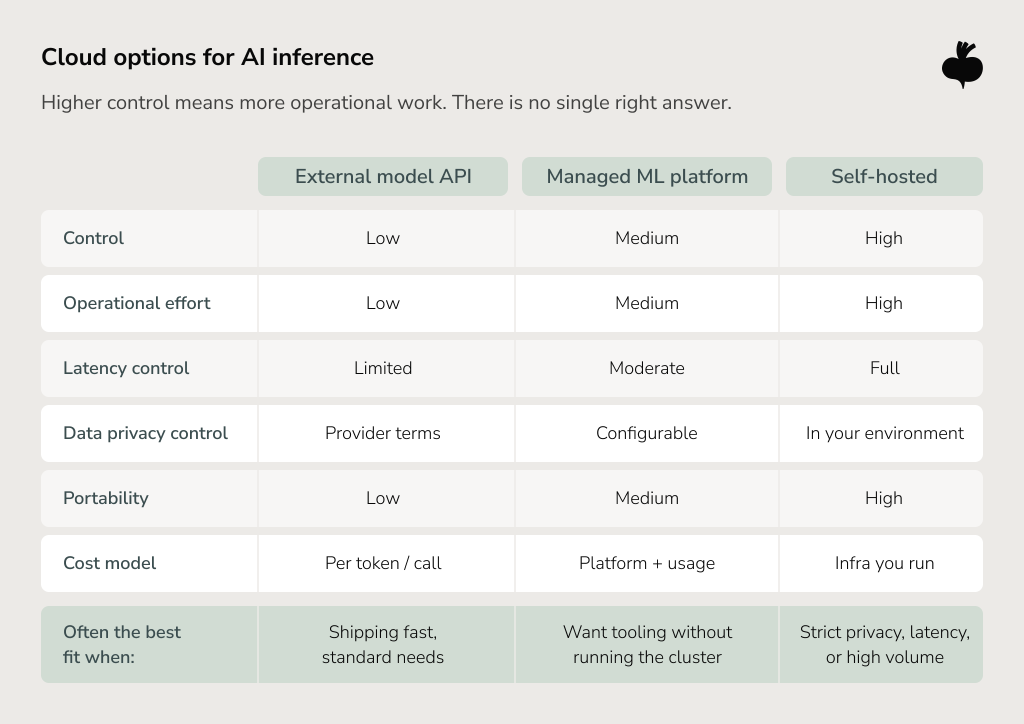
The main cloud options for AI inference are external model APIs, managed ML platforms, and self-hosted models. They trade off control, operational effort, latency, privacy, portability, and cost in predictable ways.
- External model APIs reduce the infrastructure a team needs to operate and can accelerate initial delivery. The trade-offs include dependence on providers, token-based pricing, and less control over latency and data-governance terms.
- Managed ML platforms provide more deployment and configuration control than an external model API without requiring the team to operate the underlying cluster. Trade-offs may include platform-specific workflows, service constraints, and some lock-in (less portability).
- Self-hosted models on your own GPU or CPU capacity give your organization the most control over the model infrastructure, runtime, privacy, and performance configuration. They also transfer responsibility for provisioning, scaling, patching, monitoring, and capacity planning to the team.
For many applications, cloud computing for AI through a managed API is a sensible first option. Self-hosting earns its keep when model or runtime customization, strict deployment isolation, predictable high utilization, or data-locality requirements outweigh the added operational burden of running your own GPU cloud infrastructure. The choice should be based on the full cost and control model rather than data sensitivity or request volume alone.
Don’t Add Complexity You Don’t Need
A complex stack is not a sign of maturity. GPUs, Kubernetes, microservices, and vector databases each solve real problems, and each adds operational load that a smaller team may struggle to carry.
GPUs may be required for training or certain self-hosted inference, though many applications run well on external APIs, managed endpoints, CPUs, or smaller optimized models. Kubernetes is an operational choice that earns its keep on some teams and adds overhead on others; it is no guarantee of production-readiness on its own. A vector database helps certain retrieval patterns and is not a mandatory layer. The term cloud-native AI is most useful when it points to appropriate cloud capabilities such as managed services, automation, elastic resources, and infrastructure as code. Read as shorthand for running on Kubernetes, it loses that meaning.
The Four Layers of Cloud Infrastructure for AI Applications
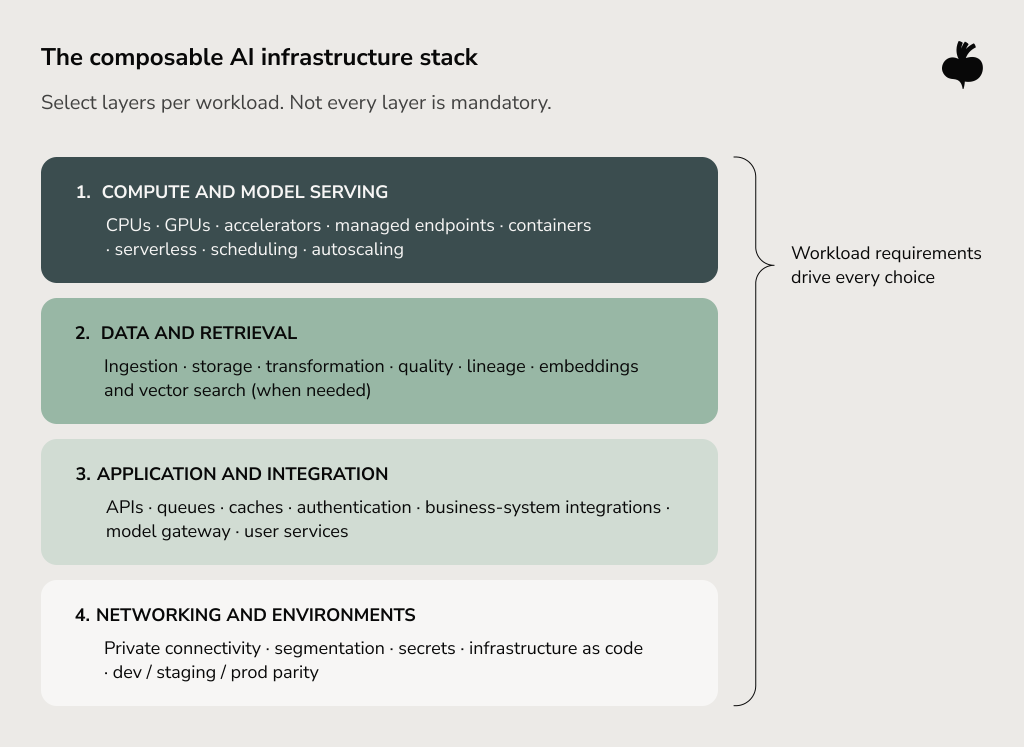
It helps to see the stack as a set of composable layers you select per workload, in place of a fixed reference architecture you implement wholesale. Four layers cover most applications: compute and serving, data and retrieval, application and integration, and networking and environments.
Compute and Model Serving
The compute layer covers where the model runs and how requests reach it: CPUs, GPUs, and accelerators; managed endpoints, containers, or serverless functions; plus scheduling and autoscaling. No single deployment model fits every case.
Batch and asynchronous work suits queued jobs and scale-to-zero compute. Low-latency inference needs warm instances and careful concurrency limits. The AWS Well-Architected Machine Learning Lens frames these as performance and cost-efficiency decisions to make deliberately per workload.
Data and Retrieval Infrastructure
The data layer covers ingestion, storage, transformation, quality controls, and, where relevant, retrieval. It shapes both AI behavior and application reliability, which is why data lineage and versioning belong here from the start.
Retrieval-augmented generation, or RAG, is a pattern that supplies a model with relevant context at query time, giving it access to organization-specific or current information as it generates an answer. RAG infrastructure often includes an embedding pipeline and a vector database for semantic search, though not always. A conventional search engine, hybrid search, or a small structured knowledge source can be enough. Reliable data engineering for AI applications under the retrieval layer usually matters more than the specific database category.
Application and Integration Layer
This layer connects the model to an actual workflow: APIs, queues, caches, authentication, business-system integrations, and user-facing services. It is where an AI feature becomes part of a product.
A model gateway sits here too, giving you one place to route requests, enforce rate limits, log usage, and swap models without rewriting the application. Much of this layer is conventional software engineering, which is a large part of why not every AI application needs exotic infrastructure to reach production.
Networking and Environments
The networking layer covers private connectivity, segmentation, and secrets management, alongside the environment discipline that keeps development, staging, and production consistent.
Infrastructure as code and controlled configuration help keep environments consistent without relying on manual setup. Staging should reproduce the production behavior relevant to the tests being run, while known differences in scale, data, permissions, and external dependencies are documented. A staging environment that has drifted leaves you debugging in front of users.
MLOps and CI/CD: A Repeatable Path to Production
MLOps connects experimentation with controlled testing, deployment, monitoring, and, where applicable, retraining. Its practices help turn a working model into a system you can change more safely and often.
The core principles carry over from DevOps, though the assets differ. Google Cloud’s MLOps maturity guidance describes a progression from manual workflows toward automated pipelines with CI/CD for machine learning and continuous training, so new model versions move through a controlled path. Teams that need implementation support can rely on our MLOps services for production AI to build deployment, monitoring, and model-lifecycle workflows around their application.
Version More Than Application Code
In production AI, application code is only one of the things worth versioning. Traceability across models, data, prompts, configurations, retrieval indexes, and evaluation datasets is what lets you reproduce a result or roll back a regression.
This is where predictive ML and generative AI diverge. A generative application may need to version and evaluate prompts, model configurations, retrieval logic, embeddings, indexes, guardrails, and evaluation datasets. Treating an LLM application as identical to a classic training pipeline misses most of what actually changes between releases.
Test for More Than Broken Code
Testing for AI extends beyond unit tests on code. A production pipeline typically adds data and schema checks, model evaluation, integration and latency tests, and security checks, and release criteria are matched to the application’s risk.
For lower-risk use cases, where errors have limited impact and are easier to reverse, a small evaluation set and targeted manual review may be enough. Higher-risk applications (for example, in regulated industries) may require automated evaluation against a curated dataset, latency budgets enforced in the pipeline, quality thresholds, and clear release criteria before promotion.
Monitor the System and the Model
Monitoring has to cover two things at once: the service and the model behavior. Infrastructure metrics confirm the system is up, but they say nothing about whether the model is still producing good answers, which needs its own signals.
Alongside latency, error rates, and utilization, useful signals may include output or model quality, input and data drift, retrieval performance, token usage, and cost per inference. AI observability that ignores model behavior will happily report green while answer quality quietly degrades.
Scaling, Reliability, and Cost Are One Decision
Scaling, reliability, and cost move together. A choice that improves response time usually changes availability and unit cost as well, so it helps to design them as one system.
Match Scaling to the Demand Pattern
Scaling should follow the demand pattern. A generic autoscaling default rarely matches how AI workloads actually receive traffic, and different patterns call for different tools.
- Spiky, delay-tolerant demand often suits queued batch processing and scale-to-zero compute.
- Steady interactive traffic may benefit from horizontal autoscaling with warm capacity and concurrency controls.
- Repeated or near-identical requests can be good candidates for caching, and rate limiting on shared endpoints helps control costs and stability.
Plan for Failure and Degraded Operation
AI components fail differently from conventional software services. They can degrade silently, return a confident answer that is wrong, or drift as input data shifts, which makes degraded operation something to design for from the start. External providers also have outages, and model endpoints can time out or slow down under load.
Timeouts, bounded retries with backoff, rollback, fallbacks to a simpler model or cached response (where safe or approved), or a non-AI workflow can keep an application usable when the AI component is unavailable. NIST’s Generative AI Profile recommends testing and managing rollover and fallback mechanisms, which may include manual processing, as part of managing generative AI risk.
Measure Cost Per Request to See If It Scales
Total spend still matters, but unit economics shows how costs scale with usage and how they compare to the value an application delivers. Tracking cost per request, prediction, workflow, or business outcome tells you whether an application remains economically viable over time.
The FinOps Foundation now treats AI as a distinct cost domain with its own unpredictability and governance needs. Its State of FinOps 2026 research reports that 98% of surveyed practitioners now manage AI spend, up from 63% a year earlier. Pairing cost per inference with GPU utilization, storage, data transfer, and model API consumption gives a picture you can act on. If cost visibility is the bottleneck, balancing cloud performance and cost is usually a better early investment than more compute.
Build Cloud Security for AI Applications Into the Delivery Path
Security works best when it is part of the delivery path and applied as work progresses. Cloud security for AI applications spans identity and least-privilege access, encryption, secrets management, network controls, data provenance, logging, and policy checks across the AI lifecycle.
What those controls need to be depends on the application, the industry, the categories of data involved, the deployment geography, the cloud services chosen, and the organization’s own policies. No generic checklist makes an AI application compliant. A framework like NIST’s Generative AI Profile is useful because it maps risks such as data leakage, prompt injection, and provenance gaps to concrete actions you can build into the pipeline, and the AWS Well-Architected Generative AI Lens does the same for cloud-specific controls. Treat both as inputs for a workload-specific risk assessment and threat model for your use case.
What to Build, What to Buy, and What to Delegate
The useful question works one component at a time: how much does this piece differentiate the product, how much control do you need, and can your team operate it over the long term?
Owning a component makes sense when it is a genuine differentiator or when governance requirements demand it. Where a component is not a differentiator, a managed service can cut operational work, as long as you are comfortable with the trade-offs it introduces in cost, control, portability, and governance.
Keep Ownership of the Decisions That Define Your Product
Whatever you delegate operationally, product and risk ownership should remain in-house. The organization should retain accountability for business requirements, risk tolerance, data governance, and success criteria. Architecture and implementation can sit with a development partner within a defined project scope, provided the scope and decision boundaries are agreed upfront.
Outsourcing implementation is reasonable. Handing over the judgment about what the system must do and which risks are acceptable is a different matter, because those decisions define the product itself.
Where a Partner Can Help
External expertise tends to help most on well-scoped technical work: cloud architecture, data infrastructure, model deployment, MLOps, security implementation, optimization, or a defined delivery workstream with clear boundaries.
This is where we step in. We work as a custom AI, cloud, data, software, and MLOps development partner. That can mean designing cloud infrastructure, building the data pipelines and integrations around a model, creating MLOps and deployment workflows, or adding cloud, data, DevOps, or ML expertise to an existing team. If cloud architecture and platform planning is the open question, our cloud consulting and implementation support can help you choose a setup you can actually run, while you keep ownership of the product.
Getting Started: A Delivery-Readiness Checklist
Before moving an AI application into production, it helps to run through a short set of readiness questions. Each maps to a decision covered above.
- Workload: Is this training, batch, or real-time inference, and does the compute match?
- Model access: API, managed platform, or self-hosted, and why?
- Data: Are ingestion, quality, lineage, and any retrieval reliable and versioned?
- Deployment: Are environments reproducible and promotion automated through CI/CD?
- Observability: Do you monitor model quality and drift, not just infrastructure health?
- Scaling: Does the scaling approach fit the demand pattern?
- Failure handling: Are timeouts, retries, fallbacks, and rollbacks in place?
- Security: Are access, secrets, encryption, and logging built into the pipeline to meet your data and compliance requirements?
- Cost: Do you track unit economics, and who owns the budget?
- Ownership: Is it clear who operates each component in production?
The Strongest AI Stack Is the One Your Team Can Operate
The most capable cloud infrastructure for AI applications is rarely the most elaborate one. It is the architecture your team can deploy, observe, secure, finance, and evolve as the application matures, sized to the workload it serves.
Work backward from the workload, add complexity only where it earns its place, and keep ownership of the decisions that define your product. If you’re deciding how much infrastructure to build versus buy for a specific AI application, let’s talk.
FAQs
What makes cloud infrastructure delivery-ready for AI applications?
Cloud infrastructure is delivery-ready for AI applications when it provides a repeatable, observable, secure, and cost-controlled path from development into production. Delivery-ready infrastructure is defined by capabilities such as reproducible environments, automated deployment, versioning, monitoring, rollback, and clear operational ownership, rather than by the size of the stack.
Why do traditional cloud architectures need to be adapted for generative AI and LLM applications?
Traditional cloud architectures were designed for deterministic software, whereas generative AI and LLM applications operate probabilistically and can exhibit varying latency, cost, and output quality. Adapting these architectures means adding model and prompt versioning, output evaluation, drift and quality monitoring, and fallbacks for when a model or external provider is unavailable.
How do you scale cloud resources for AI applications without losing cost control?
You scale cloud resources for AI applications by matching the scaling method to the demand pattern and tracking unit economics as you grow. Queued batch processing, autoscaling with warm capacity, caching, and rate limiting each fit different workloads, while measuring cost per request or per inference keeps spend tied to usage.
When does an AI application need a vector database?
An AI application needs a vector database when it relies on semantic retrieval over unstructured data, typically in a retrieval-augmented generation pattern. A vector database is not required when the application uses no retrieval, works with structured queries, can use a conventional or hybrid search engine, or draws on a small and simple knowledge source.
How should you choose between AWS, Azure, and Google Cloud for an AI application?
You should choose among AWS, Azure, and Google Cloud for an AI application based on your workload requirements, existing environment, data governance needs, and the managed services you plan to rely on. Beetroot approaches this as a workload-first decision and designs cloud infrastructure around the application’s actual latency, data, and operational needs before settling on a provider.
Subscribe to blog updates
Get the best new articles in your inbox. Get the lastest content first.
Recent articles from our magazine





Contact Us
Find out how we can help extend your tech team for sustainable growth.