
Contents
Contents
Most HR leaders evaluating AI have moved past the question of which tool to buy. The live question is which parts of their operation would improve if a system handled them, and which parts should stay exactly where they are. An assistant that answers a benefits question and a system that ranks candidates belong to different risk categories and fail in different ways.
Much of the real work in HR automation happens before any technology is selected. Teams decide what a workflow should produce, which systems it can reach, and where a person signs off. The goal is custom AI development shaped around an HR process that someone has already mapped end to end.
In this article, we look at seven HR workflows where automation can cut repetitive work, each with the technology that fits it and the point where the human decision boundary belongs.
AI in HR Starts With Workflow Friction
The most useful starting point for AI in HR is a workflow that already causes visible friction. Repetitive rekeying between the HRIS and payroll counts, and so does onboarding that stalls because one form is missing. These are measurable problems with owners attached to them and a baseline you can measure against later.
Deloitte’s 2026 Global Human Capital Trends survey, run with Oxford Economics across more than 9,000 business and HR leaders in 89 countries, found that seven in ten leaders name speed and adaptability as their primary competitive strategy for the next three years. Deloitte also cites separate research with 100 C-suite leaders in which 59% took a technology-first approach to AI, and those organizations were 1.6 times more likely to miss the returns they expected.
The important constraint: AI cannot repair a process that is broken for non-technical reasons. Automating an approval chain nobody can justify mostly makes the existing problem arrive faster. Map the workflow first, then decide whether it needs AI at all.
Use the Least Complex Technology That Solves the Problem
HR automation spans several distinct technologies, and treating them as a single category is a common source of overspend. A workable rule for HR process optimization is to pick the simplest option that handles the work reliably, then move up a tier only when the workflow demands it:
- Rules and API integrations. Deterministic steps such as moving approved employee records between the HRIS and payroll, or triggering a task list on a confirmed start date.
- Robotic process automation. Repetitive, stable actions across systems with no usable API, where screens and fields rarely change.
- Generative AI. Language-heavy work: policy retrieval, document summarization, drafting standard communications, and preparing case summaries.
- Predictive analytics. Aggregate patterns such as hiring capacity and headcount scenarios in workforce planning, including gaps in your skills data.
- Agentic AI. Multi-step workflows that cross several systems and have to handle follow-up and exceptions inside defined permissions.
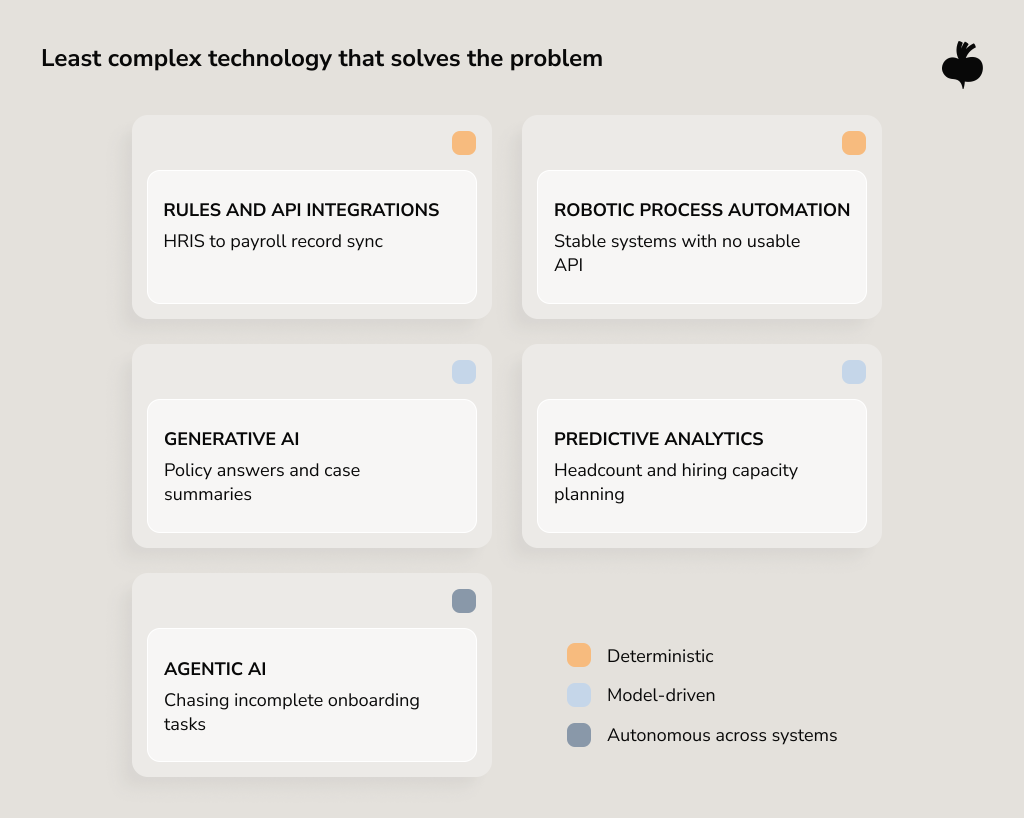
Treat autonomy as a design choice tied to the workflow. A nightly file transfer between two systems does not need an agent, and describing it as one makes the system harder to govern.
Most HR operations end up running two or three tiers side by side in the same process, with stable steps on rules or robotic process automation and the language-heavy parts on AI. Deciding that split early keeps the eventual system explainable.
Decide What Must Stay Human Before Automating
Before automating anything, separate the administrative work around an employment decision from the decision itself. Organizing applications and scheduling interviews are administrative. Deciding who advances belongs to the decision itself.
Regulation draws a similar line. The European Commission maintains guidance on high-risk classification under the EU AI Act. Employment and worker management is one of the eight Annex III areas covered, spanning recruitment and selection as well as promotion, termination, and performance monitoring. Because implementation timelines in this area can shift (as they already did), it is best to verify current compliance dates directly against the official text as you build out your roadmap.
Adding a human reviewer does not by itself take a system out of the high-risk category. Classification depends on the system’s intended role, whether it materially influences the outcome, and which verification step comes before anyone acts on its input. Work through those points for each workflow before you design the review step around it.
7 HR Workflows Worth Improving With AI and Automation
The AI in HR examples below are recognizable in medium and large HR operations, and they differ in weight. Some justify a serious build, and some come down to an integration.
1. Employee Self-Service and HR Policy Questions
High-volume routine policy questions can be the lowest-risk place to start with generative AI in HR. A grounded assistant can retrieve approved policy text, then route the case to HR when the answer depends on individual circumstances.
The fit here is retrieval-based generative AI development connected to an approved HR knowledge base. Retrieval grounds answers in your own documents, which reduces fabricated details without removing the need for review. When citations and retrieval logging are built into the system, responses can also be linked back to approved source documents.
Exceptions and individual interpretation stay with HR, and the measure that matters is the share of routine queries resolved without a ticket. We saw a comparable pattern outside HR on an AI marketing copilot that reduced ad-hoc requests to the data team by 60%, largely by making governed data easier for non-specialists to reach.
2. AI in HR Recruitment: Coordination Before Selection
Coordination absorbs most of the time lost in recruitment. AI in HR recruitment is on the safest ground when it supports requisition drafting, organizes incoming applications, handles scheduling, and prepares structured summaries for recruiters.
Much talent acquisition technology already handles pieces of this, and generative AI with workflow automation and ATS integration covers the rest. On our own presales workflow automation tool, a Django and React platform built on the Claude API, automating the end-to-end workflow cut turnaround time by roughly 65% and fully eliminated manual CV reformatting for the recruitment team.
Selection and rejection stay under accountable human review, and that boundary is the one regulators watch most closely. Track scheduling turnaround and the recruiter hours that go back into candidate conversations.
3. Automated Onboarding Across HR Systems
Onboarding rarely fails on a single step. It fails in the gaps between HRIS, IT provisioning, payroll, and the hiring manager.
APIs and RPA handle the predictable parts of automated onboarding, such as creating records and triggering task lists on schedule. Agentic AI in HR earns its place at the next layer, where the workflow has to check what is still outstanding and prepare an exception for a human to resolve. A genuine multi-step workflow across several systems is the test for whether an agentic build is the right answer.
Onboarding steps differ in how easily they can be undone. Creating a task list is simple to reverse, while account permissions, payroll setup, contractual records, and benefits enrollment need tighter controls and a named approver. Measure incomplete task rates at day one and manual transfers removed.
4. HR Document and Case Management
HR runs on documents, and much of the effort goes into finding and summarizing them. Document AI can classify incoming files, extract structured fields, flag missing records, and summarize case history.
Intelligent document processing with generative AI and workflow routing fits this well, provided the output does not become the authoritative record. Extracted values still reconcile against the system of record; anything that changes an employment condition stays with a named owner, and case resolution time is the measure to watch.
5. Payroll and Benefits Exception Handling
Core payroll calculations and eligibility rules are the one place where generative AI should not become the authoritative decision layer. Those rules are deterministic and better kept that way, in systems where the same inputs produce the same result and the logic can be checked line by line.
The exceptions around payroll work differently. Employee questions, unusual cases, document handling, and anomaly triage are language-heavy and high-volume, which suits generative AI and workflow routing. Anomaly detection surfaces a signal, and a flagged discrepancy still needs a person to investigate before any correction reaches someone’s pay.
Keep the calculation rules-based and put the AI around it, then track exception handling time and first-contact resolution.
6. Performance-Cycle Preparation Under Human Ownership
Performance cycles generate a lot of administrative work: chasing goals and checking what is missing before a review can happen. Generative AI can organize approved goals and summarize submitted feedback, then flag gaps in the inputs.
Ratings, promotion, compensation, and disciplinary outcomes stay with managers and HR. EU rules are most explicit here, since performance evaluation and worker monitoring sit in the same Annex III category as recruitment.
The gain sits entirely in preparation. If managers arrive at a review with complete inputs and less chasing behind them, the cycle improves without AI touching the judgment.
7. AI in HR Analytics and Workforce Planning
AI in HR analytics is most defensible at the aggregate level. Skills demand, hiring capacity, and headcount scenarios are questions about the organization, and people analytics can answer them without profiling individuals.
Individual attrition scores and productivity ranking raise a different question. A correlation in historical data is a weak basis for a claim about one employee’s intent, and using it that way costs trust that takes a long time to rebuild.
Keep the analysis job-related and explainable, and aggregate it at team or organization level wherever the question allows. Getting there depends on connected, governed data analytics, since most workforce questions stall on fragmented people data long before they reach a modeling problem.
Where HR Process Automation Should Stop Short of Deciding
HR process automation and employment decision-making fall into different risk categories and deserve different controls. Operational tasks — like syncing approved data between systems — can be reversed and audited if an error occurs. In contrast, ranking candidates or evaluating employees directly impacts a person’s livelihood, and those mistakes are far harder to detect and undo. Governing both under a single blanket policy often leaves high-impact decision-making as the second case underprotected.
A Gartner survey of 2,918 job candidates, run in the first quarter of 2025, found that only 26% trust AI to evaluate them fairly, while 52% believe AI already screens their application information. One in four said they trust an employer less when AI is used to evaluate them, making disclosure and process design part of how candidates judge the hiring experience.
An earlier American study examined where that distrust concentrates. Pew Research Center found that most respondents oppose AI making a final hiring decision, and sentiment is even more negative toward using AI to track workers’ movements or monitor their behavior at work, for example, by analyzing facial expressions.
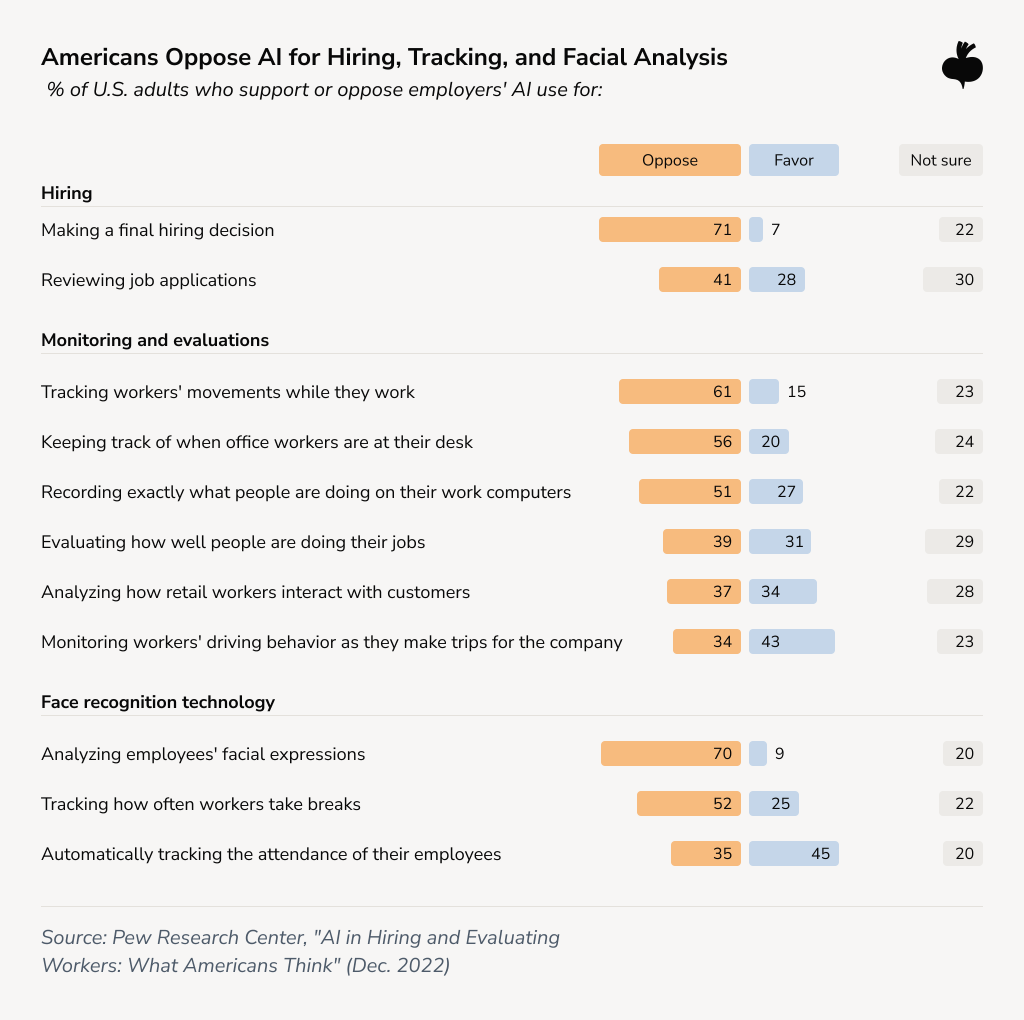
Human review works best when it is tied to consequence. Reversible low-risk actions can be automated more extensively. Hiring, promotion, compensation, and termination call for documented reasoning and a named accountable owner. Set that gradient deliberately, because a review step applied everywhere by default turns into a formality.
How to Implement AI in HR Responsibly
A workable sequence for AI in HR management settles the design decisions before the technology decision. The four steps below are ordered on purpose:
- Map the existing workflow first. Document the systems, data, handoffs, exception paths, owners, and current performance before redesigning anything around AI.
- Limit data and access to what the workflow needs. HR records can include compensation, performance, health-related, and demographic information, so data minimization, role-based access, retention rules, and a documented purpose deserve a higher bar than most internal projects get.
- Test the whole workflow, including its failure modes. Evaluate how the system handles exceptions, different user groups, bad input data, and outages. Accuracy on a benchmark says little about behavior in production.
- Design escalation before launch. Define confidence thresholds, reviewer ownership, override paths, logging, and fallback behavior before the system takes on operational responsibility.
Algorithmic bias deserves its own note. Explainability tooling helps people interrogate a system; fairness is a separate property, since bias can enter through historical data, label choices, feature selection, and feedback loops. Test against the specific use case in front of you. The patterns we use are covered in our look at human-in-the-loop and agentic AI workflows.
Choosing HR AI Tools, Custom Workflows, and Technology Partners
Start with what you already own. HRIS, ATS, payroll, and analytics platforms have absorbed a lot of AI functionality, and much of what teams buy as new human resources automation duplicates the current stack.
Custom development becomes more relevant when a workflow crosses several systems, encodes organization-specific business logic, or requires controls that existing HR software does not provide. In those cases, custom HRIS integration or HR workflow automation may be justified.
When you do bring in a partner, look for implementation capability. A useful technical partner understands AI, data, integrations, security, and production delivery, and leaves employment decisions where they belong. Organizations comparing options should also weigh workflow handover and how much of the finished system their own team can run afterward.
How Beetroot Helps Build AI Into HR Workflows
At Beetroot, we help organizations build AI and automation around the HR workflows and systems they actually run. We work with the HRIS, ATS, and payroll platforms you already run, and we build human review, escalation, access, and logging into the workflow itself.
Depending on the use case, our work can bring together custom AI development, robotic process automation for stable administrative steps, generative AI for documents and internal knowledge, controlled agentic workflows, and the data engineering that connects them to what you already run.
Better HR Operations Start With Clearer Boundaries
The clearest benefits of AI in HR show up in preparation and coordination work: removing repetitive handoffs and improving the inputs that reach the people who carry the decision. Value tracks the quality of the underlying workflow map.
If you are deciding where to begin, pick one workflow with clear friction and available data, then use it as the template for the next. Our team can help you scope it and design the review points around it. For a second opinion on where to start, let’s talk.
FAQs
What HR processes are most suitable for AI automation?
The HR processes most suitable for AI automation are high-volume administrative workflows where the data already exists: employee self-service, recruitment coordination, onboarding, document and case management, and payroll exception handling. These workflows prepare and move information, while employment decisions stay with people. Errors in payroll records, employee data, or policy answers still carry real consequences, so each workflow needs a defined review point.
How is AI in HR different from traditional HR process automation?
Traditional HR process automation follows fixed rules to complete predictable steps, such as copying approved employee data between systems or triggering onboarding tasks on a start date. AI in HR adds capabilities that handle language and unstructured documents, which suits work that rules cannot express cleanly. Most HR environments combine both.
Which HR decisions should always include human review when AI is involved?
Hiring, promotion, compensation, performance ratings, disciplinary action, and termination decisions should always include accountable human review when AI is involved. The EU AI Act treats AI used in recruitment, selection, and worker management as high-risk, and European Commission draft guidance indicates that a human reviewer does not by itself remove a system from that category if its output materially influences the outcome.
How can HR teams reduce bias and protect employee data when using AI?
HR teams can reduce bias exposure by testing AI systems against the specific use case rather than a general benchmark, and by logging how each output was produced and reviewed. Employee data privacy depends on data minimization, role-based access, and retention limits. Neither practice makes a system fair or compliant on its own.
When should a company build a custom AI workflow instead of using existing HR software?
A company should consider a custom AI workflow when the process encodes proprietary business logic, or needs controls that off-the-shelf HR software does not provide. Beetroot can integrate AI and automation with the HRIS, ATS, and payroll systems a company already runs, building the workflow logic and review points around them.
Subscribe to blog updates
Get the best new articles in your inbox. Get the lastest content first.
Recent articles from our magazine





Contact Us
Find out how we can help extend your tech team for sustainable growth.