
From Reforestation to Renewables: Scaling Sustainability Technology
- October 7, 2026
- 9 min read
- Green Tech

Contents
Contents
Reforestation and renewable energy are at opposite ends of the GreenTech spectrum. One maps trees across restoration sites; the other supports how renewable energy is produced and used. Teams in both fields often reach the same point: the environmental method works, but the growth exposes new demands on software, data, and analytics capabilities.
Below, we look at what changes technically as a GreenTech product outgrows its early setup, drawing on two engagements: computer vision built for reforestation monitoring, and predictive analytics built into a renewable energy platform. Both raised the same questions about data foundations and where technical ownership should stay.
Why Scaling Sustainability Technology Becomes a Software and Data Challenge
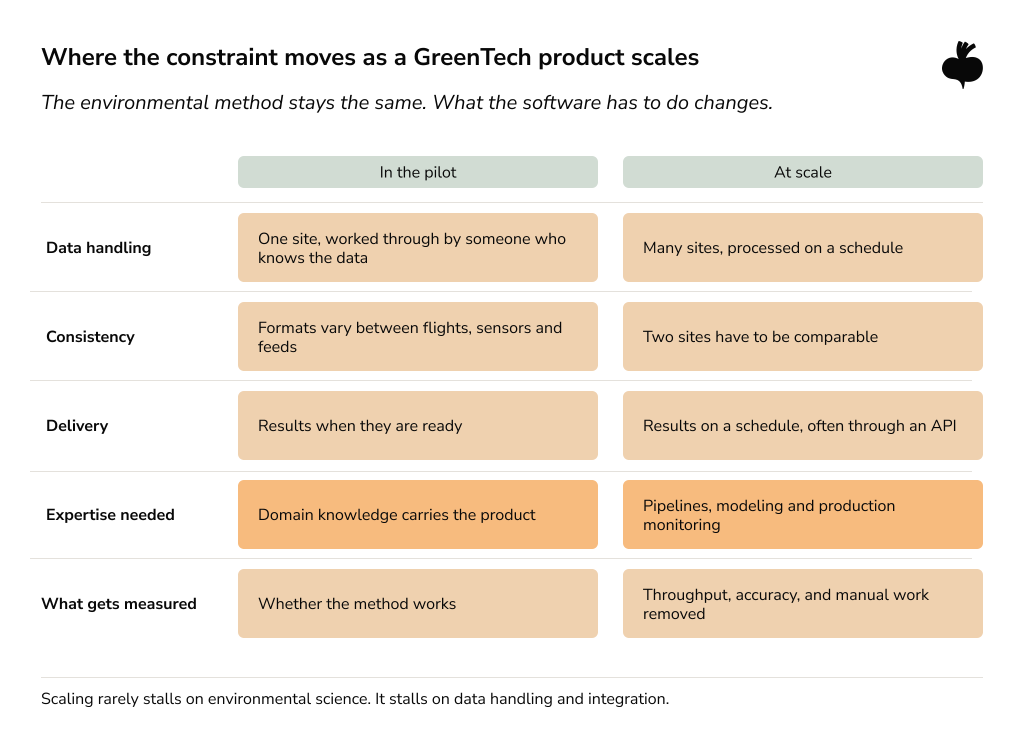
As GreenTech products move beyond early deployments, data handling and integration often become important scaling constraints long before they run into limits in environmental science.
The pilot version of almost any environmental product often relies on domain experts who understand the data to handle parts of the work manually. That arrangement holds at one site and becomes expensive as sites multiply. Volume is only part of the change: customers start expecting results on a schedule, and output has to be consistent enough that two sites can be compared.
The underlying markets are growing fast enough to make this a near-term question. IRENA’s Renewable Capacity Statistics 2026 recorded 692 GW of renewable capacity added during 2025, bringing the global total to 5,149 GW, with variable solar and wind reaching 35.3% of installed power capacity. As the number of installations and digital platforms grows, more assets generate telemetry that someone’s software has to collect and interpret.
Physical-World Impact Creates Complex Data Problems
GreenTech products describe physical things, so their data arrives unevenly and stays tied to place and time. Making it usable is the work that precedes any analytics.
Four kinds of input show up repeatedly:
- Imagery from drones or satellites, which needs alignment before flights from different dates can be compared.
- Sensor and IoT telemetry, which arrives continuously and leaves gaps whenever a device drops offline.
- Weather and grid feeds from external providers, delivered on their own schedules and formats.
- Asset and operational records, often held in spreadsheets rather than a database.
Scale also changes what a measurement has to resolve. WRI’s Global Forest Watch tracks tree cover change at roughly 30-meter resolution, which works well for showing where forest is disappearing across a country; its April 2026 release put 2025 tropical primary forest loss at 4.3 million hectares.
Counting individual planted seedlings on a restoration site calls for a much closer view, which is where drone imagery and the processing behind it come in.
Scaling Exposes Capability Gaps
Domain depth and specialist engineering are separate things. Teams building green technology solutions usually have deep knowledge of restoration methods or energy systems, but may lack in-house background in time-series modeling or specific ML, data, cloud, and production model monitoring skills needed for the next product stage. Those gaps become more visible when the product expands to more sites or users, so they rarely appear on an early hiring plan.
Hiring for a narrow specialism can take time, and the need is sometimes concentrated in one phase of the product. A company may need intensive machine learning work to build the first version, then far less once it runs. That mismatch between a temporary need and a permanent hire is the practical reason external engineering support gets considered, ahead of any argument about cost.
How Land Life Scaled Reforestation Monitoring Beyond Manual Review
Land Life is an Amsterdam-based reforestation company that has run projects in 25 countries since 2013. Its scaling constraint sat in one place: processing drone imagery.
The company had already brought drones and UAVs into its survey work, mapping a site in a fraction of the time with 1–2 team members. The imagery then had to be processed by hand, which capped both how far the mapping could scale and how much insight it produced, and internal capacity to build machine learning and computer vision for reforestation was thin.
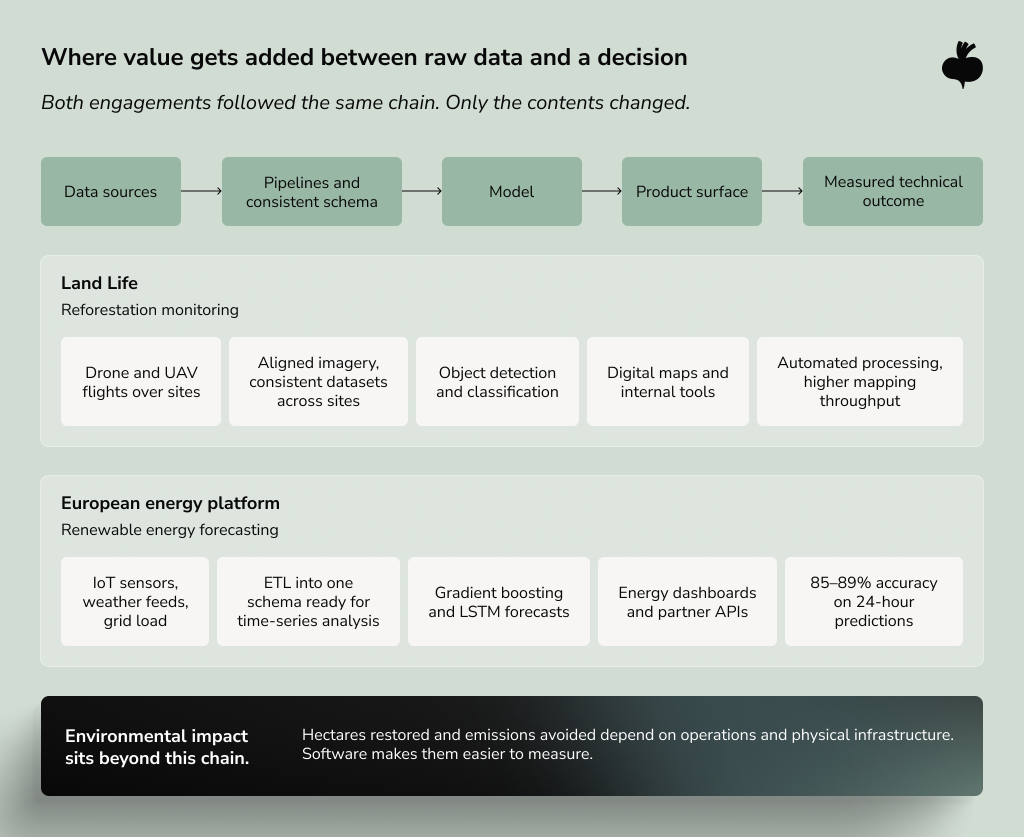
We assembled a senior Python team of two engineers with machine learning and computer vision for environmental monitoring. They built algorithms that process drone imagery and classify objects, which turned raw flights into structured geospatial data. We also provided local infrastructure support and ran onboarding so Land Life’s team could work with the solution and extend it.
The algorithms produced accurate geospatial mapping of planted trees across restoration sites and consistent datasets that support downstream geospatial analysis. Drone-image processing was automated, which reduced manual effort and increased mapping throughput, and the results were integrated with digital maps and internal tools so stakeholders could explore validated planting data more easily.
A two-engineer team was enough because the bottleneck was relatively narrow and well understood. What the case evidenced is a stronger reforestation monitoring and analytics capability. Tree survival and restoration outcomes depend on Land Life’s planting methods and site conditions, and the software does not claim them.
Adding Forecasting to a Live Renewable Energy Technology Platform
A European renewable energy company came to us with a live platform for smart grid management and solar production. The platform connects households with their solar installations and storage systems, so users can monitor energy flows in real time.
The client wanted to move from reactive monitoring toward prediction: 24–48-hour forecasts of both demand and solar generation across diverse user profiles.
The pressure behind that request is not specific to one company. The IEA’s Electricity 2026 report projects the share of global generation from variable solar and wind rising from 17% today to 27% by 2030, and grids running that mix depend more on how accurately production and demand can be predicted.
Four constraints shaped the work. Forecasts had to hold up across those profiles. IoT sensor data and weather feeds had to be combined with grid load metrics into one high-quality dataset. Models had to deploy inside established AWS infrastructure without disrupting live operations. And GDPR alignment had to hold across multiple European regions.
The team reflected that scope, combining machine learning and backend development with DevOps and QA.
The work started with pipelines. We built ETL workflows on Apache Airflow and AWS S3 to consolidate the incoming feeds into a schema ready for time-series analysis. Forecasting models followed, using gradient boosting and LSTM architectures, with backtesting and rolling-window evaluation to check stability before deployment.
Predictions reach the product through a FastAPI microservice serving energy dashboards and partner APIs. Grafana dashboards track performance and automated retraining pipelines address seasonal and regional drift, so a change in model behavior surfaces early enough for the team to review it.
After 12 months in production across three pilot markets, the module reached 85–89% accuracy for 24-hour demand and solar generation predictions. Manual grid balancing interventions fell by 10–12%. Reserve energy purchasing costs decreased by 8%, and the share of local renewable use during peak hours rose by 9%.
Those figures describe one forecasting module inside one client platform after a year in production. Results from predictive analytics for renewable energy vary with data quality and market conditions.
What These Two GreenTech Engagements Had in Common
Computer vision on drone imagery and time-series forecasting on grid data are different disciplines. Three delivery patterns carried across both anyway.
Data Engineering Is the Foundation of Scalable GreenTech
Both projects relied on transforming raw, fragmented data into consistent inputs for analytics and product features. For Land Life, that meant turning raw drone flights into structured geospatial records that hold their meaning across sites and dates. For the energy platform, it meant ETL workflows that brought separate feeds into one schema.
Consistent inputs let processing run automatically, and they let a model train on records that mean the same thing each time. Without that layer, a model trained on one site’s conventions produces confident output that nobody can reconcile with another site’s. That is the practical case for data engineering for GreenTech platforms: it decides what the analytics above it can be trusted to say.
AI and Analytics Need an Operational Destination
A model becomes useful when its output reaches a place where someone acts on it. Accuracy on its own changes nothing about how a business runs.
Land Life’s classifications feed digital maps and internal tools where stakeholders explore validated planting data. The energy forecasts reach dashboards and partner APIs through a service built for that purpose. In both cases, the integration work is what converts a model output into something operational.
Some GreenTech scaling problems are not AI problems. If the constraint is that data arrives in six formats or that a pipeline breaks weekly, a model adds cost without addressing it. Custom AI development for GreenTech pays off when the decision it supports is clear, and the underlying data is reliable, a point we look at more broadly in the article about AI’s role in sustainability.
Build for Production and for Measurable Outcomes
Scaling covers more than serving additional users or data. It includes deploying inside a live system without interrupting it, and knowing afterward whether the capability works.
The energy module had to go into an established AWS environment while the platform kept running, with GDPR alignment holding across regions.
The Land Life engagement included infrastructure support and onboarding, so the client’s team could extend the solution instead of depending on us to touch it. Practices drawn from sustainable software engineering, such as designing for maintainability, matter here because GreenTech products operate in changing physical conditions and get revised often.
Measurement deserves care. The outcomes software can be held to are technical and operational, including forecast accuracy and the share of manual work removed. Environmental impact metrics such as hectares restored or emissions avoided depend on the organization’s operations and physical infrastructure. Software can make those metrics easier to calculate and easier to trust. It does not produce them.
What GreenTech Companies Need From a Sustainability Technology Partner
Define the constraint before choosing the engagement. The phrase sustainability partner covers everything from ESG advisory to carbon accounting, and the relevant kind here is narrower: a technology and engineering partner for sustainability-focused products.
Start With the Capability Gap Before the Cooperation Model
Companies often pick a cooperation model before naming the gap it should close. Reversing that order makes the decision easier, because the gap points to the shape of the work.
Land Life’s gap was specialist machine learning and computer vision expertise aimed at one image-processing bottleneck. The energy client needed cross-functional depth to build a forecasting module and keep it running in production.
A few questions settle most of it:
- Name the bottleneck in one sentence. If it takes a paragraph, the constraint is probably several problems that need separating first.
- Check whether the need is temporary or ongoing. A six-month modeling push and a capability you will run for years justify different setups.
- Decide what stays in-house. Environmental methodology and success criteria usually belong inside the company.
- Agree how the work will be measured. Forecast accuracy or integration coverage make better checkpoints than a delivery date alone.
Look for Cross-Functional Depth Where the Product Requires It
Team shape should follow the problem. Two senior Python engineers were right for Land Life, where the gap was narrow and deep, while the energy module needed several disciplines working toward one outcome.
Neither shape is inherently better. A focused specialist engagement can be a good fit for a narrow, time-bound gap.
Keep Product and Domain Ownership Close
Domain judgment stays with the GreenTech company. Deciding what a healthy tree looks like, or which forecast error actually costs money, draws on restoration and energy knowledge that sits inside your organization.
In the Land Life engagement, those calls belonged to their ecologists. Beetroot’s role was to build algorithms for detection and classification at scale, and help their team work with the resulting solution. One useful signal when evaluating a partner: they ask what the output has to support before proposing a technology.
Choose a Delivery Model That Can Evolve
Different stages suit different setups. The Land Life work ran as a two-stage collaboration with progress and costs visible throughout. The energy engagement continues, with ongoing model maintenance and retraining support after launch.
A defined project suits a bounded bottleneck with a clear finish. Longer-term team extension suits a capability you intend to keep running and improving. Organizations comparing a GreenTech delivery partner with additional development capacity should also weigh documentation, workflow handover, and access to adjacent disciplines.
We work with GreenTech companies as an engineering partner. Depending on what is constrained, that can mean building custom analytics capabilities on top of environmental data, or taking responsibility for a scoped technical workstream inside an existing product. Custom GreenTech software development works best when it is built around your product direction and domain expertise.
Sustainable Technology Scales When Capability Meets a Real Problem
Reforestation monitoring and renewable energy forecasting are different problems with a similar shape. In both, the environmental goal already existed. The technology question was how to make the underlying data easier to process and use at a greater scale.
What traveled between the two engagements was delivery discipline: reliable data first, then models aimed at a decision someone actually makes. Production engineering kept both capabilities usable after launch.
If you are weighing which technical capability your product needs next, let’s talk. We will help you identify where the constraint sits and what cooperation setup would move the work forward.
FAQs
What technical challenges do GreenTech companies face when scaling?
GreenTech companies scaling a product commonly face data volumes that exceed manual processing and fragmented datasets drawn from sensors and third-party feeds. A second frequent gap is specialist machine learning or production engineering expertise that a domain-led team was not built to cover.
How can software help GreenTech companies measure environmental impact?
Software helps GreenTech companies measure environmental impact by collecting field data consistently and turning it into structured records that can be compared across sites and time periods. Reported environmental impact metrics still depend on the organization’s own methodology and physical operations, so software supports the measurement rather than producing the outcome.
What role does data engineering play in GreenTech and renewable energy software?
Data engineering builds the pipelines that consolidate sensor and operational data into consistent datasets that analytics and machine learning can use. In renewable energy software, data engineering is what allows forecasting models to run on inputs that mean the same thing across markets and time periods.
When should a GreenTech company work with an external technology partner?
A GreenTech company should consider an external technology partner when a defined capability gap is blocking the product and the internal team lacks the specialist expertise, time, or capacity to address it alone. Common examples include a narrow machine learning bottleneck or a production deployment that needs cloud and QA expertise the internal team does not hold.
What should GreenTech companies look for in a software delivery partner?
GreenTech companies should look for a delivery partner that takes responsibility for a defined technical workstream and builds around the company’s existing product direction and domain expertise.
Subscribe to blog updates
Get the best new articles in your inbox. Get the lastest content first.
Recent articles from our magazine



Contact Us
Find out how we can help extend your tech team for sustainable growth.