Agentic AI for Smart Agriculture: From Crop Monitoring to Coordinated Farm Operations
- November 6, 2026
- 9 min read
- AgTech
- AI/ML
- Green Tech

Contents
Contents
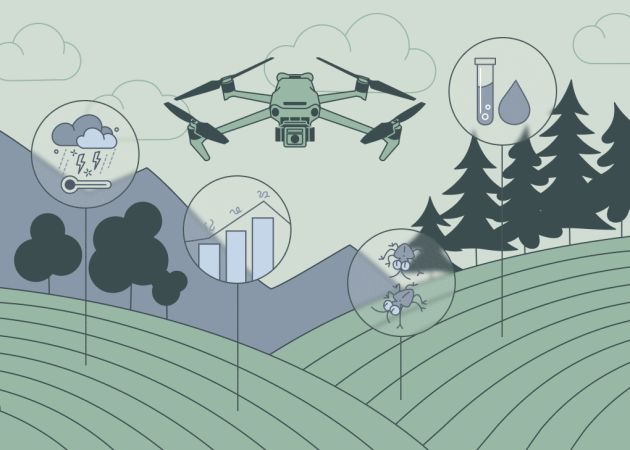
Precision agriculture platforms already collect data from soil sensors, machinery, and satellite imagery, and predictive models estimate irrigation demand or disease risk. The focus of GreenTech software development for agriculture is now moving toward connecting these capabilities, so that less of the follow-up after an alert depends on people moving between systems.
FAO likewise frames smart farming as data, AI, IoT, and precision agriculture working together. Agentic AI in agriculture can coordinate field data, specialist models, farm software, and equipment schedules, then carry out approved actions within defined limits or pass the decision to a person.
In this article, we look at where agents add value to existing farm systems and where simpler automation is enough.
From Smart Farming Software to Agentic AI: What Has Actually Changed?
A typical AgTech stack already covers a lot of ground. Farm management software keeps field records and schedules, crop monitoring software flags stress from drone imagery, and agricultural IoT reports soil conditions.
On its own, a low-moisture alert does not check the rainfall forecast or book an irrigation run. An agent can read outputs from several systems, apply approved rules, and call the right specialist model. It can then propose an action, schedule it within limits, or hand the case to a person.
Monitoring and Prediction Are Not Yet Agentic
Most smart farming tools monitor or predict. A soil probe reports current conditions, while a disease-risk or yield forecasting model estimates what comes next. Some systems also recommend a response.
Agentic action begins when a system coordinates several steps toward an operational goal, then executes an approved action or escalates it. A vision model that detects leaf spots stays a monitoring tool until something acts on its output and checks the result. Keeping this line clear makes it easier for buyers to compare products and for teams to scope AI in agriculture projects.
Farm Autonomy Has Levels
Autonomous farming covers tasks with very different levels of risk. A system can recommend while a person decides, prepare a task and run it after approval, or act on its own within strict limits, such as shifting irrigation timing inside an approved range. Safety-critical control of steering and implements belongs to dedicated machinery systems, and an LLM-based agent should not take over that layer.
Threshold-based irrigation triggers run well on rule-based automation, and back-office tasks with stable, repeatable steps, such as entering supplier invoices or compiling weekly compliance reports, often get further with robotic process automation services than with an agent. Agents fit workflows with changing conditions, several data sources, and decisions that no fixed rule covers.
Why Agriculture Is a Difficult Environment for AI Agents
Most software automation works with digital data that can be checked and corrected. Farm workflows depend on weather, soil, living crops, and field machinery, and many actions cannot be undone. For example, a missed spray window may not return that season. For agriculture technology teams, this raises the bar for any agent that triggers physical work.
Agricultural Context Changes Across Fields and Seasons
A disease-risk model trained on wheat in one region may perform poorly on another variety, soil type, or climate. Tillage, planting dates, and input strategies also change what the data means. An agent inherits these limits, so deployments need local validation and a way to route unfamiliar conditions to an agronomist.
Data Comes From Many Physical and Digital Systems
A single field decision can draw on soil probes, machinery telemetry, remote sensing data, weather services, the farm management system, and scouts’ notes. Satellite images may be days old, sensors drift or drop offline, and field names differ across agriculture software tools. Before an agent can coordinate anything, it needs to know which field a reading belongs to and how reliable it is.
How Agentic AI Can Support the Farm Workflow
Below, we look at five common farm workflows where an agent can take on the coordination work. In each one, existing tools and farm staff keep their current roles. The agent connects them and keeps the task moving, and the amount of freedom it gets depends on how much is at stake if an action goes wrong.
Crop and Soil Monitoring Agents
Agronomists typically review dashboards in precision agriculture software and then decide which fields to walk. An agent can compare soil readings, recent imagery, weather, and field history to rank anomalies and flag possible sensor faults before assigning a scouting task with the evidence attached. This shortens the path from signal to field check and makes crop health monitoring more consistent across large areas. Interpreting what the scout finds remains the agronomist’s job.
Irrigation and Resource Management Agents
Smart irrigation controllers usually follow schedules or moisture thresholds set by the farm. An agent can combine soil moisture, the rainfall forecast, crop stage, and water allocation, then apply approved irrigation rules to recommend a run or schedule it within set limits.
If rain is coming or readings conflict, it can hold the run and notify the farm manager. Water requirements still come from validated agronomic models and thresholds. The agent works inside them and doesn’t set them.
Pest and Disease Detection and Response Agents
Image models flag suspected disease in drone or trap photos, and risk models add weather-based warnings. Reliable detection is work for dedicated computer vision services and validated models, so the agent’s role starts once a flag appears.
It can pull field history and recent treatments, assess urgency, and schedule an inspection. Diagnosis and treatment choices, especially chemical ones, keep a human-in-the-loop who checks approved guidance and local regulations.
Equipment Scheduling and Autonomous Machinery Coordination
Autonomy is advancing at the machine level. John Deere’s second-generation autonomy kit uses computer vision, AI, and cameras to help tractors navigate the field. An agent can match field priorities with equipment availability, maintenance status, operator schedules, and weather windows, then propose or queue approved jobs.
When a machine goes down, it can rework the plan and alert the farm manager. Steering, obstacle detection, and stop functions stay with the machine’s own control systems and the wider agricultural robotics stack.
Yield Forecasting and Harvest Planning Agents
Yield forecasting output often ends up as a number on a dashboard. An agent can feed updated forecasts into harvest planning by checking combine and truck availability, crew schedules, storage capacity, and buyer commitments, and flagging conflicts early.
The agent passes the forecast along without producing it, so its value depends on the underlying model. Teams usually validate that model for the specific crop and region first, either in-house or with outside predictive analytics development services. Final harvest decisions stay with the farm manager.
AI in Agriculture Today: What Is Actually Autonomous?
The OECD’s 2026 review of AI in agriculture identifies three areas where AI is emerging in the EU: agricultural robots, predictive analytics, and crop, soil and livestock monitoring. The report treats the last two as integral parts of precision farming. It also describes adoption as early and uneven, held back by limited rural digital infrastructure, fragmented datasets, regulatory complexity, and financial barriers.
Mapped against the levels described earlier, most deployed smart agriculture tools sit in monitoring and prediction. Field analytics platforms and crop and soil monitoring tools report conditions, and predictive models estimate disease risk or water demand. Automated irrigation usually follows fixed schedules or thresholds, which makes it conventional automation even when a sensor triggers it.
Autonomous machinery and agricultural robotics are the most visibly autonomous category, and their autonomy covers perception and navigation for a defined physical task. Decision support tools add recommendations, and a person still acts on them.
Agentic orchestration, which connects monitoring, forecasts, equipment, and smart farming software into workflows that plan and follow up with limited supervision, remains the least mature layer. For product teams, this is where most of the room to build sits. It is also a reason to read claims about autonomous farming carefully.
What Reliable Agentic Smart Agriculture Requires
An agent is only as dependable as the data, tools, and rules around it.
Reliable Farm Data and Interoperability
The European Commission’s report on AI for sustainable agriculture lists limited access to high-quality data, high development costs, lack of interoperability, and regulatory uncertainty among the obstacles to adoption. For an agent, every sensor, machine, image, and field record should map to consistent field and asset identifiers, with timestamps and basic quality checks.
Building the pipelines for farm data integration that reconcile formats and flag stale or missing inputs is standard data engineering services work, and it usually has to happen before any agent goes live.
Specialist Models and Deterministic Controls
The agent should call validated tools for specialist questions: agronomic models for water demand, vision models for disease detection, weather services for forecasts, and control systems for machine actions.
A general-purpose language model is useful for planning the steps of a workflow and summarizing evidence for the farm manager. Irrigation volumes need validated agronomic models or rules, while disease identification relies on vision models trained on representative image data. Before any proposed action runs, deterministic rules check it against the limits the farm has approved.
Connectivity, Edge Operation, and Safe Fallbacks
Rural connectivity is often unreliable, so essential farm functions should not depend on a constant link to a cloud-based agent. Irrigation controllers and machines need local rules that keep them safe when the connection drops, and edge computing can run critical checks on site. Each workflow should define what happens when a sensor goes silent or an external service fails, whether that means holding the last safe state or pausing and alerting a person.
Match Permissions and Human Review to Consequence
Shifting an irrigation start time within an approved window or moving a scouting visit to another day are small, reversible changes, and an agent can usually handle them on its own. Things are different when the model is unsure or the data looks unfamiliar, for example when sensors and imagery disagree about a field. Those cases should go to a person, and so should any treatment decision or unusual machinery action, however confident the system is.
Evaluating Smart Farming Software and Agentic AI Options
Most AgTech teams end up combining more than one option, depending on the workflow:
- Existing farm management software is often enough when a task follows stable rules inside one system, such as logging field activities or triggering a threshold alert. Many platforms now include their own AI features that you can test.
- A specialist point solution fits a narrow problem where a vendor already has validated models, such as variable-rate application maps or crop-specific disease detection.
- An agentic extension makes sense when a workflow crosses several systems and still depends on people to connect the steps, as irrigation scheduling often does.
- Custom development is justified when the coordination logic or approval rules are specific to the organization. A common setup keeps the farm management or precision agriculture software as the system of record and adds custom pipelines, models, or agents around it. Teams often pair in-house product knowledge with external AI development services for that layer.
When comparing options, check whether the tool integrates with existing systems, supports configurable action limits and approvals, behaves safely offline, and shows value in operational terms such as faster response to field issues.
Risks and Governance Considerations
Once an agent can trigger irrigation runs or queue machine jobs, its mistakes carry physical costs.
Bad Data Can Become a Bad Physical Decision
A failed soil probe can make a well-watered field look stressed, and a week-old satellite image may miss a recent storm. Models also drift as varieties or practices change. The agent’s logic may be sound while its inputs are wrong, so checking data freshness and escalating when sources disagree are basic safeguards.
Security and Permissions Matter Once Agents Can Act
An agent with broad access to irrigation controls, machinery platforms, and external APIs is both an attractive target and a larger source of error. Each agent should hold only the permissions its workflow needs. A harvest-planning agent, for example, may read machinery availability without being able to dispatch equipment.
Keep Agronomic and Operational Accountability Clear
Before launch, the team should agree who owns model assumptions, intervention thresholds, exceptions, and approvals. Agronomists usually own treatment logic, farm managers own operational approvals, and the technology team owns data quality and system behavior. A log of what the agent did and why makes it possible to review decisions after the season.
Where to Start With Agentic AI in Agriculture
The next stage of AI in agriculture builds on what farms already have. Sensors, imagery, forecasts, smart farming software, and machinery each do their job well. The remaining gap is the coordination between these systems and the people who make the decisions. Agentic AI in agriculture can narrow that gap when it relies on validated models and keeps human review matched to the consequence of each action.
The most practical place to start is one well-defined workflow with a clear owner and measurable outcomes, such as irrigation scheduling or scouting prioritization.
If you’re planning a workflow like this, or want to extend an existing platform with AI and data capabilities, Beetroot can help define and integrate the data and software components around your existing farm systems.
FAQs
What is agentic AI in smart agriculture?
Agentic AI in smart agriculture refers to AI systems that coordinate several farm tools and workflow steps toward an operational goal. An agricultural AI agent can combine sensor data, forecasts, and farm management software, then propose an action, schedule an approved task within set limits, or escalate the decision to a farm manager or agronomist.
How are AI agents different from precision agriculture software?
Precision agriculture software typically monitors field conditions, predicts outcomes, or guides input application within a single tool or task. AI agents in agriculture work across these tools. An AI agent uses outputs from precision agriculture software, other farm systems, and approved rules to coordinate multi-step workflows such as field inspections or irrigation scheduling.
Which farm management tasks can AI agents automate?
AI agents can automate coordination tasks in farm management, such as prioritizing field inspections, scheduling irrigation within approved limits, assigning equipment to field jobs, and feeding yield forecasts into harvest planning. Higher-consequence farm decisions, including crop treatment choices and unusual machinery actions, should remain with farm managers and agronomists.
Can AI agents control irrigation and agricultural machinery autonomously?
AI agents can schedule or trigger irrigation within limits the farm has approved and can coordinate agricultural machinery at the task-planning level. AI agents should not directly control steering, obstacle detection, or other safety-critical machinery functions, which belong to dedicated machine control systems.
What data and infrastructure are needed to implement agentic AI in agriculture?
Implementing agentic AI in agriculture requires reliable farm data with consistent field and equipment identifiers, integrations with farm management and precision agriculture systems, and validated models for tasks such as irrigation planning or disease detection. Agentic AI in agriculture also needs defined permissions, approval points, and safe fallback behavior for periods when connectivity or sensors fail.
Subscribe to blog updates
Get the best new articles in your inbox. Get the lastest content first.
Recent articles from our magazine






Contact Us
Find out how we can help extend your tech team for sustainable growth.