Agentic AI for Carbon Accounting: Automating the Work Around the Numbers
- September 16, 2026
- 10 min read
- AI/ML
- Green Tech
- Sustainability

Contents
Contents
Many carbon reporting delays come from coordination work: a utility invoice for one facility that has not arrived, or a reviewer waiting on an assumption nobody wrote down. Agentic AI is now offered as a way to absorb that work. The useful version of the promise is narrower than the marketing suggests, and it starts with knowing which part of your workflow consumes the team’s time.
A major automation opportunity in carbon accounting is coordination across systems and teams, which usually comes down to building AI agents around existing workflows. Agents collect data and prepare it for calculation, while methodological choices and final approval remain with the people accountable for them. Below, we look at where that holds up and how to weigh an existing platform against a custom one.
How Carbon Accounting Relates to ESG Reporting
Carbon accounting is the structured process of building and maintaining a greenhouse gas inventory. ESG reporting covers a wider set of topics, including environmental matters beyond emissions along with social and governance disclosures. A project that automates the emissions inventory therefore leaves most of an ESG reporting program untouched. If your remit covers the wider disclosure set, a broader look at AI agents for ESG & corporate sustainability makes that scoping decision easier; here we stay with the greenhouse gas inventory.
The distinction matters when you scope the work. Broader ESG reporting software can cover environmental, social, and governance aspects (full disclosure set), while carbon accounting software is designed to produce a defensible inventory, and one vendor may well sell both. Teams that set out to automate ESG reporting usually find the emissions inventory one of the more structured parts, while processes such as double materiality assessment require substantial judgment.
What Carbon Accounting Software Actually Manages
Carbon accounting software manages the chain that turns operational records into a reportable inventory. That chain starts with the organizational boundary and the activity data collected inside it, and it covers everything applied to that data before a figure reaches a report.
Two terms carry most of the weight. Activity data is the measurable quantity behind an emission source, such as fuel burned or kilometers traveled. An emission factor is the coefficient that converts that quantity into estimated greenhouse gas emissions.
Vendors label the category differently, so you will also see it sold as carbon footprint software or greenhouse gas reporting software. The products differ mainly in how much surrounding ESG data management they take on.
A carbon accounting platform holds the factor libraries and version history that let someone reconstruct a figure months later, which these products generally do well. The organization-specific work of getting clean activity data into them tends to stay manual.
Where Carbon Data Enters ESG Reporting
Approved inventory data feeds climate disclosures, and those disclosures now carry tightening evidence expectations. The Council of the EU signed off the Omnibus simplification package in February 2026, narrowing CSRD scope to companies above 1,000 employees and €450 million net turnover. The population of reporters is smaller as a result.
The European Commission then adopted revised European sustainability reporting standards (ESRS) on 3 July 2026 that reduce mandatory data points by over 60% and the total number of data points by more than 70%, with reporting costs expected to fall by more than 30% per company. The revised ESRS aims to reduce administrative burden while maintaining high-quality disclosures, so the evidence behind each remaining figure stays in place, and companies in scope still need to release defensible emissions figures.
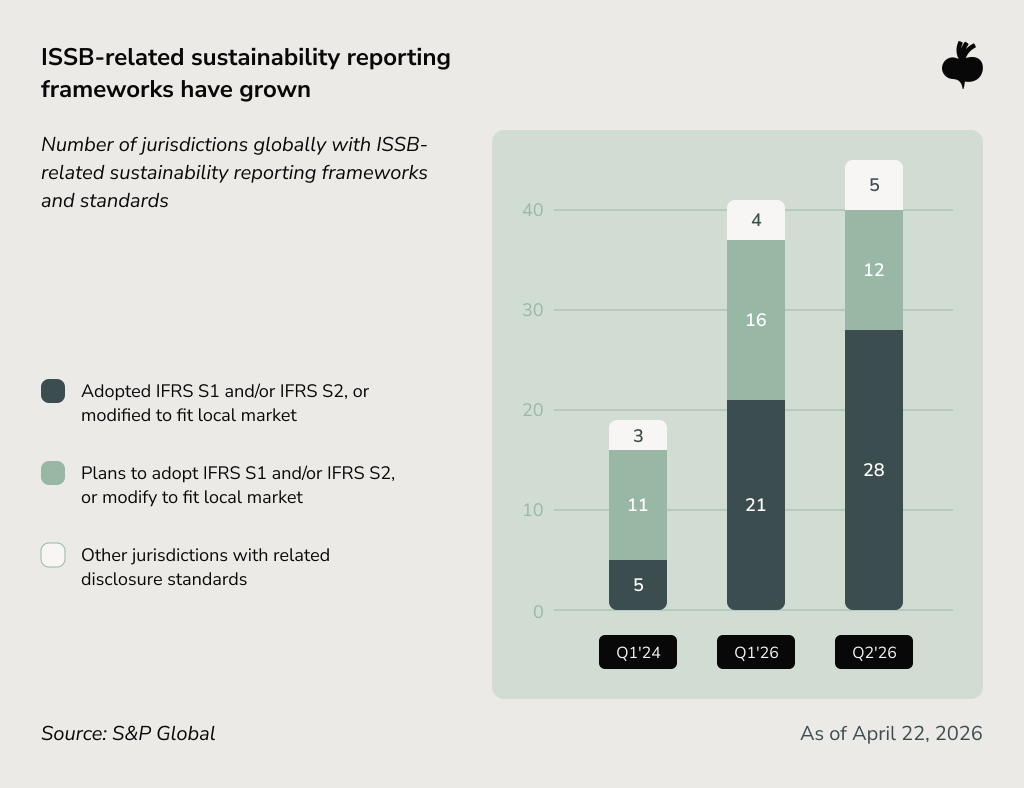
The global picture is widening at the same time. S&P Global counted 28 jurisdictions that had adopted the ISSB standards on a voluntary or mandatory basis as of April 2026, with a further 12 planning to. For a group operating across several of these markets, one inventory has to serve multiple disclosure formats, which puts pressure on how well the underlying emissions data is documented.
What Agentic AI for Carbon Accounting Means
Agentic AI describes a system that pursues a defined goal using approved tools, drawing information from several sources and handling exceptions within set limits. A chatbot that only answers questions about your emissions falls outside that definition, as does a scheduled data import.
An agent earns its place when work crosses systems and teams, and when the next step depends on what comes back from the last one.
Roles of Agentic AI, Generative AI, and Traditional Automation for Carbon Accounting
A working reporting stack combines several technologies. Predictable data movement belongs to APIs and pipelines, while approved emissions formulas belong in a calculation engine that returns the same result every time it runs. Validation rules handle the stable, well-understood checks, and machine learning becomes useful where volume makes manual classification impractical. Generative AI can support document extraction and drafting. Agents coordinate the sequence and escalate whatever does not fit.
Choosing an agent for work that a scheduled API call already handles adds cost and unpredictability. The useful test is whether the task requires a decision about what to do next, because conventional automation will be cheaper and more reliable for fixed, repeatable tasks.
How Bounded Autonomy Keeps Accountability With People
The workflows that hold up in carbon reporting give agents narrow, explicit permissions. An agent may perform specific reversible actions, and anything consequential routes to a named person for a decision.
NIST’s AI Risk Management Framework makes a similar point in general terms, treating documented practice and defined oversight as the conditions that make an AI system’s risks manageable. In carbon reporting, that becomes concrete: an agent proposes an emission factor and a person approves it, with both actions recorded.
Why Emissions Data Workflows Resist Automation
Emissions workflows resist automation because much of the effort goes into exceptions. A fixed script handles the predictable majority of records and stalls on the remainder, and that remainder is where reporting timelines tend to go.
Emissions Data Rarely Starts in One System
Activity data for a single inventory rarely lives in one place. ERP and procurement systems hold part of it and utility platforms hold the energy data, with the remainder arriving as supplier PDFs or travel records from whichever tool the team uses. Each source comes with its own owner and refresh cycle.
Sustainability teams depend on colleagues in finance and procurement to release that data on time, and whether a report lands on schedule usually comes down to that dependency. Before you choose the first source to integrate, the architecture patterns in AI agents in environmental sustainability help you weigh what an agent should reach directly.
Emission Factor Selection Is a Judgment Call
Factor selection is where matching logic runs out. A line item reading “freight, DE-PL, 12t” could map to several factors with materially different results, depending on transport mode and on whether the factor includes well-to-tank emissions.
A language model can rank plausible candidates by semantic similarity, and similarity alone is a weak basis for choosing an authoritative factor. Factor choice therefore belongs with approved rules and human review.
The direction of the standards reinforces the point. The GHG Protocol’s March 2026 Phase 1 progress update on the Scope 3 Standard, still a working draft, proposes that companies disaggregate reported Scope 3 emissions by data type and quantify all required emissions to justify any exclusions. A further proposal would have companies label whether reported figures were verified by a third party. Each of these adds to the provenance a reporting system has to carry per number.
Where Agentic AI Fits in the Carbon Reporting Workflow
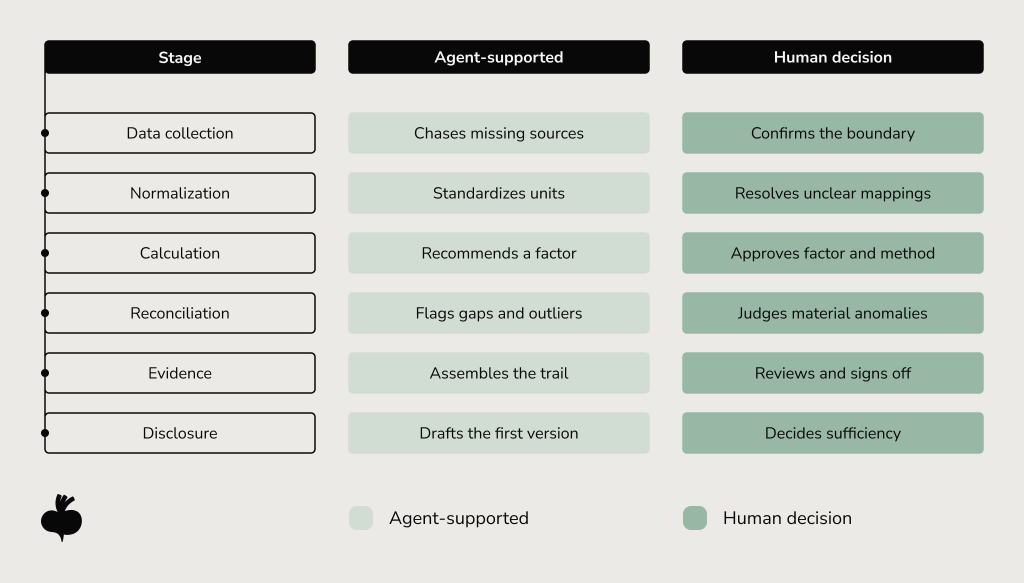
Agents add the most value in the stages between data ownership and calculation, where information has to be located and made consistent before anything can be computed.
Finding and Chasing the Source Data
An agent can hold the expected data inventory for a reporting period and check what has arrived against it, following up with the responsible owner in week three, when a facility’s utility data first goes missing. Classifying incoming documents and monitoring connectors for silent failures fits the same pattern.
The measurable outcome is fewer manual follow-ups and earlier visibility of gaps, which compresses the reconciliation cycle without touching a single calculation.
Normalization and Calculation Orchestration
Once files arrive, agents can standardize units and time periods, along with the supplier and facility naming your reference data expects. Mappings that fall below a confidence threshold go to a reviewer.
For calculation, the pattern that holds up under review is separation. The agent recommends an approved factor and calls a deterministic calculation engine, which does the arithmetic, and the language model never generates a factor value itself. Beetroot’s generative AI work in reporting contexts follows the same rule: extraction and drafting from the model, authoritative arithmetic left to code.
Reconciliation and Evidence Trails
Agents can run the checks a controller would run given time, from missing periods and duplicate records through to year-over-year movements outside an expected band or totals that disagree between the source and reporting systems. Checks of that kind depend on analytics for carbon and ESG data that already knows your reporting periods and factor versions.
Agents can also link each figure to its supporting material, from the source document and factor version through to the reviewer comment and the approval. Software supports assurance readiness by preserving that record, though it does not produce audit readiness on its own, and no AI system replaces independent assurance.
That distinction matters given the volume of assurance activity now. IFAC, AICPA and CIMA reported in June 2026 that 75% of large global companies obtained assurance on at least some sustainability disclosures in 2024, with most engagements at a limited assurance level.
Framework Mapping and Disclosure Drafting
Grounded generative AI can compare what you already hold against the fields a disclosure standard expects and flag where evidence looks thin. It can then draft explanatory text from approved figures, with retrieval keeping the drafting anchored to your own documents. Our work here focuses on generative AI for controlled disclosure drafting: the model pulls information out of sustainability documents, and every sentence traces back to a figure someone approved.
The agent produces a first draft with its gaps marked, and deciding whether a disclosure is sufficient stays with the reporting team.
Where ESG Reporting Automation Should Stop
Some decisions should never reach an unsupervised agent, however well it performs. Whether your company falls within a regulation’s scope requires a legal or compliance decision, and so does the way organizational boundaries get drawn. Materiality judgments and the choice of calculation method carry similar professional weight.
The same applies at the end of the process. Material anomalies and unsupported estimates need an accountable reviewer, as do public claims and final sign-off. A faster report has limited value if the figures behind it cannot be traced or defended. ESG reporting automation works best when its limits are agreed in advance. If you are deciding where an approver must step in, the review patterns in human-in-the-loop and agentic AI are a practical starting point.
What Reliable Carbon Accounting AI Requires
Four foundations keep an agent-supported workflow defensible when an assurance provider starts asking questions.
- Keep a clear system of record. Agree where activity data and approvals officially live, even when agents operate across half a dozen systems. Without that agreement, reconciliation becomes an argument about which copy is right.
- Recommendation and calculation stay separate. Agents organize information and propose actions, while approved formulas remain in deterministic code. Results then stay reproducible when someone reruns a prior period.
- Permissions should follow risk. Routine, reversible actions such as sending a data request can run with light oversight. Anything affecting a reported figure needs explicit approval.
- Log the workflow and test it. Record data sources and agent actions, together with every approval and override. That log is what lets you answer an assurance provider’s question about how a number was produced.
Build, Buy, or Extend Existing Carbon Accounting Software
An established carbon accounting platform or broader ESG software will usually cover the accounting core faster than anything built in-house, particularly when the data already lives in a handful of connected systems.
The case for building strengthens when the friction lies outside that core. Bespoke integrations with systems your vendor does not support point in that direction, as does reconciliation logic specific to your operating model.
A hybrid outcome is common and often the most sensible. The carbon accounting platform stays as the calculation and reporting system of record, while custom data pipelines and agents handle organization-specific collection and evidence work around it. Before committing either way, we would suggest running one reporting cycle with honest time tracking, because the steps that consume the most hours are the ones worth automating first.
At Beetroot, we work with in-house data and product teams on custom AI development for sustainability workflows, building the integrations and controlled agentic layers that surround a clearly defined carbon accounting process. Where the accounting core already works, and the surrounding workflow needs attention, we take on custom GreenTech software development to close that gap.
How Far Each Reporting Task Can Reasonably Be Automated
Carbon reporting will keep getting more demanding in its evidence requirements even as scope narrows. The question worth asking is how far each task can be automated before you lose calculation discipline or accountable review.
Answered task by task, that question tends to point in a consistent direction. Chasing data and running reconciliation checks can be automated a long way, with normalization in between. Methodology and approval stay with the people who answer for them. If you are weighing whether your next step is better integrations or a custom agentic layer on top of your existing platform, let’s talk.
FAQs
What is agentic AI in carbon accounting?
Agentic AI in carbon accounting refers to AI systems that pursue a defined reporting goal using approved tools, drawing on multiple data sources and handling exceptions within set permissions. Agentic AI differs from a chatbot or a scheduled data import because an agent decides what step to take next and escalates cases it cannot resolve.
Which carbon accounting and ESG reporting tasks can AI agents automate?
AI agents are best suited to coordination work, including identification of missing activity data and follow-up with the data owners who hold it. Methodology choices and final approval of reported greenhouse gas emissions remain with accountable people.
Can AI agents calculate Scope 1, Scope 2, and Scope 3 emissions?
AI agents should not calculate emissions directly. In a controlled workflow, an agent prepares activity data and recommends an approved emission factor, then calls a deterministic calculation engine that applies the formula, which keeps results reproducible and traceable.
How can organizations keep AI-assisted carbon reporting traceable and auditable?
Organizations keep AI-assisted carbon reporting traceable by logging the source of each data point and the emission factor version applied to it, together with every approval or override along the way. Software can support assurance readiness through that record, though independent assurance and human accountability remain separate requirements.
Should a company use existing carbon accounting software or build a custom agentic workflow?
Existing carbon accounting software is usually the right foundation, because it already covers factor libraries and calculation logic that would be costly to rebuild. Custom development becomes worthwhile when organization-specific integrations or evidence workflows fall outside what the platform handles, and Beetroot typically builds these as a layer around an existing accounting core.
Subscribe to blog updates
Get the best new articles in your inbox. Get the lastest content first.
Recent articles from our magazine





Contact Us
Find out how we can help extend your tech team for sustainable growth.