
Collaborative DevOps: How to Integrate In-House and Nearshore Teams
- August 14, 2026
- 9 min read
- Cloud
- Dedicated Teams
- Outsourcing


Contents
Contents
Bringing in DevOps specialists is one of the more practical ways to increase delivery capacity, and it works best when the new engineers join a single shared environment. The aim is to integrate DevOps engineering and automation support into your existing setup while preserving control, security, and internal knowledge. Treating the integration as an operating-model question makes the risks, responsibilities, and technical dependencies easier to address.
The sections below walk through when a team extension makes sense, which responsibilities stay internal, how to grant secure access, and how to tell whether the collaboration is improving delivery.
What Collaborative DevOps Means
Collaborative DevOps is the practice of uniting software development, IT operations, and security teams through shared tools, open communication, and joint responsibility. In a nearshore setup, that means internal and nearshore DevOps engineers working within the same delivery, infrastructure, and reliability practices. Shared context and ownership are what create the value. Adding headcount has limited effect until those are established.
The gains come from how the work is organized. When ownership and workflow are clear, extra engineers genuinely add capacity — once they have enough context and the right access to contribute. When those things aren’t in place, adding more people just means more handoffs and more context to keep in sync, which is often what stands behind a cloud or delivery bottleneck in the first place.
The 2025 DORA State of AI-Assisted Software Development report describes AI as an amplifier of the surrounding engineering system: it magnifies the strengths of high-performing organizations and the dysfunctions of struggling ones. The broader lesson is useful in the team context as well, since additional capacity is more effective when the platforms, workflows, and ownership structures around it are already healthy. That’s why the practices you set up before your first engineer starts matter so much.
Working Through One Shared Delivery System
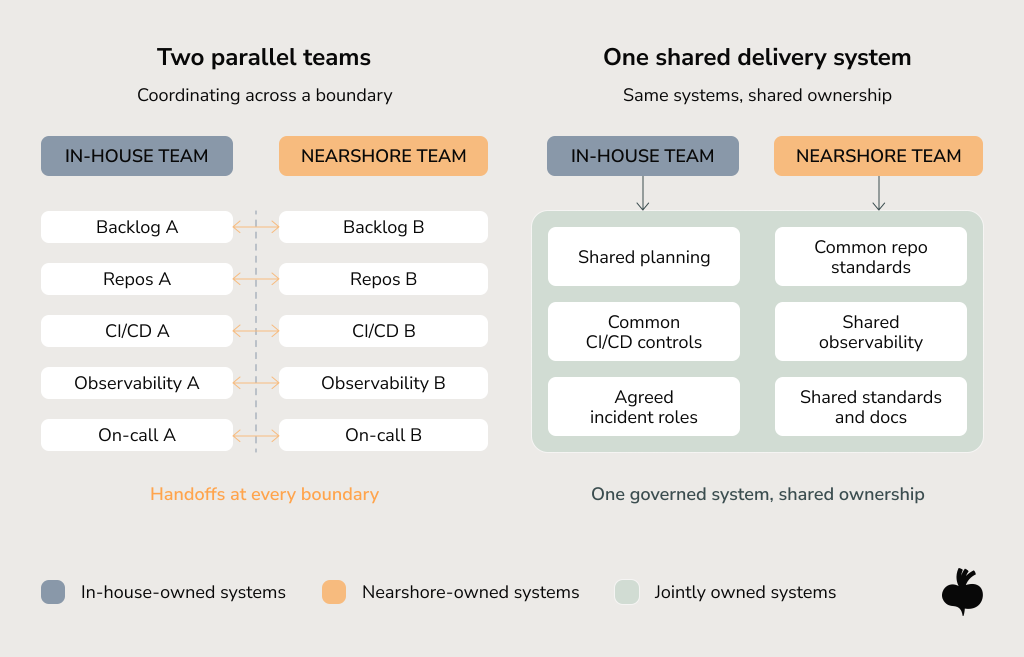
Both groups should work within one governed delivery system: shared planning visibility, common standards and controls, accessible documentation, and agreed escalation paths. Larger environments may legitimately run several linked backlogs, repositories, or CI/CD pipelines, as long as they follow the same standards and ownership stays visible across them. When internal and external engineers work to separate standards with no shared view of planning or ownership, distributed DevOps collaboration ends up being a label with little behind it.
A governed system lets a change written in one time zone be reviewed, tested, and deployed safely in another. When governance splits along team lines, handoffs appear at every boundary, and that is where release reliability usually starts to slip.
When DevOps Team Extension Makes Sense
A DevOps team extension is feasible when an internal team faces specialized or time-boxed work it cannot staff quickly, which first requires clarity on which DevOps roles you actually need. More people will not fix an ownership or process problem.
Common situations where added capacity or specialist expertise is justified include:
- Cloud migration and cloud architecture and infrastructure support
- Pipeline standardization and CI/CD rebuilds
- Adopting infrastructure as code (IaC) across environments
- Implementing DevSecOps controls in the delivery workflow
- Platform engineering, observability, and reliability work
- Temporary delivery peaks and hard-to-hire specialist roles
In-House vs. Nearshore DevOps: Where Each Model Fits
The in-house vs. nearshore DevOps question rarely has one right answer. What usually decides it is where strategic ownership needs to sit and how much day-to-day management your internal team can absorb.
Fully In-House DevOps
A fully in-house team keeps context and decision-making close, which is valuable for core architecture and long-lived production ownership. The constraints show up in hiring speed, specialist availability, and uneven workloads, where a niche role can sit open for months or a migration can stall for want of one skill set.
Nearshore DevOps Team: Project-Based or Ongoing
A nearshore DevOps team can be engaged for a defined project or workstream, with the cooperation concluding after delivery, or on an ongoing basis, such as a dedicated development team that builds long-term knowledge of your environment. In both cases, geographic proximity and workable working-hour overlap allow for real-time reviews, pairing, incident handling, and coordination. Responsibilities vary by engagement: the client team stays accountable for strategic matters, such as governance and risk ownership, while the day-to-day management can be handled by the client, by the technical partner, or split between them, depending on what’s been agreed.
Blended DevOps Team
A blended DevOps team brings internal and nearshore engineers into the same day-to-day operating model. It combines internal context and organizational accountability with additional implementation capacity and specialist expertise, and both groups contribute to shared systems and outcomes. The setup suits distributed DevOps collaboration, and it works for either a defined initiative or a longer-term engagement.
The comparison below shows three common setups. They may overlap in practice: for example, a project-based or ongoing nearshore dedicated team can operate as part of a blended DevOps model.
| Criterion | Fully in-house | Nearshore teams | Blended DevOps team |
| Strategic ownership | Internal | Internal, with scoped partner ownership | Internal, with shared decision rights |
| Day-to-day management | Internal | Client-led, partner-led, or shared | Shared |
| Specialist access | Limited by hiring | Strong for defined scope | Strong and integrated |
| Onboarding | Standard | Scoped to the engagement | Deeper, shared context |
| Continuity | High if retained | Project-based or ongoing | High with shared practices |
| Scalability | Hiring-dependent | Flexible within scope | Flexible with added coordination |
| Internal management load | High | Varies by delivery setup | Moderate |
| Knowledge-retention risk | Concentrated internally | Depends on handover and documentation | Distributed if managed well |
| Best for | Core long-term ownership | Defined projects or ongoing workstreams | Ongoing shared delivery |
How to Structure a Successful DevOps Team Extension
Before external engineers change shared infrastructure, agree on who decides what, how access is granted, and how incidents are handled. A DevOps staff augmentation arrangement fails quietly when these are left implicit and only surfaces during the first risky change or outage.
Define Scope and Decision Rights
Name the owner for architecture, infrastructure changes, pipeline standards, security exceptions, production approvals, and technical-debt calls. A lightweight responsibility matrix works well here, though it is not the only method. What matters is that no important decision is left without a clear owner.
Establish Secure Access From the Start
Grant access by identity and least privilege, following the zero-trust principles set out in NIST SP 800-207. External engineers get separate accounts, managed devices where required, and permissions that change only when their responsibilities and explicitly authorized access needs change.
Pair that with secrets management, audit logs, scheduled access reviews, and a documented offboarding process. Nearshore engineers should not receive unrestricted production access on day one, and access management is a living control you revisit as roles and needs change.
Getting this right early also removes a common source of friction later. When permissions map to responsibilities, engineers spend less time blocked or waiting on someone else to run a change, and security reviews have a clear record to work from.
Agree on Escalation and Incident Responsibilities
Decide how incidents are reported, who acts as incident commander, and whether and when nearshore engineers join on-call rotations. Assign postmortem actions to named owners so that lessons turn into real changes.
Create Shared Backlog Visibility
Keep infrastructure, reliability, security, and automation work visible through a shared or cross-linked planning view. Separate product or platform backlogs may remain, but dependencies, ownership, and prioritization should be clear to both internal engineers and the external team.
Shared Practices for Distributed DevOps Collaboration
Communication tools are the easier part of distributed DevOps collaboration. The harder, more valuable part is the technical practice that lets engineers in different locations make safe, consistent changes to the same systems.
Standardize Repositories, Pipelines, and Environments
Shared version control, reusable pipeline templates, infrastructure as code (IaC), and consistently defined production-like environments reduce how much delivery depends on individual knowledge. Automated checks can help identify configuration drift and policy violations before changes reach production. This is also where a standardized approach to CI/CD pipelines pays off.
DevSecOps: Build Security Into the Delivery Workflow
Protected branches, required reviews, dependency scanning, and policy checks make security checks a routine part of delivery. These controls complement formal audits, risk reviews, penetration testing, and compliance assessments; they do not replace them. Production changes should be traceable to an accountable person or system, with an appropriate change record.
Share Observability and Operational Context
Both internal and nearshore engineers need access to the dashboards, alerts, service-level objectives, runbooks, and incident history relevant to their responsibilities. Without shared observability, external engineers can change a system they cannot actually see, which limits safe diagnosis and can delay incident response.
Treat Documentation as Part of Delivery
Document architectural decisions, deployment steps, dependencies, failure modes, and recovery procedures as work happens. DORA identifies documentation quality as a capability that supports technical and organizational performance, and in a blended team, documenting decisions and procedures as part of delivery helps ownership move without critical knowledge being lost.
Make Knowledge Transfer Continuous
Pairing, review rotation, recorded walkthroughs, and shadow on-call periods keep knowledge from pooling on one side of the partnership. Treat knowledge transfer as an ongoing habit so that neither the internal nor the external group becomes a single point of failure.
Common Challenges in Blended DevOps Teams
A few predictable challenges come up when teams add engineers without also adjusting ownership, access, or workflow. Knowing them in advance makes each one straightforward to design around.
Treating Nearshore Engineers as Ticket Takers
Nearshore engineers need enough architectural and operational context to understand the consequences of their work, along with their contribution to technical decisions. Without that context, they can address the immediate ticket but may be unable to identify the underlying constraint or assess its effect on the wider system. Bringing external engineers into the reasoning is what makes the blended model pay off.
Unclear Production Ownership
If no single person or team holds explicit authority over production, risky changes and incidents become harder to manage under pressure. That cost lands hardest during an outage, when there is no time to work out who decides.
Separate Tools and Undocumented Workflows
Parallel repositories, private channels, manual deployment steps, and undocumented exceptions tend to make an environment harder to operate over time. Each shortcut becomes a piece of the system only one person understands, so bringing these into shared, documented workflows keeps the whole team on steady footing.
Too Much Access or Too Little Access
Broad permissions handed out for convenience raise real security risk. Access that is too tight causes the opposite failure, leaving engineers unable to support the systems they are responsible for. Neither extreme is safe, so permissions should map to responsibility and get reviewed as that responsibility changes.
Knowledge Concentrated in One Group
Dependency builds whenever one group becomes the only one that understands a critical system. That risk applies equally to the internal team and the nearshore partner, and continuous knowledge transfer is the defense.
How to Launch and Evaluate the Partnership
Bring nearshore engineers into the environment based on a concrete objective, then evaluate the collaboration by system outcomes. The steps below give you a workable sequence.
- Start with a defined technical objective. Begin with a specific workstream such as pipeline stabilization, IaC adoption, or a cloud migration. This way, you can assess the progress against a defined baseline.
- Plan onboarding around production readiness. Structure it around architecture, access, failure modes, deployment processes, security expectations, and supervised operational work. The goal is an engineer who can safely make a change and know what happens next, which can take a few weeks of operational walkthroughs, supervision, and shadowing, and not a single onboarding call.
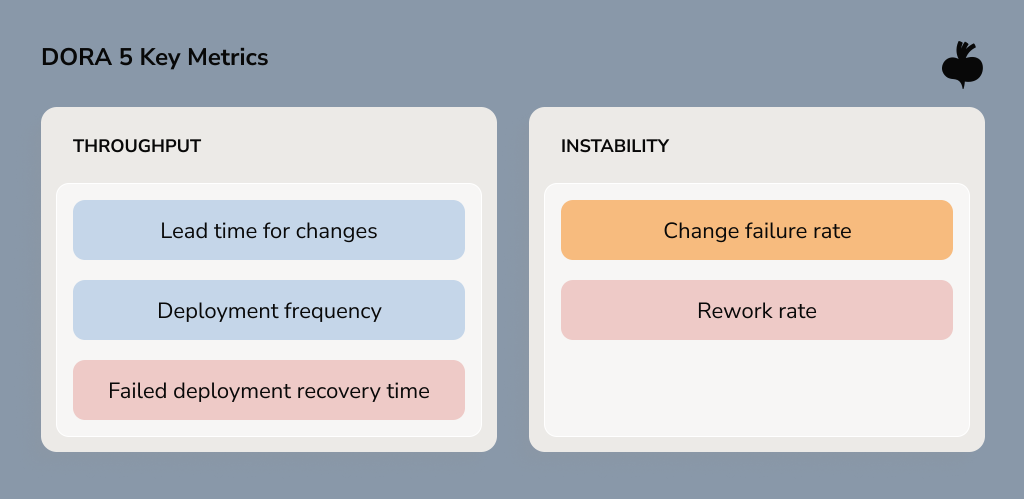
- Measure system outcomes. Track the throughput signals (deployment frequency, change lead time, and failed deployment recovery time) alongside the stability signals (change failure rate and rework rate). Include qualitative measures such as blocked work, review delays, documentation quality, and ownership clarity.
- Plan for continuity from day one. Shared documentation, access records, code ownership, internal counterparts, and transition procedures protect delivery if team composition changes.
These are DORA’s current five metrics — a widely used set of metrics for assessing software delivery performance — grouped into throughput (how fast work moves) and instability (how safely it ships).
Use them at the application or service level, and read any change against that system’s own baseline and delivery context. That said, the metrics should not become a scorecard for individual engineers, and an improvement should not be seen as proof that the engagement alone caused it.
Building One DevOps Team Across Company Boundaries
Successful nearshore DevOps collaboration comes down to shared ownership, secure technical foundations, and a partnership model matched to the work, far more than to geography. When internal and external engineers share goals, standards, CI/CD pipelines, and responsibility for outcomes, the boundary between companies becomes less definitive for day-to-day delivery.
Depending on whether you need individual expertise, a stable team that grows long-term knowledge of your environment, or ownership of a defined initiative, Beetroot can support you through DevOps team extension or project-based delivery. If you are planning a migration, a pipeline rebuild, or a longer nearshore DevOps engagement and want to get the operating model right, let’s talk.
FAQs
What is the difference between nearshore and offshore DevOps teams?
Nearshore DevOps teams are based in a nearby region and typically offer more working-hour overlap with the client. Offshore DevOps teams are based farther away and may rely more heavily on asynchronous handoffs, although actual time-zone overlap depends on the countries involved.
How do you maintain security when integrating nearshore DevOps engineers into an in-house pipeline?
Maintain security by giving nearshore DevOps engineers identity-based, least-privilege access with separate accounts, secrets management, audit logs, and regular access reviews, in line with zero-trust guidance such as NIST SP 800-207. Nearshore DevOps engineers should not receive unrestricted production access, and permissions should widen only as need and trust are established.
What DevOps responsibilities should remain in-house when working with a nearshore team?
Strategic ownership should remain in-house, including core architecture direction, security policy, production authority, and final approval of high-risk changes. A nearshore team can own defined implementation workstreams within those boundaries while the internal team keeps accountability for the wider technical function.
What are the most common communication bottlenecks in a blended DevOps team?
The most common communication bottlenecks in a blended DevOps team are private channels that hide decisions, undocumented workflows, unclear production ownership, and knowledge concentrated in one group. These bottlenecks usually come from operating-model gaps, and they ease when a blended DevOps team shares one backlog, one set of pipelines, and clear ownership.
How can a blended DevOps team improve release velocity?
A blended DevOps team can improve release velocity by removing delivery bottlenecks: standardizing CI/CD pipelines, automating manual steps, and clarifying who owns each decision. A blended DevOps team raises release velocity when shared practices and clear ownership let changes move safely through one delivery system. Adding engineers by itself has little effect on velocity.
Subscribe to blog updates
Get the best new articles in your inbox. Get the lastest content first.
Recent articles from our magazine






Contact Us
Find out how we can help extend your tech team for sustainable growth.