

Contents
Contents
Most CTOs running an aging core system already know what it costs them. Releases take longer each quarter, and every new integration arrives with a workaround attached. Often only one or two people understand the billing module well enough to change it safely. AI coding tools have reopened an old question for these teams: how much of legacy system modernization can now happen faster?
AI-powered modernization is legacy modernization in which AI development tools take on selected engineering tasks, from reading unfamiliar code to generating tests. Those tools now can reduce manual effort in selected parts of a migration. What they should not decide independently is what your system should become, and that decision shapes both the sequence of the work and the risk you carry through it.
In this article, we look at where AI genuinely shortens modernization work and where established engineering practice still decides the outcome. Both questions come up as soon as you scope legacy system modernization services, whether the work stays in-house or goes to an external partner.
Why Legacy System Modernization Remains Difficult
Modernization can run over budget when the most expensive parts of an old application were never written down anywhere. Maintenance shows up on a budget line every quarter, so it gets planned for. The undocumented business rules and the fragile dependencies stay invisible until something breaks, and by then they sit on the critical path of the project.
Age on its own is rarely the trigger. Plenty of stable systems run for years on frameworks that stopped being fashionable a decade ago, and they keep serving the business perfectly well. What usually forces the question is a change the business wants, and the system cannot absorb, such as entering a new market or meeting a compliance requirement that touches how data is stored.
Legacy Code Often Carries Critical Business Knowledge
Old software encodes decisions nobody remembers making. A rounding behavior the finance team depends on, or an exception for one customer segment added after a dispute years ago, is a business rule in everything but name. The only place it is written down is the code itself.
Documentation for AWS Transform lists business logic extraction as a named capability, presenting logic from COBOL programs in plain language so teams can see what an application actually does. Reconstructing that context is usually the first job in modernizing legacy systems, and it is one of the places where AI helps most. It is also the work that tends to get underestimated when a program is scoped.
Technical Debt Compounds the Cost of Change
Technical debt raises the price of every change that follows it. Tightly coupled components mean a single edit ripples outward into parts of the system nobody planned to touch. Thin test coverage means nobody can prove the ripple was harmless, so releases slow down, and manual verification expands to fill the gap.
The 2025 DORA report, based on responses from nearly 5,000 technology professionals, found that teams working in loosely coupled architectures with fast feedback loops saw gains from AI, while teams constrained by tightly coupled systems and slow processes saw little or no benefit. The implication for planning is direct: the systems that would benefit most from acceleration are often the least ready to absorb it, so some architectural groundwork usually has to come first.
Legacy Tech vs. AI-Powered Development: Why That Comparison Misleads
These two terms describe different things, and comparing them directly leads teams to the wrong question. Legacy tech describes the state of your system. AI-powered software development describes how engineers do their work, whatever system they happen to be working on. AI’s effect on software development applies whether the codebase is three months old or thirty years old, which is why it tells you very little about whether to modernize.
The modernization decision underneath is older and more specific. For each part of the estate, you are choosing whether to retain it, rehost it, replatform it, refactor it, rearchitect it, or replace it, and each of those options carries a different cost and risk profile.
Choose the Modernization Path Before the AI Tool
Business criticality and current architecture decide the path, and the assessment happens component by component. A stable component with low change frequency may deserve nothing more than encapsulation behind an API. A module that blocks every new product feature is a candidate for rearchitecting, even when the effort is substantial.
Legacy system modernization strategies usually mix several of these approaches across one estate, and sequencing matters as much as selection. Which dependency gets decoupled first determines what becomes possible six months later. That is architecture work, and it belongs with the people who will live with the result. Architecture consulting can support that thinking when internal capacity is stretched, though the decisions themselves stay with your team.
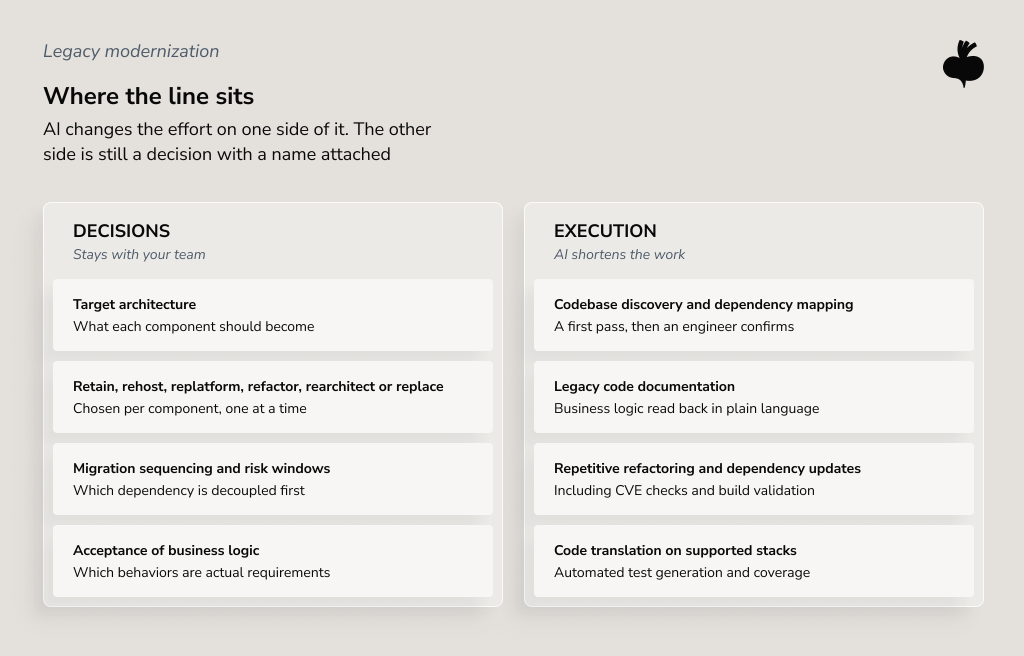
AI Speeds the Work After the Destination Is Set
Once you know what a component should become, AI changes the effort of getting there. Analysis that used to take an engineer two weeks of reading may take two days. Mechanical upgrade work stays mechanical, and it moves considerably faster with a tool proposing the changes.
Faster analysis will not tell you whether a component should be rebuilt or wrapped behind an API, and neither will a faster framework upgrade. AI-powered app modernization shortens the path you already chose. Choosing a better path remains a judgment your team makes, and it is where most of the eventual cost is decided.
4 Ways AI-Powered Modernization Can Accelerate the Work
AI helps most on bounded tasks with checkable output, where an engineer can look at the result and tell fairly quickly whether it holds up. Each of the four areas below produces a reviewable artifact and a clear test of whether it worked.
1. Reverse Engineering and Legacy Code Documentation
Reverse engineering here means reconstructing how a poorly documented system behaves. AI handles the first pass well, summarizing what a module does and drafting documentation an engineer can then check against the source code and the system’s actual runtime behavior.
Microsoft’s GitHub Copilot modernization documentation describes an assessment that analyzes code and dependencies to generate modernization plans, flagging outdated libraries and likely migration problems. Treat that output as a starting hypothesis. Generated documentation that nobody has verified against running behavior reads with the same confidence as documentation that has been checked, which is what makes it risky.
2. Repetitive Refactoring and Dependency Updates
Repetitive refactoring is where AI-assisted engineering pays back fastest. Replacing a deprecated API call across 400 files is tedious for a person and well suited to a tool that can propose the change and then validate the build.
Microsoft documents CVE checks and build validation as part of its upgrade flow, and that validation layer matters at least as much as the refactoring itself. A dependency update that compiles cleanly while still carrying a known vulnerability has only moved the problem downstream.
3. Code Translation and Stack Migration
Supported scenarios have expanded well beyond demos. Microsoft’s tooling covers .NET, Java, and C++ upgrades plus selected Azure migration scenarios, while AWS Transform covers COBOL-to-Java refactoring for z/OS workloads alongside .NET and VMware. Scope varies by product and by stack, and both vendors describe engineers reviewing every step.
Translation is a technique inside a strategy, and it is a different job from decomposition. Converting COBOL to Java leaves the original data model and coupling intact, so the system arrives in a new language carrying its old constraints. Splitting a monolith into business domains is a separate exercise with its own risks and its own decisions. AI-powered software modernization at this layer still needs cloud migration and integration work built around it.
4. Test Generation and Regression Coverage
Test coverage is the asset that makes every other modernization step safer, and it is usually the thinnest thing in a legacy estate. AWS reports that testing typically consumes more than half of mainframe modernization project time, which is why AWS Transform now generates test plans and data-collection scripts.
Generated tests carry a specific risk worth naming. A test written from current behavior can lock in existing bugs along with current requirements, so someone who knows the domain has to separate the two. Our QA and software testing work on legacy systems usually starts at exactly that question.
Where AI-Powered Modernization Needs Engineering Guardrails
Two kinds of guardrails matter here: some decisions should never leave your team, and some outputs should never reach production unchecked. The advantages and disadvantages of using AI in development apply to any codebase, and legacy estates raise the stakes, because a generated change can alter behavior that is poorly documented or understood. The 2025 DORA report found AI adoption positively associated with software delivery throughput and product performance, and negatively associated with delivery stability, which is what acceleration without control systems looks like in the data.
The same report puts AI adoption at 90% of respondents, with more than 80% saying it improved their own productivity. Individual productivity and system-level stability are measured in different ways, so both findings can hold at once. For a modernization program, the stability number is the one to plan around.
Business Logic and Architecture Stay With People
Domain rules and system boundaries carry accountability, and accountability does not transfer to a tool. An agent can propose a decomposition of a monolith into domains, and the proposal may well be sound. Deciding that the payments domain stays frozen through your busiest quarter is a business judgment that needs a person’s name attached to it.
Proprietary Code and AI Tool Security
Blanket statements about AI coding tools being safe or unsafe rarely survive a security review. The specifics below are what your security team will ask about, and they are worth answering before a pilot starts:
- Data flow: what code and surrounding context leave your environment
- Training use: whether your inputs can be used to train models
- Retention and deployment: retention policies and options such as enterprise tenancy or self-hosting
- Repository scope: which repositories a tool can reach, and how secrets and credentials are handled
- Agent authority: what permissions coding agents hold and what they can do unattended
Choosing AI IDEs that decrease operational vulnerabilities comes down to those same answers, which is why the evaluation belongs at the start of a pilot rather than at the point of rollout.
Validation Before Migration
NIST’s NCCoE DevSecOps guidance is direct about the expectation. Teams should keep humans monitoring and validating what AI produces, backed by processes that can be verified, and every AI suggestion should meet the same scrutiny a human contribution would. The concern the guidance names is insecure or non-functional code entering the development lifecycle unchallenged.
Developer sentiment points the same way. In Stack Overflow’s 2025 Developer Survey, 46% of respondents said they distrust the accuracy of AI output against 33% who trust it, with experienced developers the most cautious group of all. Code review and regression testing apply to AI-generated modernization changes exactly as they apply to human ones, and so do security scanning and staged release.
A Practical Legacy System Modernization Strategy With AI
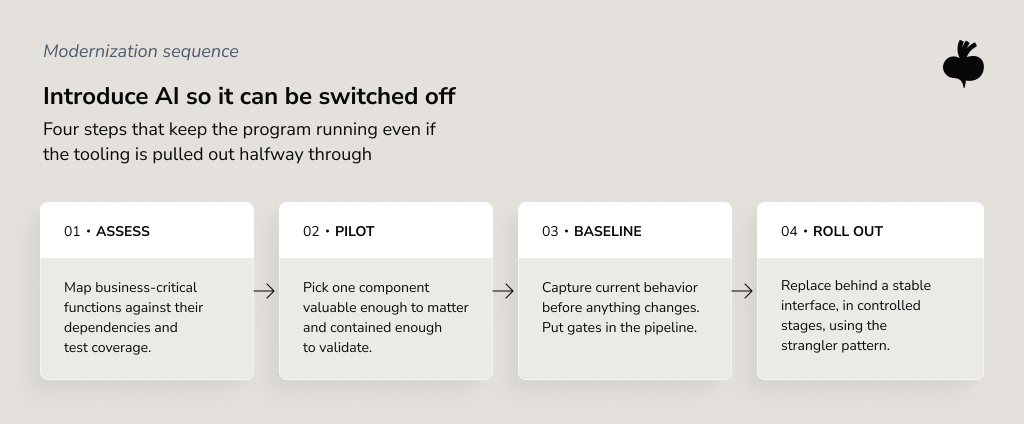
A workable legacy software modernization program introduces AI in a way that can be switched off without stopping the project. Four steps make that possible, and they work best in sequence.
Assess the System Before Changing It
Codebase discovery is the step teams skip under deadline pressure. Map your business-critical functions against their dependencies and current test coverage, and note which components rely on knowledge held by a single engineer. That concentration of knowledge shapes your risk more than the age of the framework does. AI-assisted assessment can produce the map quickly, and an engineer who knows the domain still has to confirm it.
Select a Bounded Modernization Pilot
Pick a component valuable enough that the result matters and contained enough that you can validate it properly. A reporting module with clear inputs and outputs makes a better first candidate than the payments core, even though payments is usually where the frustration sits. The pilot exists to prove the process, and a contained scope keeps the evidence readable.
Establish a Baseline and Verification Gates
Capture current behavior and performance before anything changes, along with the security requirements the component has to meet. Without that baseline, you have no way to tell whether a generated change preserved behavior or quietly shifted it. Gates belong in the pipeline rather than in a review meeting, which is where DevOps services usually earn their place in a modernization program.
Modernize Incrementally and Measure What Changed
Roll out in controlled stages, using the strangler pattern where a legacy component can be replaced behind a stable interface. Measure outcomes rather than the volume of code transformed, since a large diff is not evidence of progress:
- Change lead time for a typical feature in the modernized component
- Change failure rate and time to restore service after a release
- Maintenance effort, in engineer-hours per month on that component
- Integration capability, measured as how long a new downstream connection takes to build
When a Technology Partner Can Help De-Risk Modernization
External help earns its place when your team has a defined modernization problem and lacks a specific capability to get there safely. It works far less well as a stand-in for internal ownership of the product, and that distinction is worth settling before any contract is signed.
Close Capability Gaps First
Adding capacity rarely fixes a modernization program on its own. What usually moves it forward is a missing capability, such as an architect who has decomposed a monolith before, or a QA team that can build regression coverage around behavior nobody documented. That is where legacy application modernization services earn their place. At Beetroot, we work alongside internal teams through custom software solutions and generative AI services, applying AI-assisted engineering where it reduces repetitive modernization work and leaving architecture decisions with the people accountable for the product.
Connect AI-Assisted Changes With the Wider System
Code transformation is rarely the whole job. A modernized component still needs the infrastructure and integration work that the old version quietly relied on, along with data migration and pipelines to match. Downstream systems often cannot move at the same pace, and the choice between data integration and application integration usually decides how much of the old system you keep alive during the transition.
Keep Modernization Ownership Clear
Business priorities and final acceptance should stay with your stakeholders, along with the target architecture. A partner can take responsibility for a defined workstream and be measured on it, which is a clear and workable arrangement. Handing over the decision about what your system should become is where modernization programs tend to lose direction.
Decide the Modernization Path, Then Let AI Shorten It
AI has removed a real amount of manual effort from legacy application modernization, particularly in understanding unfamiliar code and building test coverage that should have existed years ago. The organizations getting value from it are the ones that settled what they were building first, then used AI to get there with fewer wasted weeks.
The engineering discipline around those changes matters more now than it did two years ago, because the volume of change a small team can produce has gone up. If you are weighing the architectural and delivery risks of a modernization initiative and want a second opinion on where to start, let’s talk.
FAQs
What is AI-powered legacy modernization?
AI-powered legacy modernization is legacy system modernization in which AI development tools carry out bounded engineering work on an existing codebase, with engineers reviewing the output. AI-powered legacy modernization accelerates execution inside a modernization strategy that engineers and business stakeholders still define.
Which parts of legacy system modernization can AI automate?
AI can automate bounded modernization tasks with verifiable output, including codebase discovery, dependency mapping, repetitive code refactoring, and automated test generation. Architecture decisions and migration sequencing remain human responsibilities, because those choices carry accountability that a tool cannot hold.
Can AI completely automate a legacy software migration?
No. Microsoft and AWS tooling supports assessment, code transformation, and validation for specific languages and platforms, with engineers reviewing each step. A complete legacy software migration also depends on architecture decisions, data model changes, and security validation that fall outside those supported scenarios.
Is it safe to use AI coding tools with proprietary legacy code?
Safety depends on how a specific AI coding tool is configured and deployed. Evaluate the data path and the agent authority boundary before granting access to a proprietary legacy codebase: where code and context are sent, how long they are retained, and how far an agent can act without approval. Beetroot applies AI-assisted engineering inside an engineering-led process, with those controls agreed before any repository access is granted.
When should a company refactor, replatform, or rewrite a legacy application?
Refactoring suits systems with sound architecture and accumulated code-level debt, while replatforming suits applications constrained mainly by their runtime or infrastructure. A rewrite is justified when the existing architecture cannot support required capabilities at acceptable risk, and Beetroot typically recommends assessing dependencies and test coverage before committing to that path.
Subscribe to blog updates
Get the best new articles in your inbox. Get the lastest content first.
Recent articles from our magazine





Contact Us
Find out how we can help extend your tech team for sustainable growth.