AI Agents for Grid Optimization: Coordinating Renewable Supply and Demand
- September 28, 2026
- 9 min read
- AI/ML
- Green Tech


Contents
Contents
Grid operators once planned around more centralized generation and comparatively predictable demand patterns, and that context is shifting. Weather now drives a growing share of output. Batteries respond to price signals, EVs draw and sometimes return power at the network edge, and industrial sites adjust consumption as grid and market conditions change. Each addition is another asset and another data stream to coordinate, along with the cloud architecture for energy data applications that supports it.
The IEA expects variable renewables to supply almost 30 percent of global electricity by 2030, so coordination grows into a larger operational challenge as variable and distributed resources scale, alongside the generation and adequacy questions utilities already manage.
This context is what has put AI agents for grid optimization on the agenda. It raises a question: do agents add value beyond the forecasting, optimization, and automation that smart grid software already provides? AI agents function as a possible coordination layer across systems that have grown hard to manage in isolation. In this article, we look at where that coordination is worth building, where existing smart grid technology already suffices, and what operators need to keep under their own control.
What Is Grid Optimization and Why Do Renewables Make It Harder?
Grid optimization is a broad term for the decisions that improve how an electricity system uses its generation, networks, energy storage, and flexible demand. It covers scheduling generation against forecast load, positioning energy storage to absorb surplus and cover shortfalls, relieving congestion, and dispatching flexible resources when and where they are needed. Grid operators increasingly have to account for thousands of distributed energy resources (DERs) whose output or consumption may vary with weather, market signals, and their owners’ priorities.
Grid Balancing Is Not the Same as Grid Stability
Grid balancing is the continuous work of matching electricity supply and demand. Grid stability is broader: the power system’s ability to hold acceptable frequency and voltage and keep operating through disturbances such as a sudden generator or load loss.
A tool that improves a forecast or schedules a battery helps with balancing, but it does not keep the grid stable on its own. NERC’s 2026 State of Reliability report shows how physical this responsibility is: in February 2025 a single transmission fault in the Eastern Interconnection caused about 1,800 MW of data center demand to disconnect within milliseconds, comparable to losing two large power plants at once. Maintaining stability ultimately remains the responsibility of accountable operators and established protection and control systems.
Variable and Distributed Resources Increase Coordination Needs
Every new class of grid-edge asset adds forecast uncertainty and participants. Solar and wind introduce weather-dependent output, batteries flow in both directions, EV charging creates mobile and sometimes highly clustered demand, and prosumers and flexible commercial loads turn consumers into active participants whose behavior has to be predicted.
The result is more forecast points, more bidirectional flows, and far more decisions per hour than a control room built for centralized generation was designed to handle. Grid balancing here increasingly involves orchestrating many smaller actions, quickly and repeatedly. Better coordination can help operators make more effective use of storage and flexible loads, respond faster to changing conditions, and reduce renewable curtailment where network and operating constraints allow.
From Smart Grid Software to Agentic AI: What Is Actually Different?
The agentic layer only matters where it adds something current software does not.
Existing Grid Software Already Forecasts, Optimizes, and Automates
Energy management software, advanced distribution management systems (ADMS), DER management platforms, virtual power plant software, and demand response software already handle established operational functions. SCADA and operational technology systems monitor and control equipment, while load forecasting and renewable generation forecasting models, optimization engines, automated demand response, and rule-based controls support or execute decisions. The question for any agent proposal is simple: which part is not already covered?
What Makes a Grid Workflow Agentic?
A workflow becomes agentic when it pursues a goal by pulling context from several systems, calling approved tools, and working through the necessary steps and exceptions within set limits. What it adds is coordination between systems, which is different from making any single forecast smarter. Where existing software lacks this layer, custom agentic AI development can connect models, tools, data, and approval workflows.
The research prototype Grid-Mind illustrates the pattern. An LLM orchestrates power-system analysis tools for connection impact assessment, while validation checks ground decisions in solver outputs. It remains an early research result rather than a fielded system.
Autonomy Has Levels
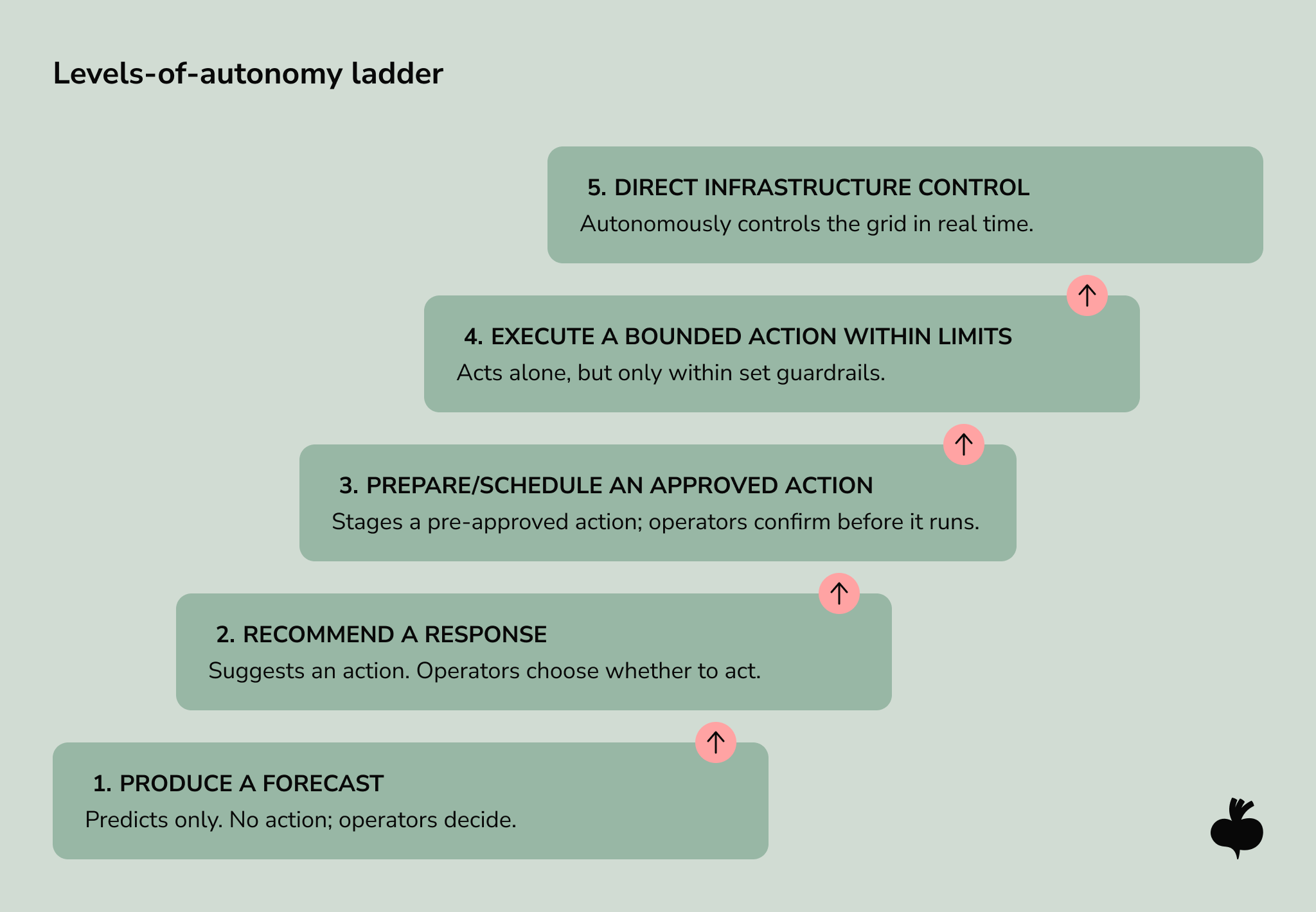
It is useful to separate five levels of action:
- Producing a forecast.
- Recommending an operational response.
- Preparing or scheduling an action that requires approval.
- Executing a bounded action within predefined limits, such as adjusting a battery dispatch schedule.
- Directly controlling critical infrastructure.
An agent that shifts a battery schedule within approved parameters may operate at the fourth level without owning balancing, reliability, or regulatory accountability. For agentic AI, near-term opportunities sit in recommendations, approval-based workflows, and bounded actions. Direct infrastructure control remains the domain of established control and protection systems.
How AI Agents Can Support Grid Optimization
Agents add value in a few specific workflows. Each of the scenarios below already runs on established software; the question in every case is whether an agent adds useful coordination on top, and what it must not be allowed to do.
Demand and Generation Forecasting Agents
Statistical and machine learning models already produce load forecasting and generation forecasts. An agent can gather updated weather, production, demand, and asset data, select an approved model, compare scenarios, check confidence, request missing inputs, and route results into planning or operational workflows.This may reduce manual data handling and make it easier to use forecasts consistently in scheduling.
Adding an agent does not automatically improve forecast accuracy, and the model remains under validation. Beetroot’s own predictive analytics for renewable energy work shows the forecasting foundation such an agent could build on: a module using weather, IoT, and grid data, rather than autonomous control.
Dispatch and Load-Balancing Agents
Dispatch decisions rest on optimization tools, operating constraints, market rules, and safety controls. An agent can coordinate forecast outputs, available resources, and those constraints to prepare a recommendation, or execute a preapproved action within limits.
In practice, this may mean integrating machine learning models and optimization services into operational applications rather than swapping them out. The constraint is firm: operating limits, physical constraints, and market rules stay explicit, and a language model should never calculate an authoritative dispatch instruction. The agent coordinates the tools that do.
Battery Storage and Virtual Power Plant Coordination Agents
Virtual power plant (VPP) software coordinates batteries, solar systems, EVs, and flexible loads as an aggregated resource. Agents can schedule charging and discharge, aggregate distributed resources, respond to market or grid signals, and escalate conflicts or unavailable assets. This may improve the use of energy storage and flexible loads and support participation in flexibility programs. The VPP’s operating rules, market obligations, and technical constraints remain non-negotiable, and asset unavailability should trigger escalation.
Demand Response Orchestration Agents
Demand response changes consumption in response to grid conditions, prices, or program signals. An agent can estimate how much flexibility is realistically available, handle the participant communication around it, and trigger authorized load changes, then check afterward whether the response actually happened. This can reduce coordination effort and provide clearer exception handling. The boundary is contractual: not every load can be changed automatically, and consent and program limits govern what an agent may do.
Where Agentic Grid Optimization Is Emerging in Practice
Much of what gets labeled agentic is still a research demonstration or simulation. Some has reached pilots, and a smaller share runs in operational settings. The examples below keep those maturity levels distinct, along with the difference between operator decision support and bounded automatic control.
Data Discovery and Ingestion Agents
Grid and energy data sits across legacy operational systems, smart meters, IoT devices, market platforms, and weather services. An agent can identify expected source data, request missing files, monitor connectors, classify incoming documents, and route information into the right pipeline. This work carries lower operational risk and is largely reversible, and because interoperability is often the real constraint, improving it may matter more than adding another sophisticated model.
Virtual Power Plants and Distributed Energy Aggregation
VPPs show what distributed coordination at scale already looks like, even when the underlying software is not agentic. The US Department of Energy’s VPP program puts current US VPP capacity at roughly 30 to 60 GW, drawn largely from aggregated home batteries, EV chargers, smart thermostats, and flexible commercial loads, and models a path to 80 to 160 GW by 2030, enough to serve 10 to 20 percent of peak load. Portfolios at this scale create the kind of cross-system scheduling, communication, and exception-handling tasks where an agentic layer could add value, while the VPP’s operating envelope remains fixed.
Microgrids and Commercial or Industrial Energy Systems
Smaller, bounded environments are where more automated coordination is realistic today. A microgrid or industrial site has a defined boundary, a known set of assets, and more limited external dependencies than a regional grid, which makes safe operating limits and fallback behavior easier to define. Much of the published work on autonomous microgrid control is still research or analysis rather than fielded regional operation, but these bounded settings can support higher levels of automation than regional grid operations.
Utility Decision Support and Grid-Edge Coordination
At the utility scale, the credible pattern is decision support. NREL’s eGridGPT, described as the first effort to apply large language models in a grid control room, integrates LLMs, digital twins, and visualizations to give operators recommendations under human review. Argonne’s GridMind uses a multi-agent design, tested so far on standard power-system models, to coordinate optimal power flow and contingency analysis and explain its suggestions. Both keep a person in the loop rather than controlling infrastructure directly. The distinction to hold onto is that a forecasting model, an optimization engine, an automated controller, and an AI agent are not the same thing, even when they serve the same use case.
Evaluating Smart Grid Software for Agentic Grid Optimization
For a leader deciding what to acquire, the question is whether a commercial product, an extension to existing software, or a custom agentic workflow best fits a specific operational problem and risk profile. A short sequence keeps it grounded.
Start With the Operational Decision
Define the exact forecast, recommendation, coordination task, or action the system should improve before looking at agent features. “We want AI agents” is not a requirement. “We want to cut the manual effort of reconciling day-ahead forecasts with battery schedules across three sites” is. Naming the decision first prevents buying a platform in search of a problem.
Check Data and Integration Readiness
Assess whether the solution can actually work with your meters, sensors, weather feeds, asset systems, market data, SCADA and operational technology environment, and existing software.
Interoperability often matters more than model sophistication, because the value depends on connecting sources that currently sit apart. That can make data engineering for smart grid applications the necessary first step before adding an agentic layer. A capable model with no path to your operational data delivers nothing.
Test Control Boundaries and Failure Behavior
Examine permissions, operating constraints, confidence thresholds, operator override, safe fallback, and recovery when data or models fail. The right question is what it does when a feed drops, a model drifts, or an asset goes offline. A system that abstains and escalates under uncertainty is safer than one that acts confidently on bad inputs.
Decide Whether to Buy, Extend, or Build
Compare commercial grid management software, custom integrations, and agentic extensions on workflow fit, differentiation, internal capability, vendor dependence, and long-term ownership. Existing software may already cover most of the workflow, in which case the task is to identify the missing coordination or decision layer. A hybrid approach may make the most sense: an established platform stays the operational core while custom agents coordinate specific data, forecasting, or operator workflows around it.
Risks and Governance Considerations
Agentic grid optimization touches operational systems, so it demands stronger validation, security, and accountability than lower-impact automation.
Reliability and Model Validation
Forecasts are uncertain, models drift, weather turns unusual, and data arrives incomplete. That’s why decisions have to be tested under adverse conditions. Validation should cover missing or delayed inputs, out-of-distribution conditions, model failures, and the agent’s ability to abstain or fall back safely when confidence is insufficient.
Cybersecurity and Access to Critical Systems
Agent identities, permissions, integrations, third-party data, and action channels have to be tightly controlled in operational energy environments. An agent that can call tools and take actions is also an expanded attack surface. Access should be scoped, monitored, and documented, and any third-party access for maintenance or data handling limited and logged. Where applicable, requirements such as NERC CIP also shape cybersecurity controls around access to critical systems.
Accountability and Operator Control
Someone has to approve operating policies, monitor behavior, handle exceptions, override actions, investigate failures, and remain responsible for outcomes. Oversight should be tied to risk: routine, reversible actions can be automated more extensively than actions that may affect reliability, physical infrastructure, or market obligations.
Coordination, Within Clear Limits
AI agents for grid optimization coordinate forecasts, optimization tools, operating constraints, distributed resources, and approved actions across systems that are becoming hard to manage through isolated software and manual work alone. Forecasts create value when connected to storage, dispatch, demand response, market, and operator workflows. Many practical near-term opportunities are likely to emerge at the grid edge, and oversight should scale with risk.
Beetroot works with energy organizations as a custom GreenTech software development partner across AI, data, and cloud. This can include building forecasting and decision-support capabilities, connecting weather, IoT, grid, asset, and market data, extending existing energy management software or renewable energy management software, and developing agentic workflows with clear operating limits and human oversight. The useful first step is usually to name the decision worth improving, then decide whether to buy, extend, or build around it.
FAQs
What are AI agents for grid optimization?
AI agents for grid optimization are software systems that coordinate forecasts, optimization tools, distributed energy resources, and approved actions across multiple grid and energy systems. They work with existing forecasting, optimization, and control systems within defined operating limits.
How can AI agents help balance renewable energy supply and demand?
AI agents can help balance renewable energy supply and demand by gathering weather, generation, and demand data, calling approved forecasting and optimization models, scheduling battery storage, and coordinating demand response within predefined limits.
What is the difference between smart grid software and agentic AI?
Smart grid software already performs monitoring, forecasting, optimization, dispatch, demand response, and automated control. Agentic AI adds a coordination layer that can interpret a goal, combine information from several systems, call approved tools, sequence steps, and handle exceptions within set limits.
Can AI agents control power-grid operations autonomously?
AI agents can produce forecasts, recommend responses, prepare actions for approval, and execute bounded actions such as adjusting a battery schedule within predefined limits. Direct control of critical grid infrastructure should remain with accountable operators and established control and protection systems. Grid reliability, stability, and regulatory accountability do not transfer to an AI agent.
What should utilities evaluate before adopting agentic grid-optimization software?
Utilities should first define the operational decision the system must improve, then assess data and integration readiness with existing meters, sensors, market feeds, and SCADA systems. They should also test permissions, operating limits, operator override, and safe fallback behavior, then decide whether to buy, extend, or build based on workflow fit, internal capabilities, vendor dependence, and long-term ownership.
Subscribe to blog updates
Get the best new articles in your inbox. Get the lastest content first.
Recent articles from our magazine





Contact Us
Find out how we can help extend your tech team for sustainable growth.