
Development Team Extension: Integrating Engineers Into Your Workflow
- October 20, 2026
- 10 min read
- Dedicated Teams
- Outsourcing

Contents
Contents
Adding strong engineers can slow delivery for a while. New developers wait for repository access, ask questions that nobody has written answers to, and send pull requests into a review queue that was already long. The added capacity is real. What holds it back is a delivery system that wasn’t prepared for a larger, distributed team.
Below, we look at how to make an extended development team part of how your software is planned, built, reviewed, and released.
Why Integration Is Harder Than Development Team Extension Itself
Sourcing engineers solves a capacity problem. Whether they can contribute depends on the context they receive and on a delivery process they can move through without constant help. A partner offering IT team extension can shorten sourcing and take over administration, yet development team extension still happens inside your engineering organization. Early friction is often structural, such as a missing permission or a backlog only one product manager can read.
More Capacity Amplifies the Workflow You Already Have
Additional engineers make existing weaknesses more visible, because each weakness now affects more people. A slow approval step that delayed one developer now delays several. DORA’s 2025 State of AI-assisted Software Development report describes AI tools in similar terms, as an amplifier of an organization’s existing strengths and weaknesses. Additional engineering capacity can behave the same way, so address the bottlenecks your current team already experiences before new engineers join.
Integration Is a Shared Responsibility
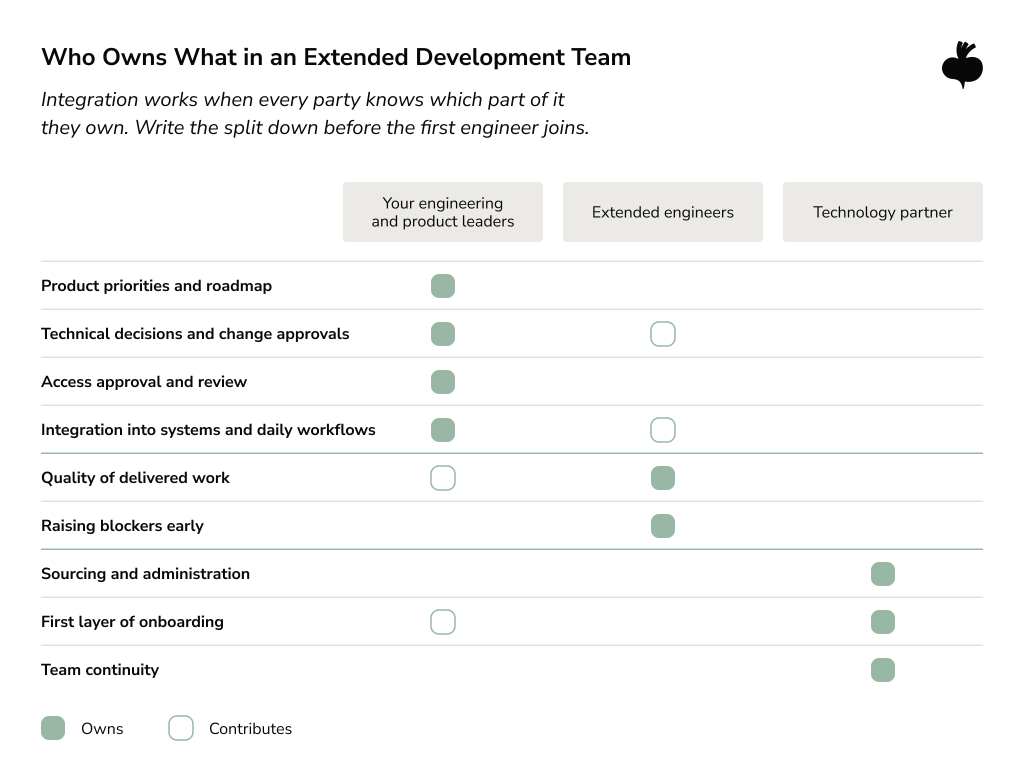
Integration works when every party knows which part of it they own. Your engineering and product leaders retain accountability for priorities and define decision rights, external engineers own the quality of their work, and the partner can handle sourcing, administration, team continuity, and early onboarding.
With Inspera, a Norwegian assessment platform, the split was explicit: we handled initial onboarding and HR administration, while Inspera’s team integrated the developers into its systems and daily workflows. Write your own split down before the first engineer joins, so gaps surface during planning, when they are cheap to close.
Set the Operating Model Before Anyone Joins
New teammates need a working structure on day one. That structure covers decision rights, planning visibility, access, and the communication norms your team already relies on, and preparing it in advance lets the first weeks go to learning the product.
Clarify Scope, Ownership, and Decision Rights
Define which components the extended team owns and who approves changes to them before work begins. A short ownership map names the services each group works on, who makes technical decisions within them, who signs off on cross-boundary changes, and where escalation goes when priorities conflict. Where several teams share one roadmap, IT project management support can help keep dependencies visible as scope shifts. The practical test: every engineer should be able to name the approver for their next change.
Create Shared Planning Visibility
Extended engineers should plan from the same roadmap and shared backlog as internal colleagues. A separate queue of tickets forwarded by one contact looks tidy, yet it strips out the context engineers need for good tradeoffs, such as why a feature matters and what depends on it. Share the relevant roadmap, dependencies, and Definition of Done, and run refinement with everyone present, so questions come up before any code is written.
Prepare Access Without Weakening Security
Map each role’s access before the start date and grant only what the role needs, an approach known as least-privilege access. The map usually covers repositories, cloud accounts, CI/CD, issue tracking, secrets, and each environment, with production access granted only to roles that require it, regardless of employer. NIST’s Secure Software Development Framework, now being revised to version 1.2, recommends storing all forms of code under the principle of least privilege. Review the map whenever roles change, and revoke access as deliberately as you grant it.
Onboard Into the Product and Workflow
Onboarding is complete when a new engineer understands why the product works as it does and how changes reach production. Accounts and introductions are only the first layer of integrating remote developers into your tech team. Product knowledge takes longer to transfer.
Give Access to Context
New engineers need the reasoning behind the system along with the documents that describe it: who the users are, how the product earns revenue, which dependencies are critical, and which past decisions still constrain the design. That engineering documentation now has two audiences. DORA’s 2025 research found that 90% of respondents use AI in their daily work, and that connecting AI tools to internal data such as codebases and documentation amplifies AI’s positive effect on individual effectiveness and code quality. Current architecture decision records and onboarding docs help both the people joining your team and the AI assistants they use to learn your codebase.
Use a Buddy Without Creating a Knowledge Bottleneck
A buddy gives newcomers an easy first contact. The risk is that one person becomes the only route to answers. Introduce new engineers directly to the product, QA, DevOps, and domain colleagues relevant to their area, and keep questions in shared channels, so knowledge transfer doesn’t depend on one person. A buddy role that evolves over the first months also supports onboarding and retention in remote tech teams.
Choose a First Task That Teaches the Delivery System
The first task should be small and bounded, and it should travel the full path from ticket to production. A minor bug fix passes through planning, code review, testing, and deployment, which exposes missing permissions and unclear review expectations while the stakes are low. Treat whatever the first task surfaces as a fix for the whole team.
Staff Augmentation Best Practices: Build One Engineering Workflow
Extended and internal engineers should follow one workflow with shared standards and delivery controls. When an external group develops its own branching conventions and review habits, the codebase gradually splits into two systems that someone later has to reconcile. Among IT staff augmentation best practices, a single workflow is the one to set up first, because the practices that follow depend on it.
Share Engineering Standards and Definition of Done
Write down what done means and apply it to everyone. A shared Definition of Done covers code quality, tests, review requirements, documentation updates, security checks, and release readiness. Automated pipeline checks can enforce the mechanical parts, while judgment calls belong in writing. If standards have drifted across teams, a custom training workshop can help internal and extended engineers align on the same practices.
Integrate Repositories, Code Review, and CI/CD
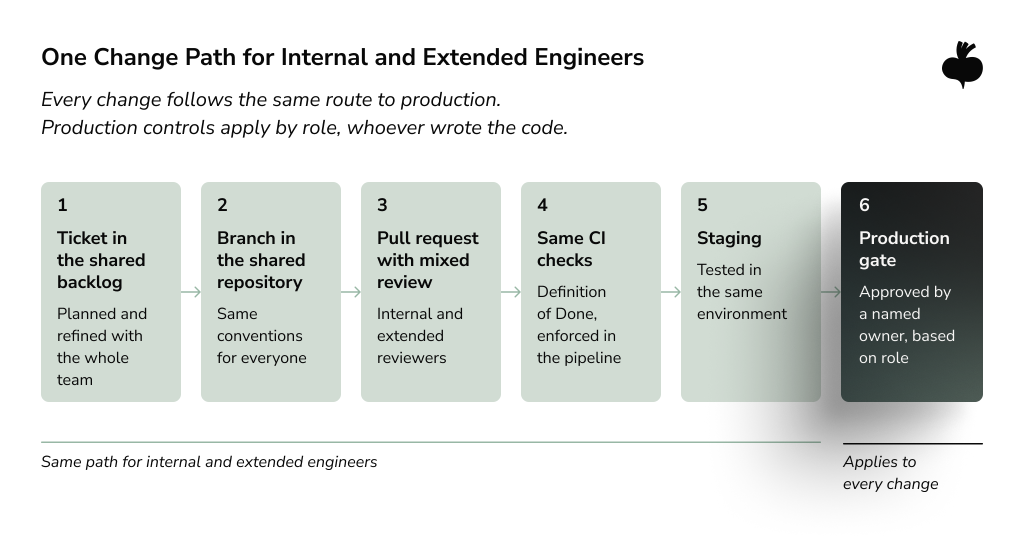
External engineers should follow the same change path and code review workflow as internal colleagues, with production controls applied by role. With full CI/CD integration, the extended team works in the same repositories and runs the same pipeline, and mixed review pairs help spread knowledge in both directions. Production deployment can still require approval from a named owner, as long as the gate applies to the change regardless of who wrote it. The same principle underpins collaborative DevOps between in-house and nearshore teams, where shared pipelines help both groups work from one release process.
Include the Extended Team in Technical Feedback Loops
Engineers who maintain a system should take part in the conversations that change it. Invite relevant extended engineers to design discussions, retrospectives, incident reviews, and architecture decisions that touch their components. Leaving them out keeps knowledge on one side of the boundary. A simple rule helps: if an engineer will maintain a service next quarter, they belong in its design review.
Design Communication Around Decisions
Distributed teams communicate well when information is written down by default and live collaboration is saved for work that needs it. Coordination time is often the scarce part: in Atlassian’s State of Teams 2026 survey of 12,035 knowledge workers, 87% said that with everyone in execution mode, they lack the time or capacity to coordinate. For distributed team integration, the implication is direct: make information easy to find in writing, and plan the connections between groups deliberately.
Decide What Should Be Async
Asynchronous communication suits status updates and decision records, which belong in writing where everyone can reach them regardless of time zone. Well-described tickets let engineers pick up work without waiting for a call. Avoid separate stand-ups for internal and external engineers on the same backlog, since duplicate meetings split information and the team.
Protect Shared Collaboration Time
Agree on core working hours, a few hours of daily overlap, for pairing, difficult design decisions, review discussions, and incidents. For a nearshore team extension in Central or Eastern Europe, that overlap with Western European offices covers most of the working day, with a shorter morning window for the US East Coast. The work lies in protecting the shared hours from recurring meetings that don’t need everyone.
Keep Important Decisions Out of Private Side Channels
Record decisions where everyone affected can find them, even when the conversation started in a direct message. Problems appear when a change to an API contract lives only in a private thread and extended engineers learn about it from a rejected pull request. A one-line summary in the ticket or decision log, with a link to the discussion, keeps everyone working from the same facts.
Avoid the “Us vs. Them” Trap
Engineers in an extended development team feel included when they have the same information as internal colleagues and can earn the same kinds of ownership. Social events help, yet they can’t compensate for being left out of planning. Trust in a distributed engineering team tends to build on these everyday signals, such as who gets invited to a design review.
Use the Same Standards Without Pretending Everyone Has the Same Role
Apply one set of engineering expectations and be open about the differences that remain. Extended engineers may have a different employer, narrower permissions, and a different say in some decisions. Naming those differences plainly helps, because people can plan around a clear boundary, while a hidden one tends to breed resentment.
Let Ownership Grow With Context
Move extended engineers from assigned tickets toward component or domain ownership as their product knowledge grows. After a few months, an engineer who knows a service well can take on its backlog and on-call rotation, within limits agreed with the internal tech lead. Set a review point, for example after the first quarter, to decide what each engineer is ready to own next.
Measure Whether Team Integration Is Working
Measure the combined engineering system and avoid tracking external developers as a separate productivity unit. DORA’s guide to software delivery metrics recommends applying metrics at the application or service level and warns that siloed metric ownership can lead to friction and finger-pointing between teams.
Measure Onboarding Friction
Onboarding friction shows up as waiting time and as dependence on specific people. Four signals are worth tracking for each group of new joiners:
- Access blockers. Days between the start date and working access to every system the role needs.
- Time to a meaningful first contribution. How long it takes to ship a change through the full review and deployment path.
- Unanswered questions. Questions in shared channels left without a response for more than a working day.
- Single-person dependencies. How often work stalls because one internal colleague is unavailable.
Measure Delivery Flow and Quality
Use application-level delivery metrics and skip individual activity counts. DORA’s current model has five: change lead time, deployment frequency, failed deployment recovery time, change fail rate, and deployment rework rate. Review wait time and the share of blocked work add useful detail. Take a baseline before the extended team joins, so you can see whether the system improves as it grows.
Look for Reduced Organizational Boundaries
Integration is working when engineers get what they need without routing requests through an internal/external boundary. Signs include extended engineers answering internal colleagues’ questions, approving pull requests in their areas, and joining incident calls without a special invitation. A short quarterly survey on how easy it is to find information can reveal friction before it appears in delivery metrics.
Which Team Extension Model Fits the Work?
The right team extension model depends on who owns delivery, how stable the scope is, how long you need the capacity, and how much management time you have internally. In practice, team extension and staff augmentation both place engineers inside your process. Budget is part of the decision as well, since dedicated teams, staff augmentation, and BPO carry different cost structures.
Individual or Small-Team Extension
Add individual specialists when your leadership and delivery processes are already strong and you are missing specific skills or short-term capacity. A developer team extension of this kind suits a cloud migration that needs one more platform engineer. It depends on your team having time to onboard and direct the new people.
Stable Dedicated Team
Choose a dedicated development team when you need ongoing capacity and expect external engineers to build substantial product context. This team extension model keeps knowledge across releases and can take on component ownership as it matures, which gives the practices in this article the most time to pay off.
Project-Based Delivery
Use project-based delivery when the outcome and scope are defined well enough for the partner to own more of the process. The partner handles planning and delivery management within agreed boundaries, while you keep product decisions and acceptance. Your day-to-day management load goes down, and clear specifications become more important.
At Beetroot, we help engineering organizations grow through IT team extension that fits their existing workflows and delivery standards. Our engineers work directly in your repositories and planning process, while we support sourcing, onboarding, team continuity, and day-to-day operations. Depending on the need, we can support any of the three models above, and you retain product accountability, while we take responsibility for technical decisions and delivery within agreed boundaries .
Development Team Extension Works Best Inside One Delivery System
Distributed team integration decides how much new capacity reaches production. New engineers become effective when they work through the same planning and release process as everyone else, with ownership and access prepared in advance. An extended development team that joins your backlog and code review can take on real ownership over time.
The right setup depends on your existing engineering system and on how much management capacity you have internally. If you are planning to extend your team, our delivery leads can help you choose the model that fits and plan the first months of integration. Let’s talk.
FAQs
What is the best way to integrate an extended development team with an in-house team?
The best way to integrate an extended development team with an in-house team is to have both groups work through one delivery process: the same backlog, repositories, code review, and CI/CD pipeline. Clear component ownership and access prepared before the start date help extended engineers contribute sooner.
What is the difference between team extension, staff augmentation, and a dedicated development team?
Team extension and staff augmentation both add external engineers who work inside a client’s own engineering process, and the two terms are often used interchangeably. A dedicated development team is a stable, longer-term group of external engineers that builds deep product context and can take ownership of components over time. Beetroot supports both setups, handling sourcing and team operations while engineers work directly within the client’s environment.
How should external developers be integrated into CI/CD and code review workflows?
External developers should follow the same change path as internal engineers, working in the same repositories and passing through the same code review and CI/CD pipeline. Production deployment can still require approval from a named internal owner, applied by role to every change regardless of who wrote it.
What communication practices work best for in-house and nearshore engineering teams?
In-house and nearshore engineering teams communicate best when decisions and status updates are written down by default in shared tools. A few protected hours of daily overlap then give both groups time for live work such as pairing and incident response.
How should companies protect source code and sensitive data when working with an extended development team?
Companies can protect source code and sensitive data by granting each role in an extended development team only the access that role needs, following the least-privilege principle in NIST’s Secure Software Development Framework. A role-based access map covering repositories, cloud accounts, secrets, and environments should be prepared before the start date and reviewed whenever roles change.
Subscribe to blog updates
Get the best new articles in your inbox. Get the lastest content first.
Recent articles from our magazine






Contact Us
Find out how we can help extend your tech team for sustainable growth.