


Contents
Contents
When an AI pilot works, it stops being a pilot. It moves into production, gains users, and starts generating cost across systems and billing models that aren’t always easy to reconcile. Finance watches the number climb, but explaining exactly why can be hard. The team knows it spent, say, €50,000 on AI last quarter, but not whether that bought a thriving product feature or a retrieval workflow generating unnecessary retries.
FinOps for AI is meant to make that spending legible rather than simply smaller. It asks the question: what did this AI-enabled outcome cost, and was it worth it? The principles here are familiar from cloud FinOps and cloud optimization; what changes is that AI adds new consumption signals and makes technical usage harder to attribute to the team, product, or outcome that created it.
In this article, we cover where AI costs actually originate, how to allocate them to teams and use cases, and how to choose meaningful AI unit economics. We also look at which optimization levers improve the economics without degrading the product, and where outside cloud, MLOps, and AI engineering expertise can help.
What Is FinOps for AI, and What Changes From Traditional Cloud FinOps?
AI spend has moved from the margins to the mainstream fast. The FinOps Foundation reports that 98% of FinOps teams now manage AI spend, up from 31% two years earlier, which means managing AI spend is rapidly becoming part of the regular FinOps remit rather than a specialist concern.
FinOps for data and AI is the practice of applying established FinOps principles, including visibility, cost allocation, forecasting, accountability, and continuous optimization, to the specific way AI and LLM workloads consume resources and generate spend. It’s the discipline you need for the cloud, extended to account for new consumption units and AI-specific usage signals.
AI FinOps isn’t something exotic that requires tearing down what already works. The FinOps Foundation lists AI as a distinct technology category, defined around cost complexity, faster development cycles, spend unpredictability, and a greater need for policy and governance. AI changes the signals feeding into the foundation, along with a cost-versus-quality dimension that traditional cloud FinOps rarely has to weigh. Making a workload cheaper to run can change its output quality, latency, or reliability, which is a trade-off ordinary cloud rightsizing almost never forces.
Same FinOps Foundation, New Cost Signals
Compute, storage, networking, and the familiar levers of cloud FinOps remain the base layer, and a good deal of AI infrastructure cost (GPU compute, Kubernetes resources, data storage) is billed in ways your existing cloud practice already understands. AI adds a second layer of signals sitting on top: tokens consumed per request, GPU hours consumed during training runs, model API calls, inference requests, context window sizes, and agent steps. These are the meters that move when an AI feature gains traction, but they do not necessarily appear in conventional cloud billing.
AI cost governance now depends on correlating two kinds of data. The cloud billing view tells you what infrastructure costs. The AI usage view tells you what the model behavior costs. Neither is complete on its own, and trying to run AI spend management from the cloud bill alone therefore leaves an important part of the picture out.
Why AI Spend Is Harder to Attribute
The attribution problem is structural. The same fine-tuned model might serve four products, a shared retrieval system might feed a dozen features, and an agent layer might call several models for workflows that each belong to a different team, while the managed LLM API behind any of them reports a single number for traffic that came from all over.
The provider invoice and the team or product that created the cost can therefore sit at opposite ends of a poorly instrumented chain. That is why cost allocation becomes more difficult as more models and infrastructure are shared across products and teams.
Retrofitting attribution after the fact can mean reconstructing which applications, users, workflows, or teams generated consumption that was originally recorded only at the provider level. The same problem shows up when several teams experiment independently and model consumption becomes hard to trace back to individual workflows.
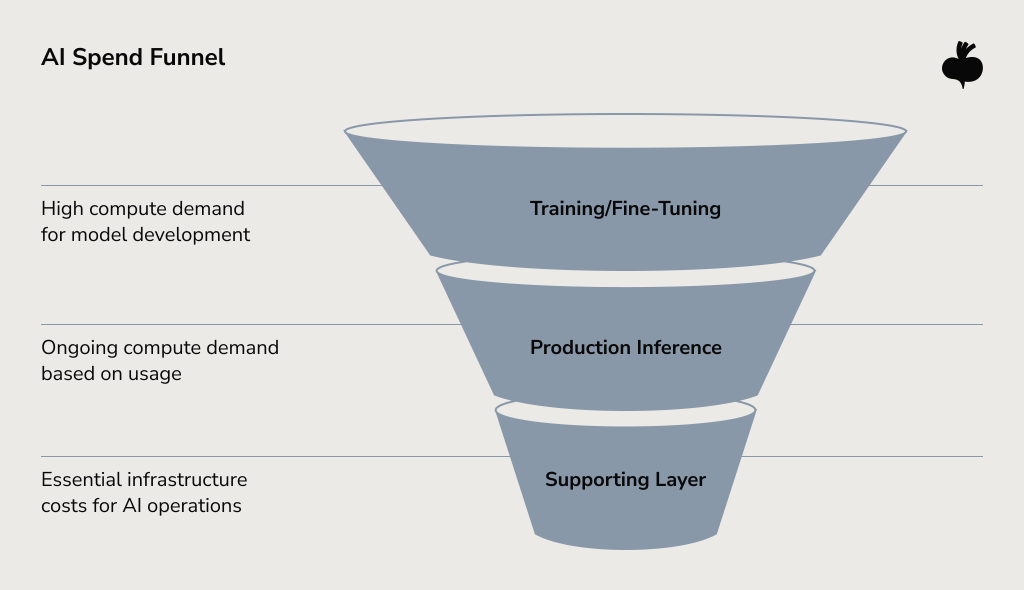
Where AI Costs Actually Come From
Optimizing AI spend starts with locating it. AI spend often gets discussed as a single figure, but it comes from several stages that behave very differently, and treating them as one usually means optimizing the wrong layer.
Training, Fine-Tuning, and Experimentation
Training and fine-tuning concentrate a lot of compute into a defined period, with heavy accelerator usage during runs and little in between. Inefficiency can appear around that compute. GPUs sit idle between experiments, teams re-run training that duplicates earlier work, and checkpoints pile up because no one set a retention policy.
Experimentation is where useful discovery happens, so cutting it back is rarely the answer. The goal is to make that experimentation economically visible and reduce unnecessary consumption around it. Disciplined MLOps practices, including reproducible pipelines, experiment tracking, and environment management, help keep experimentation from leaking spend.
Production Inference and LLM Usage
Inference behaves differently, because it scales with usage rather than arriving in a burst. Every user, application, or agent calling a model in production adds ongoing consumption: token cost on input and output, per-request charges, provisioned-capacity commitments, retries, and context size inflating as prompts grow.
This is where LLM cost management matters, because a feature that looked cheap in a demo can become a significant recurring cost once real traffic arrives. Managed models change the shape of this cost and shift spend toward token-, request-, or provisioned-capacity pricing.
Hidden Supporting Costs
The headline model cost is rarely the whole story. Around it sit storage, data processing and movement, retrieval systems and vector databases, observability and evaluation tooling, agent orchestration, third-party AI services, and development environments left running long after anyone needs them.
Not every system carries all of these, and a simple classification workload looks nothing like a multi-agent RAG application. But these supporting costs can materially change the economics behind an inexpensive-looking model, which is why they need to be visible from the start.
Building a FinOps for Data and AI Framework
A working FinOps for data and AI framework gives an organization assigned ownership, usable forecasts, and a real view of whether its AI spend is producing value.
Cost Allocation and Tagging for AI Workloads
Cost allocation attributes infrastructure and API consumption along the dimensions that map to business questions: by product, application, environment, workload, team, tenant, or use case. For AI, that means tagging cloud resources and capturing model usage with enough context to tie token and request consumption back to the feature, workload, or tenant that triggered it. The better that attribution, the more meaningful the unit economics become.
Define AI Unit Economics
AI unit economics connect spend to a unit of business activity: cost per resolved support request, per processed document, per successful agent task, per prediction, or per active user of an AI feature. The right unit depends on your product. Raw token or GPU cost shows consumption, not whether it produced a useful outcome. A workload getting more expensive may be justified if it’s delivering proportionally more value; a flat bill can still represent waste.
Showback and Chargeback for AI Teams
Showback and chargeback are two ways to make AI consumption accountable. Showback shows teams the cost they generate without moving the expense onto their books; chargeback formally assigns it.
Chargeback can look like the more mature option, but formal internal billing isn’t automatically better. Showback often creates enough cost awareness on its own, and the FinOps Foundation points to it as a practical way for teams to understand their AI consumption before anyone commits to the overhead of chargeback.
Set Budgets, Forecasts, Alerts, and Guardrails
AI budget management works best as an upfront operating control. Catching consumption at month-end is too late to change it. AI usage shifts quickly as a product moves from experiment to adoption, so fixed annual assumptions age badly and workload forecasting needs shorter feedback loops and more frequent review.
Around the forecast sit the guardrails: budget alerts and anomaly detection, quotas, API rate limits, workload-specific budgets, and owner attribution so someone is accountable when a threshold trips. Good AI cost control catches unexpected consumption while you can still act on it, well before it reaches the invoice.
Practical Levers to Reduce AI Costs Without Optimizing Away Value
Each lever below can improve AI economics, but every one has two sides. There’s the spend it reduces, and there’s what it may cost in quality, latency, reliability, scalability, or engineering effort.
Choose the Right Model for the Task
The largest available model is rarely the only workable choice, and smaller models can handle many tasks at lower cost. Model routing can send simpler requests to cheaper models while reserving more capable ones for tasks that need them.
Managed versus self-hosted is a similar call: managed APIs trade per-token pricing for less infrastructure to operate, while self-hosting adds operational responsibility in exchange for greater control and, at sufficient scale, potentially better inference cost. Routing and multi-model setups also add engineering and evaluation overhead, and a cheap model that fails often can cost more than the expensive one it replaced.
Reduce Unnecessary LLM Consumption
LLM applications can consume more tokens and requests than the task requires. Several things help here: trimming context so you’re not sending entire histories into every prompt, caching repeated requests, retrieval that fetches only what’s relevant, sensible retry behavior, and hard limits on agent loops. Each can reduce token and request consumption.
At this layer, AI infrastructure cost optimization often comes down to not paying for tokens that added little to the result. Push caching or context trimming too far, though, and you can hurt answer quality or freshness, so measure the effect. Building this kind of efficiency into an application can be a part of AI development rather than a separate cost exercise.
Improve GPU and Compute Utilization
Idle or poorly matched infrastructure can quietly drive up AI spend. Effective GPU utilization comes from a few basics: rightsizing accelerators to the workload, scheduling jobs to fill capacity, and autoscaling to demand. Beyond that, matching work to the right hardware, using spot capacity where interruptions are acceptable, and committing to reserved capacity where demand is stable all help.
Pushing GPU utilization up shouldn’t override the reliability or performance the workload needs, and spot capacity on a latency-critical inference path is a false economy. In an AWS environment, this can also involve AWS consulting around instance choice, scheduling, and commitment planning, all of which affect infrastructure cost.
Optimize Data and Supporting Infrastructure
A few things can reduce the infrastructure spend around AI workloads: storage tiering, cutting unnecessary data movement (egress and cross-region transfer add up fast), removing duplicated processing, and shutting down idle development environments.
These changes still require engineering effort, but they can remove unnecessary infrastructure consumption without directly reducing model capability. Much of it comes down to cost-aware cloud architecture: deciding early where data lives, how it moves, and which environments stay on.
Tools Teams Use for AI FinOps
Tooling for AI FinOps tends to fall into a few categories, each solving a different visibility or control problem:
- Cloud-native billing and cost-management tools for the underlying infrastructure spend
- Dedicated FinOps platforms that consolidate allocation and reporting across accounts
- LLM gateways and observability tools that meter token and request usage
- GPU and Kubernetes cost monitoring for accelerator and cluster consumption
- MLOps and infrastructure observability for the pipelines and services around a model
- Product analytics or custom dashboards that tie spend to AI unit economics
The important judgment is how much of this you actually need. A single-cloud organization with a couple of AI features may need nothing more than its existing cloud cost tooling plus a few AI-specific metrics wired in. A large multi-cloud, multi-model environment with many teams may justify a dedicated platform.
The FinOps Foundation takes a similar approach, treating tooling as something that spans infrastructure, model usage, observability, allocation, and business-level unit economics rather than pointing to one mandatory product. There’s little sense in buying a platform to solve a visibility problem your existing tooling and a well-designed dashboard can already handle.
Common FinOps for AI Mistakes
Poor AI economics often come from visibility gaps and misguided optimization, not just high provider prices. Common mistakes include:
- Reading total AI spend as one undifferentiated number, with no allocation beneath it
- Optimizing a single metric in isolation (token count, GPU count, model price) while task success or customer experience quietly degrades
- Treating the cheapest model as automatically the best choice
- Deferring attribution until the architecture is already too shared to instrument cleanly
- Running AI budgets on annual assumptions that adoption makes obsolete within weeks
- Reaching for a dedicated platform before exhausting the tooling already in place
Spotting which of these is driving a bill usually takes looking at the architecture, not the invoice.
When External Expertise Can Help With AI Cost Control
External expertise is most useful when the division of responsibilities stays clear. Finance and product owners hold the budget, define acceptable quality-and-cost trade-offs, set chargeback policy, and decide what business value means. Cloud, architecture, MLOps, and AI specialists work on the technical changes that improve the economics.
Diagnose the Technical Cost Drivers First
A rising bill can come from traffic growth, inefficient model routing, idle GPUs, a particular deployment pattern, or simply legitimate business adoption, and each of those calls for a different response. An architecture and usage review is how you tell them apart. An external review of cloud usage and spending can add another perspective on where consumption originates and which technical changes are worth prioritizing.
Turn Cost Findings Into Engineering Changes
A cost report is only useful if something gets implemented from it: rightsizing infrastructure, adding automation, adjusting model deployment, or building the observability that makes consumption visible in the first place. This is where cloud optimization engineering can help turn findings into shipped changes on a defined workstream without taking over cost governance.
Keep Financial and Product Ownership Internal
Budget priorities, the balance between quality and cost, chargeback policy, and the definition of business value stay with finance, product, and executive stakeholders. Reliable external partners diagnose and implement against targets you set; they don’t own the targets.
Making FinOps for AI Work in Practice
FinOps for AI comes down to a few basics: teams being able to see what they’re spending, knowing who owns it, understanding what value it produces, and identifying which technical changes would improve the economics without hurting the product. A more expensive model can be entirely justified for a high-value task, and a cheap one can be pure waste if it keeps failing.
When one of your workloads gets expensive and no one can fully explain why, the invoice alone rarely tells the whole story. Reviewing the cloud, MLOps, and AI engineering behind it is a sensible first step, and if an outside perspective would help, you can contact us for advice.
FAQs
What is FinOps for AI?
FinOps for AI applies FinOps principles, such as visibility, allocation, forecasting, and optimization, to AI and LLM workloads. It makes AI spend visible and attributable, so teams can weigh cost against quality, latency, and scale.
How is FinOps for AI different from traditional cloud FinOps?
FinOps for AI extends traditional cloud FinOps with AI-specific cost signals such as tokens, model API calls, GPU usage, and inference requests. It also accounts for shared models, fast-changing usage, and more direct quality-versus-cost trade-offs when teams change models or inference behavior.
What are the biggest cost drivers for AI and LLM workloads?
Major cost drivers for AI and LLM workloads include production inference, training and fine-tuning, and supporting infrastructure such as storage, retrieval, data processing, and observability. Inference creates ongoing consumption as users, applications, and agents make model calls in production.
How can teams reduce LLM costs without reducing output quality?
Match tasks to the right model, manage context, cache repeated requests, and limit unnecessary retries. These techniques can cut consumption, but their impact on quality and performance should be measured.
What metrics should teams use to measure AI cost efficiency?
Use unit economics that tie spend to a business outcome, such as cost per resolved support request or per active user of an AI feature. These help show whether AI spending produces proportional value, which raw token or GPU cost cannot.
Subscribe to blog updates
Get the best new articles in your inbox. Get the lastest content first.
Recent articles from our magazine






Contact Us
Find out how we can help extend your tech team for sustainable growth.