
10 Data Management Companies for 2027: How to Choose the Right Fit
- October 30, 2026
- 9 min read
- Data
- Outsourcing

Contents
Contents
Search for the “best data management company” or “top data management companies,” and you get a strange list. A global consultancy that runs multi-year governance programs sits next to a specialist that builds streaming pipelines, next to a software brand that mainly sells a platform. They all describe themselves with the same words, but none of them are really doing the same job.
Before comparing data management companies, take a look at what is actually broken or missing in your environment. That might be fragmented systems, inconsistent records, unreliable data pipelines, weak governance, an aging warehouse, poor data quality, a stalled cloud migration, or data that simply is not ready for an AI use case. The answer points you to the right kind of help.
Once an organization decides it needs outside help, the next question is what kind. Some need a strategy and a governance model, others need data management services that work directly on their pipelines and systems, and others just need a platform bought and configured well.
In this guide, we help you tell those apart. We explain what different data management service providers really do, how we selected a shortlist of ten, and how to match one to your problem rather than to brand size.
What Do Data Management Companies Do?
Data management companies cover a wide span of work, and few providers cover all of it with the same depth. The category runs across data strategy, data architecture, data governance, data integration, engineering and data pipelines, data warehousing, master data management (MDM), data quality, business intelligence and analytics consulting, and the ongoing operations that keep it all running.
Some firms are strongest at defining operating models, policies, ownership, and standards. Others are strongest at building the systems (pipelines, warehouses, integrations, and data products) that put those standards into practice. Many firms do both, but they rarely do both with equal weight.
A provider that writes an excellent governance charter is not automatically the team you want refactoring a brittle ingestion layer. For more on the problems these companies address, take a look at Top 10 Enterprise Data Management Problems and Ways to Solve Them.
Data Management Services vs. Data Management Software
Data management vendors that sell software provide a product, such as an MDM hub, a catalog, a governance or data quality tool, an integration layer, or a warehouse or lakehouse platform.
Data management service providers help you assess, design, implement, integrate, migrate, govern, improve, or operate parts of your data environment, usually on top of whichever platforms you already own.
Those are different purchases. A platform license does not deliver the architecture, integration logic, and organizational work that make it useful, and custom engineering is wasted when a mature product already solves a standard requirement.
In this article, we focus on the service, implementation, engineering, and consulting side. If you are comparing master data management companies because you’re looking for an MDM platform, catalog, or governance software, start with our companion guide, Best Data Management Solutions & MDM Tools in 2026.
How We Selected Best Data Management Companies for Different Needs
There is no useful way to compare a company that spends years redesigning enterprise governance with one brought in to rebuild a data platform. They may describe their services in similar language, but the work, engagement model, and expertise involved are very different.
That is why data governance companies here are grouped by their primary delivery model rather than ranked. Some are global consultancies built for large transformation programs. Others concentrate on data, analytics, and the operational side of managing information. A third group brings a stronger engineering focus, building and integrating the systems data teams depend on.
Within each group, we weighed what matters once a project moves beyond the service page: how much of the work a provider actually implements, its expertise across relevant cloud and data platforms, its approach to governance and data quality, its ability to support the environment after go-live, and the verifiable evidence from its recent work. These factors show where a provider fits, but they do not produce a universal winner. The useful question is not which company is “best,” but which one matches the work you actually need done.
10 Data Management Companies to Consider in 2026
The enterprise data management companies and other providers below are not interchangeable. Some are built for large transformation programs where data work sits alongside cloud, AI, and organizational change. Others go deeper into data and analytics, while engineering-focused partners are better suited to building, integrating, and modernizing the underlying systems.
Global Enterprise Transformation Providers
Accenture
Accenture is a global consultancy that usually handles data work as one part of a much larger change program. Its teams cover enterprise data strategy, master data management, reference-data lifecycle design, governance and stewardship models, platform modernization, and analytics. Accenture is a strong option for large enterprises that are reworking data, cloud, AI, processes, and organizational structure at the same time. For a single, clearly bounded technical task, a firm of this size can bring more overhead than the project needs.
Capgemini
Capgemini brings advisory work and hands-on implementation together under one roof, and it operates across many data domains. Its services include data strategy, enterprise data governance, master data management, data quality, legacy data migration, and modern big data architecture. In 2024, Capgemini acquired Syniti, which strengthened its data quality, MDM, and migration capabilities for large programs. Companies planning a broad governance or data management initiative will find a good match here. Teams with a narrow technical scope may be better served by a specialized engineering partner.
Cognizant
Cognizant is a global consulting and services company. Its Data and AI portfolio includes master data management, data privacy and governance, customer data platforms, cloud data modernization, and platform implementation. Its strongest work is in large modernization, migration, and platform transformation projects. Cognizant tends to suit organizations that already have a defined program in place, with internal owners ready to keep governance decisions moving after the implementation phase ends.
IBM Consulting
IBM Consulting helps large and complex organizations with data strategy, architecture, modernization, governance, and analytics. It draws on deep experience with hybrid and multi-cloud technology. Its teams combine enterprise data governance with master data management and modernization across hybrid data platforms and a wide technology stack. IBM is most relevant when hybrid architecture and enterprise-scale governance are at the heart of the problem. Organizations with a narrow, cloud-native need may move faster with a leaner specialist.
Data and Analytics Specialists
Genpact
Genpact connects data management to the everyday processes that keep data accurate and well governed. Its offerings include continuous data quality monitoring, master data strategy, traceability, governance frameworks, and data engineering. Managed services are available for companies that want long-term operational support. Genpact suits enterprises looking for a partner to run and maintain data quality and governance over time. For a one-off architecture or platform build, an engineering-led partner is often the closer fit.
Tredence
Tredence is a data and analytics services company that helps businesses modernize their data platforms and prepare them for analytics and AI. Its work covers cloud data platforms, data pipelines and DataOps, governance and cataloging, master data management, data quality, migration, and managed platform operations. It has notable depth in Databricks, Snowflake, and the major cloud providers. Tredence fits organizations where data engineering and analytics go hand in hand. Much of its public experience comes from retail and consumer goods, so companies in other industries should check for relevant sector work early on.
Tiger Analytics treats data engineering and management as the foundation for advanced analytics and machine learning. Its services include data strategy, data modernization, cloud data engineering, DataOps, governance and cataloging, and data quality, all designed to feed analytics and AI use cases. Tiger Analytics fits organizations whose data work ultimately serves an AI or analytics goal. If a project calls for broad application engineering around the data, a wider technology partner may be a better match.
Engineering and Implementation Partners
Beetroot
Beetroot is a custom technology and engineering partner that handles data work alongside custom software development for its clients. Its data services cover data quality, database optimization, data integration, strategy and governance, and security, supported by wider expertise in data architecture, warehousing, analytics, migration, and AI. Beetroot fits organizations whose data challenges are tied to application or platform development, where integration, pipelines, warehousing, data quality, and analytics need to evolve together with the surrounding software.
EPAM
EPAM is a software engineering company whose data and analytics services cover data strategy, platform builds, data governance, master data management, data quality, cloud data migration with lineage, and implementation. EPAM fits organizations that need custom platforms, cloud migration, integration, and governance implementation delivered together. For a purely advisory or policy-first engagement, a governance-led consultancy may offer a more direct route.
Slalom
Slalom is an engineering and consulting partner. It organizes its data work around three areas: engineering and architecture, management and governance, and analytics and data literacy. The firm puts strong emphasis on collaboration and on building skills inside client teams, so in-house data capabilities grow alongside the delivered work. Slalom suits organizations that value knowledge transfer alongside delivery. For a primarily technical build, engineering-focused providers may be a closer fit.
Which Type of Data Management Company Do You Actually Need?
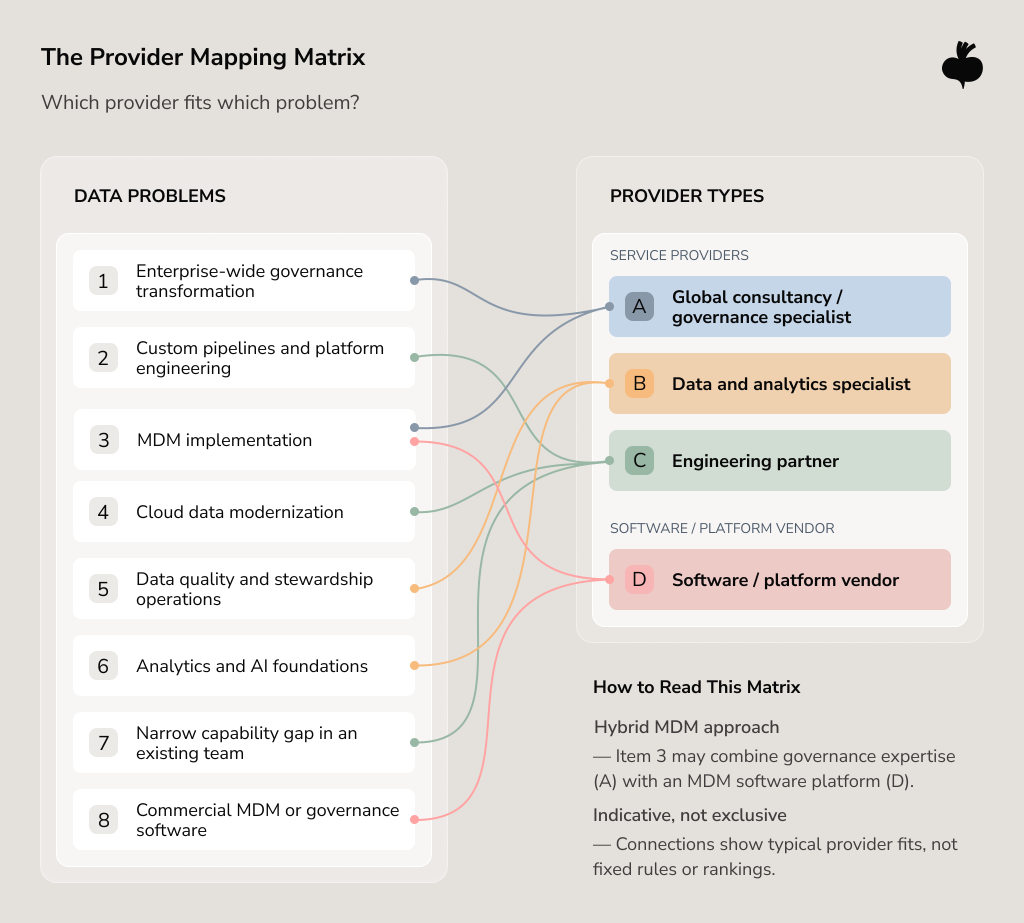
Start with the problem, not the provider’s reputation. The right provider is the one whose core work matches your problem. If no one agrees on definitions, ownership, or policy, you need a governance-led firm. If pipelines keep breaking or the platform cannot scale, you need engineers. If you own a capable platform but cannot get value from it, the gap may be implementation, integration, or adoption.
The problem usually points you toward the type of provider you need:
- Enterprise-wide governance transformation: a large consultancy or governance specialist.
- Custom pipelines and platform engineering: an engineering-focused data partner.
- MDM implementation: an MDM-capable consultancy working alongside a selected platform.
- Cloud data modernization: a cloud or data engineering specialist.
- Data quality and stewardship operations: a data-management specialist or managed-service provider.
- Analytics and AI foundations: a data and analytics specialist or engineering partner.
- A narrow capability gap in an existing team: a flexible engineering partner.
- Commercial MDM or governance software: a platform vendor rather than a service provider.
Two cautions. The largest name is not automatically the right one. And software alone does not fix an organizational problem: when ownership, integration, or governance are weak, another platform adds complexity rather than resolving it.
Questions to Ask Before Choosing a Data Management Partner
Once you have a shortlist, the right questions reveal whether a provider understands your environment, can implement what it recommends, and can leave your team with clear ownership. Here are some questions to start with:
- What specific data problem are you proposing to solve first?
- Which parts of this require commercial software, and which require custom engineering?
- How will you work with our existing cloud and data platforms?
- Who owns data definitions, governance decisions, and architecture after the engagement ends?
- How do you approach data quality, lineage, testing, and observability?
- Can you integrate with our legacy and operational systems?
- What relevant implementation examples can you show us?
- How do you measure successful delivery?
- What expertise should remain with our internal team?
- What happens after the initial implementation?
A reliable provider should be able to answer these without falling back on generic promises, and a good answer usually makes ownership clearer, not murkier.
Where a Broader Technology Partner Can Fit
Some organizations are better served by a partner that connects data management with custom software, cloud, analytics, and AI than by a specialized governance consultancy or a standalone platform vendor. That broader engineering model tends to make sense when:
- The data problem is closely connected to application development
- Custom integrations are a significant part of the work
- Data pipelines feed AI or analytics products directly
- Existing commercial platforms need custom extensions
- Your internal team needs specialist implementation capacity for a period
- Architecture, cloud, backend, and data work need to be coordinated as one effort
At Beetroot, we pair data work with broader engineering, delivering a defined project or adding capacity alongside an existing data team.
Choosing Well Starts With Your Data Environment
The right data management partner is the one whose capabilities and delivery model match your actual problem, not the largest name or whichever company appears first in a “best data management companies” list. A governance specialist, an analytics-led firm, and an engineering partner can all be excellent choices, and all be wrong for the same project.
So before comparing tools or shortlists any further, assess where your data environment actually stands: what is broken, what is missing, and how much of the fix is software, implementation, or organizational work. If you need custom data engineering, integration, or implementation support, get in touch and our specialists will talk through your environment and where we can help.
FAQs
What does a data management company do?
A data management company helps organizations organize, integrate, store, govern, and use their data. Depending on the provider, a data management company may focus on areas such as data strategy, architecture, governance, engineering, warehousing, master data management, data quality, or analytics, and most are stronger in some of these than others.
How do I choose the right data management company?
To choose the right data management company, start by defining the specific data problem you need solved, then match that problem to the provider type built for it. Governance transformation suits a large consultancy, custom pipelines suit an engineering partner, and focused analytics or operations suit a specialist. The right fit depends on the problem, not the size of the provider.
What is the difference between a data management company and an MDM software vendor?
A data management company provides services, helping an organization assess, design, implement, integrate, govern, or operate parts of its data environment. A master data management (MDM) software vendor sells a product rather than a service. The difference matters because purchasing MDM software does not deliver the architecture, integration, and organizational work that a data management service provider handles.
When should a company outsource data management instead of building an internal team?
A company may use an external data management provider when it needs specialized skills it lacks in-house, faces a defined project with a clear end point, or needs capability sooner than internal hiring can provide it. Building an internal team makes more sense when the data ownership and operational decisions are continuous and core to the business.
What should enterprises compare when evaluating data management service providers?
When evaluating data management consulting companies, enterprises should compare the depth of relevant capabilities, engineering and architecture strength, governance and data quality capability, integration experience, platform ecosystem fit, and the ability to implement. Enterprises should weigh these against their own data problem rather than brand size.
Subscribe to blog updates
Get the best new articles in your inbox. Get the lastest content first.
Recent articles from our magazine





Contact Us
Find out how we can help extend your tech team for sustainable growth.